People & Company Updates
General Oceans Invests in Turbulence Solutions Specialist ReynKo
General Oceans Inc., a subsidiary of General Oceans AS, has entered into an investment agreement with ReynKo Inc., a US based turbulence solutions specialist. The SAFE (Simple Agreement for Future Equity) is a commitment to invest up to $4 million.
General Oceans AS is the parent company of multiple underwater technology brands including Oslo-based Nortek, UK companies Tritech and RS Aqua, Australian Reach Robotics, and Klein Marine Systems and Strategic Robotic Systems (SRS) who both operate out of the US. General Oceans' most recent acquisition was ocean technology distributor, RS Aqua, in 2024.
ReynKo provides engineering solutions for modeling and control of turbulent fluid flows. Their software offers an algorithmic solution to one of the greatest mysteries in physics, the turbulence problem, and will use the investment to move to a commercial offering that can be utilized across multiple industries including the marine industry, aviation and Formula 1.
ACUA Ocean, RS Aqua to Scale Offshore AI Acoustic Data Gathering

ACUA Ocean has signed a memorandum of understanding (MoU) with RS Aqua to accelerate the remote deployment of long-endurance, persistent ocean acoustic data-gathering systems using uncrewed offshore platforms.
Under the agreement, the companies will collaborate on scaling long-endurance offshore missions involving the deployment of AI-enabled deep-water acoustic sensors in open-ocean environments.
The partnership focuses on the technical integration and operational development of clusters of RS Aqua’s NiKA ASW Profiling Floats equipped with MARLIN AI acoustic processing systems, deployed by ACUA Ocean’s long-endurance, high sea state-capable uncrewed surface vessel (USV) PIONEER.
The combined mothership-and-payload concept is designed to allow the deployment of dozens of ASW profiling floats from USV PIONEER during a single mission.
The approach is intended to support persistently positioned offshore platforms capable of deploying deep-water sensors at short notice, while reducing the operational risks and costs associated with crewed vessels and manual deployment in hazardous offshore environments.
HII Expands Portchester, UK Facility for Unmanned Systems

HII, a manufacturer of autonomous surface and underwater unmanned vehicles, has doubled the size of its unmanned facility in Portchester, U.K.
The enlarged facility enhances and strengthens the company’s presence in the United Kingdom and increases capacity and support for the U.K. Royal Navy and European partners that operate the REMUS line of unmanned underwater vehicles (UUVs).
In addition to supporting regional unmanned customers, the Portchester facility will serve as a European hub for HII’s Mission Technologies division, enabling customer support for U.S. combatant commands and allied missions. The site will provide operational, technical, and logistics support to deploy, sustain, and integrate electronic warfare and C5ISR systems, fleet modernization efforts, artificial intelligence capabilities, and live, virtual, and constructive training.
The facility also prepares the region for the deployment and sustainment of HII’s ROMULUS family of unmanned surface vessels (USVs), a modular AI-enabled line powered by HII’s Odyssey Autonomous Control System and scheduled for availability in 2026.
The expanded Portchester facility will operate as a strengthened regional hub for HII’s unmanned systems. Staffed by U.K. employees, it will drive new jobs and support supplier engagement, maintenance, training and long-term sustainment for operators across the U.K. and Europe. The site will also work in close coordination with HII’s global engineering, production, training and mission support teams to keep programs aligned and effective.
Avikus Secures Contract to Supply Autonomous Navigation to 40 HMM Vessels
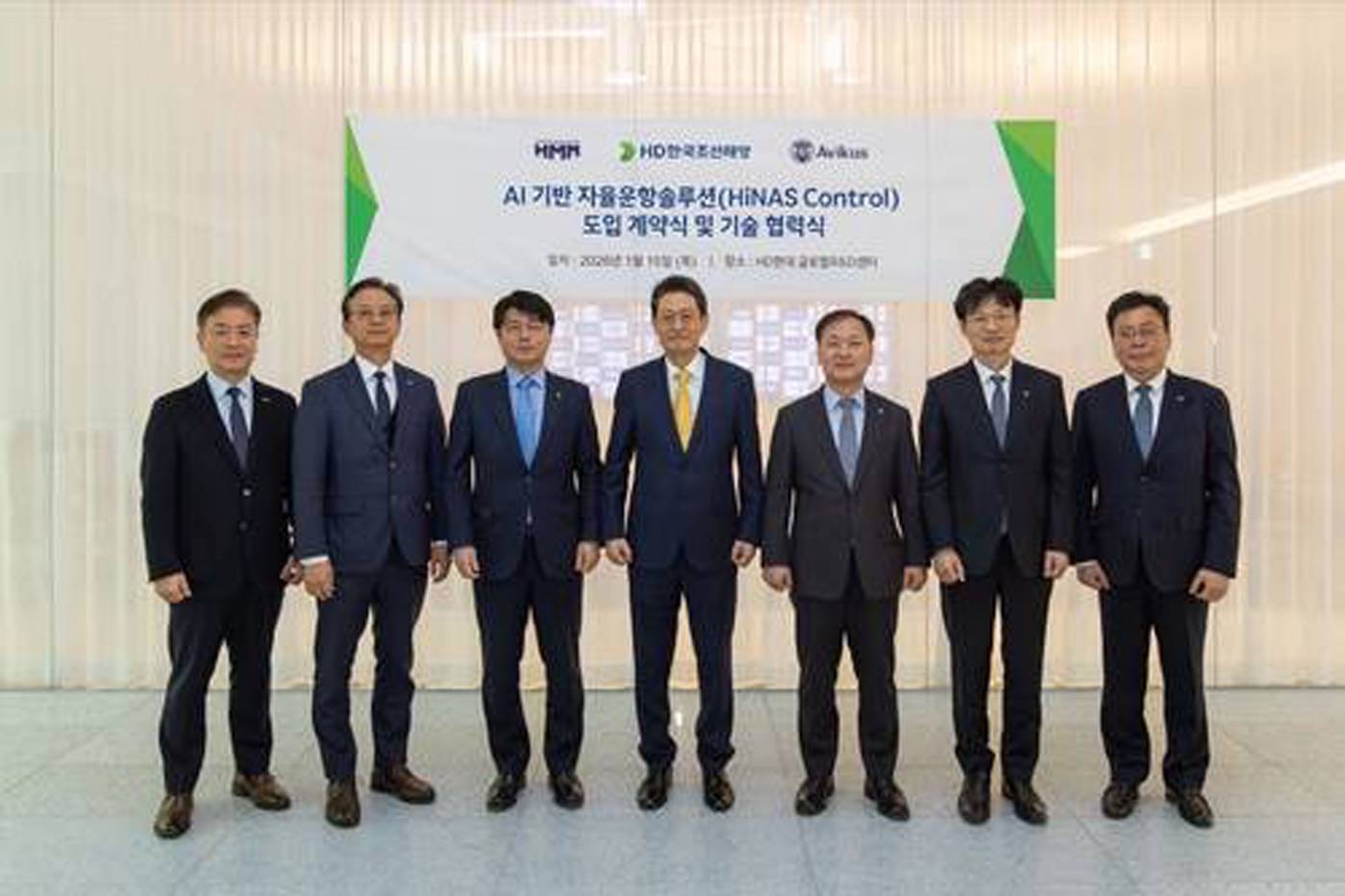
Avikus, HD Hyundai’s specialized autonomous navigation subsidiary, has signed an agreement with HMM, South Korea’s leading national carrier, to supply its AI-based autonomous navigation solution, HiNAS Control, to 40 vessels.
This agreement represents the largest single supply contract for autonomous navigation solutions to date. With this deal, Avikus becomes the first company in the industry to surpass 100 cumulative units of autonomous solutions supplied to large-scale commercial vessels (based on retrofit installations).
Unlike existing navigation support systems that focus solely on recognition and judgment, HiNAS Control is a “Level 2” autonomous system that performs active vessel control.
-
Autonomous Operation: The system sets optimal routes and navigates without crew intervention.
-
Enhanced Safety: Prevents maritime accidents by utilizing advanced AI for real-time situational awareness.
-
Economic Efficiency: Maintains optimal speeds to maximize fuel savings and operational efficiency.
-
Operational Continuity: Offers a viable solution to the global shortage of seafarers by reducing crew workload.
In tandem with the supply contract, Avikus, HMM, and HD Korea Shipbuilding & Offshore Engineering (KSOE) have signed a memorandum of understanding (MoU) for AI-Based Autonomous Navigation Technology Cooperation. This partnership aims to strengthen industrial competitiveness and secure global standards in the evolving shipping market.
Defined roles under the MOU:
-
Avikus: Advancement and supply of the autonomous navigation solution.
-
HMM: Deployment and operation of the solution using real-world voyage data.
-
HD KSOE: Comprehensive technical support for system integration.
Silicon Sensing Expands Distribution in North America

Silicon Sensing Systems Ltd has extended its distribution agreement with Althen Sensors and Controls Inc. in response to a surge in demand, particularly across North America.
The new agreement enhances Silicon Sensing’s global distribution network, which stretches across 15 countries. It will help improve customer access to the company’s gyroscopes, accelerometers, and inertial measurement systems and to product integration services.
Silicon Sensing’s inertial products are in use in many of the most extreme environments, from space to subsea, and in diverse roles including platform stabilization, industrial robotics, unmanned navigation and control, detailed terrain mapping and precision agriculture.
MRECo Develops Two Marine Energy Test Sites in Massachusetts

GeoAcoustics Ltd, a leader in hydroacoustic survey technology, has announced a new channel partnership with Seafloor Systems Inc., a California-based specialist in integrated hydrographic survey solutions. The agreement sees Seafloor Systems represent the entire GeoAcoustics product portfolio in the United States, including the GeoSwath 4 bathymetric sonar, GeoScan side scan sonar, and GeoPulse sub-bottom profiler systems.
Founded in 1999, Seafloor Systems is known for uncrewed systems, survey-grade integration, and customer-focused engineering. With a strong base in the US hydrographic and geophysical survey sector, Seafloor Systems is well positioned to provide sales, service, and integration support for GeoAcoustics technologies across inland, coastal, and offshore projects.
With a focus on operational efficiency and data quality, GeoAcoustics systems are designed to perform in demanding environments and diverse applications from seabed mapping and dredging surveys to infrastructure inspection and rapid environmental assessment.
Seafloor Systems Inc. as US Channel Partner for GeoAcoustics

The Marine Renewable Energy Collaborative of New England (MRECo) is developing and improving two ocean testing sites in Massachusetts: the Bourne Tidal Test Site (BTTS) in the Cape Cod Canal and the Cuttyhunk Test Range (CTR) off Cuttyhunk Island.
Together, these sites give innovators a safe, affordable, and permitted way to deploy new ocean technologies in the water, bridging the gap between lab experiments and real-world use.
The Bourne Tidal Test Site, located in the Cape Cod Canal, is a platform built specifically for testing tidal energy devices and marine sensors in fast-moving water. The site allows engineers and researchers to see how their technology performs in strong tidal currents, while still being close to shore and easy to access.
Planned upgrades to the Bourne site will allow for faster testing, real-time data sharing, and improved safety, which will make it further simplified for new ideas to move forward.
Off the coast of Cuttyhunk Island, MRECo is also developing the Cuttyhunk Test Range, a location designed for testing floating devices and wave energy systems. This area experiences ocean waves similar to those found near offshore wind farms along Massachusetts’ South Coast. The site will include permanent moorings, power access, and monitoring equipment to help developers understand how their technologies perform in open-water conditions.
These efforts are part of a larger push to grow Massachusetts’ ocean technology economy through the Massachusetts Clean Energy Center’s (MassCEC) Ocean Innovation Network, a statewide initiative that connects startups, researchers, and businesses with the facilities, mentorship, and resources they need to bring new clean energy solutions to market. By investing in shared testing infrastructure like BTTS and CTR, MassCEC and its partners are helping ensure that promising ideas don’t stall in the lab, and that Massachusetts remains a national leader in ocean-based climate and energy innovation.
MRECo is the only organization in Massachusetts focused on developing open-water test sites for tidal and wave energy and marine sensors. With decades of combined experience in ocean engineering and testing, MRECo works with startups, universities, and established companies to help new technologies reach the water faster and more affordably.