Floating Power
Nuclear
Floating Nuclear: A New Offshore Energy Frontier
For decades, floating nuclear power occupied a niche position in the energy debate – technically feasible, strategically intriguing, but commercially marginal. Today, however, combined pressures of decarbonization, energy security, land constraints, rising electricity demand and water scarcity are making floating nuclear power a more serious proposition for policymakers, utilities, and infrastructure
By Alisa Reiner, Master of Environmental Management, Yale University, Offshore Energy Markets Analyst, Intelatus Global Partners
Floating Nuclear offers a potential source of reliable, low-carbon electricity and heat (and, where possible, desalinated water) for locations where conventional energy systems are expensive, carbon-intensive, or physically impossible to build.
The strongest case emerges in remote coastal regions and small island developing states (SIDS). In these contexts, the challenge is not only decarbonization – it is the high cost of imported fuel, the vulnerability of supply chains, and the difficulty of scaling grid infrastructure.
A floating nuclear power plant (FNPP) can be manufactured in a shipyard, towed to site, moored near shore, connected to the local grid, and later serviced, replaced, or decommissioned with less land disruption than a large onshore plant.
This is particularly relevant for SIDS. Many islands remain dependent on imported diesel or fuel oil, face volatile electricity prices and have limited space for large-scale generation assets. At the same time, these countries are on the front line of climate change and often face freshwater scarcity. Floating nuclear could provide firm, clean power without consuming scarce land, while also supporting water resilience by powering desalination processes with excess heat. For SIDS, where energy security and water security are often closely linked, this dual-use capability significantly improves the economic case for floating nuclear.
Floating Nuclear Power ‘101’
FNPPs are nuclear generation units mounted on barges or platforms and deployed near coastal demand centers. They provide reliable baseload electricity with minimal operational carbon emissions. Unlike solar and wind, they are not intermittent, which is critical in smaller or weaker grids where balancing variable renewables can be more difficult. Typically, they can be fabricated in part or in whole in controlled shipyard environments, potentially reducing construction risk and making replication easier. Notably, they do not require large greenfield land sites. Finally, they can make use of waste heat for industrial processes or desalination.
The floating nuclear landscape today includes both deployed technology and emerging concepts. The only operational FNPP is Russia’s Akademik Lomonosov, a FNPP deployed in Pevek in the Russian Arctic. The plant uses reactor technology derived from Russia's long experience with nuclear icebreakers and marine propulsion systems. Another ready-to-go is Russia’s Baim FNPP to be commissioned in the Baimskaya ore zone in 2028.
Other players, including the United States, Denmark, South Korea, and China, are exploring floating reactor solutions. Some rely on compact pressurized water reactors, drawing on naval reactor experience and established nuclear technology. Others are based on advanced concepts such as molten salt reactors, high-temperature gas-cooled reactors, fast-spectrum reactors and micro modular reactors.
According to the author's analysis, there are currently 118 FNPP reactor designs and/or prototypes globally (Figure 1). The market is developing along several parallel pathways – relatively familiar water-cooled systems for near-term deployment; marine-based reactors drawing on propulsion and icebreaker experience; high-temperature and molten salt systems targeting industrial heat and cogeneration; fast-spectrum designs with longer-term fuel-cycle potential; and microreactors aimed at smaller, remote, or mission-critical loads. This matters commercially because different reactor types imply different safety cases, fuel cycles, operating temperatures, end-use markets and licensing pathways.

The commercial value of these designs also depends on what energy products they can supply (Figure 2). Floating nuclear is often discussed as a power-generation technology, but several concepts are designed for broader multi-utility use, including heat and desalinated water. This is particularly important for islands, ports, remote coastal regions, and industrial clusters where electricity demand is only one part of the infrastructure challenge.

This output breakdown demonstrates that floating nuclear should not be assessed only on a dollar-per-megawatt basis. In some markets, the bankability of a project may depend on stacking several revenue streams – electricity sales, heat supply, desalinated water, industrial energy services, grid resilience payments, or long-term capacity contracts.
The Wider SMR Market
Most current FNPP concepts are based on small modular reactor (SMR) designs. These are smaller than conventional gigawatt-scale nuclear plants and offer several advantages. There are 83 SMR designs at various stages of development or deployment worldwide (Figure 3). These included water-cooled reactors1, high-temperature gas-cooled reactors2, liquid metal-cooled fast neutron spectrum reactors3, molten salt reactors4, and microreactors5.

SMRs offer several advantages over traditional large-scale nuclear power plants. Standardized designs facilitate cost reductions through replication and accumulated operational experience, extending benefits beyond reactor design to include associated delivery processes. Modular construction methods enable the pre-fabrication of reactor components off-site in factories with higher productivity levels and improved quality control compared to traditional on-site construction methods.
Modularity also allows for incremental power additions based on demand. For offshore power markets, this flexibility is commercially relevant – customers may not need a single large baseload plant, but rather a scalable, modular source of firm low-carbon power that can be matched to the needs of an island grid, industrial cluster, remote mine, port, desalination facility, or offshore energy hub.
Refueling cycles are also an important part of the value proposition. Depending on the design, floating SMRs may require refueling only every three to seven years, with some advanced concepts being developed with fuel cycles extending up to 30 years. For countries that currently rely on regular fossil fuel imports, this offers a pathway toward greater energy independence and lower exposure to fuel price volatility.
Importantly, smaller core inventories reduce radiation exposure risks both on-site for workers and off-site by limiting potential accident consequences and emergency planning zone requirements.
Identifying Priority Markets for Floating Nuclear
The analysis began with a dataset covering 252 countries and territories and then focused on 128 markets identified through preliminary screening as having potential for floating nuclear deployment. Based on aggregate political and economic framework scores, 75 countries and territories merit further study (Figure 4).6
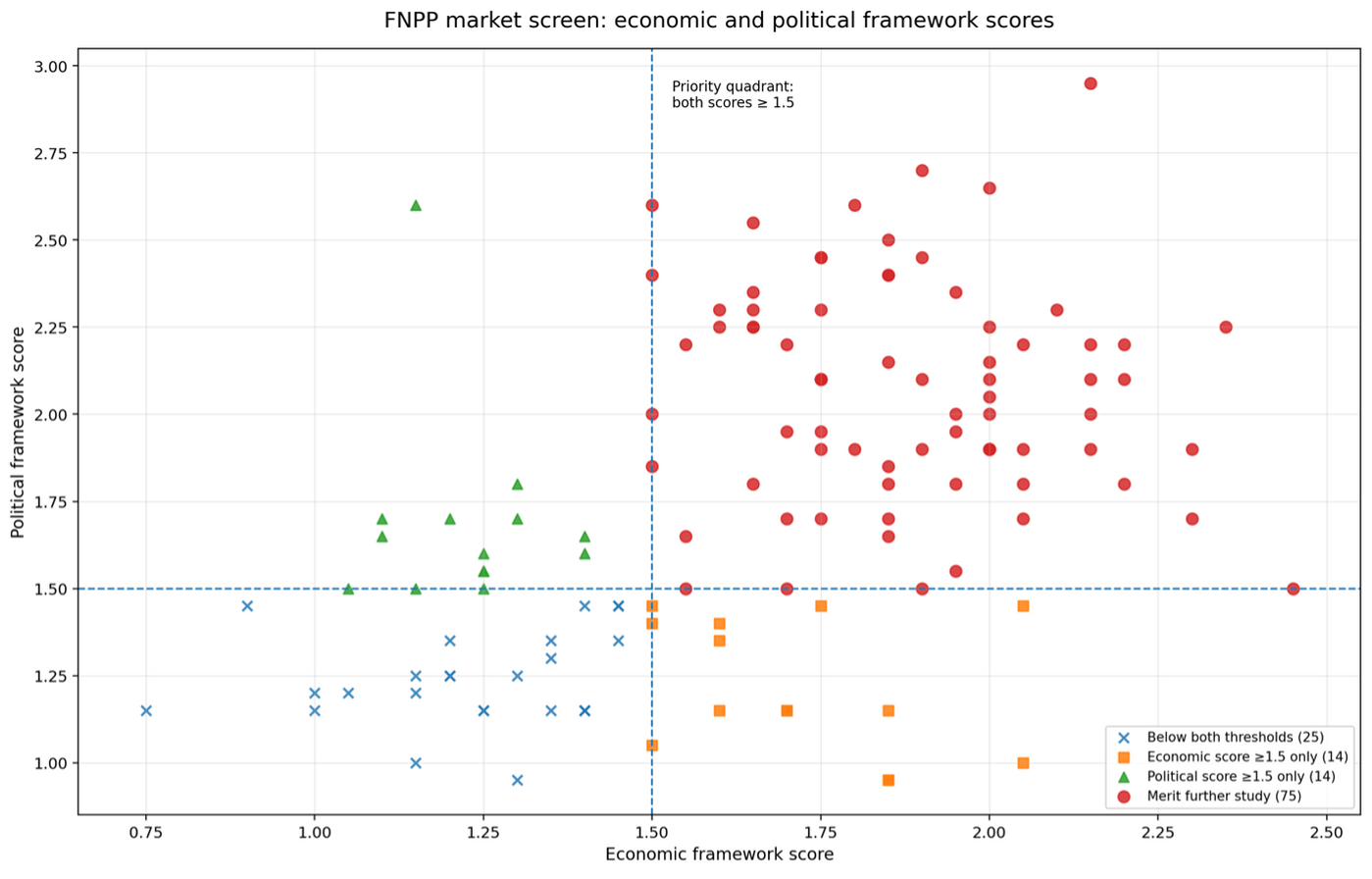
This result represents a balanced investability screen rather than a simple technical-opportunity map. Several markets may show strong demand for floating power but fall below the threshold on either political or economic conditions. Conversely, the countries that pass the screen combine sufficient economic capacity with a political framework that could support further project development.
Within the broader group of 75 countries and territories that merit further study, 14 markets form a higher-priority subset, with both economic and political framework scores at or above 2.0. These countries combine comparatively stronger economic capacity with more favorable political and regulatory conditions, making them relevant for deeper feasibility assessment, investor engagement, and project readiness screening. The result is therefore not a final investment shortlist but a commercially meaningful funnel including the following countries:
-
Algeria
-
Egypt
-
France
-
Ghana
-
India
-
Indonesia
-
Mexico
-
Oman
-
Saudi Arabia
-
South Africa
-
South Korea
-
Sweden
-
United Kingdom
-
Vietnam
Commercial Challenges and Investment Questions
The case for floating nuclear may be strong, but the barriers remain substantial. These include nuclear licensing, maritime regulation, physical security, emergency response planning, spent fuel management, insurance, liability regimes, public acceptance, grid integration and financing capacity. For international deployment, an additional challenge arises – the plant may be built in one country, operated by an entity from another, and deployed in a third. That raises complex political, legal, and regulatory questions.
From an investor perspective, the key issue is whether floating nuclear can become a repeatable infrastructure product rather than a bespoke megaproject. If shipyard-based fabrication, standardization, and modular deployment reduce construction risk, floating nuclear could become more attractive than conventional nuclear in certain markets. That remains to be demonstrated at commercial scale.
For offshore companies, however, the delivery model is familiar. Floating assets, modular construction, tow-out, offshore installation, and long-term operations are all part of the sector’s core capabilities. The main question is not whether the offshore industry can build and deploy such platforms. It is whether the regulatory, political, and financial ecosystem will mature quickly enough to support bankable projects.
Overall, floating nuclear is worth attention. It may not become a mass-market solution overnight – however, as the search intensifies for firm, clean, and flexible energy infrastructure, floating nuclear has the potential to become one of the most strategically important new segments in offshore power.
Sources
-
International Atomic Energy Agency
-
Nuclear Threat Initiative
-
Office of Industry and Competitiveness Analysis, U.S. International Trade Commission
-
Lovering, J.R., A. Yip, and T. Nordhaus. 2016. "Historical Construction Costs of Global Nuclear Power Reactors." Energy Policy 91: 371–382
-
Nuclear Engineering International
-
RBC Climate Action Institute
-
1 Closest to the existing commercial nuclear fleet. These designs use water as coolant and generally build on light-water reactor operating experience, which may support licensing, fuel supply, workforce training, and investor confidence.
-
2 Use gas, typically helium, as coolant and are designed for high outlet temperatures (above 750 C). Relevant for electricity generation, industrial heat, hydrogen production and cogeneration applications.
-
3 Use fast neutrons and liquid metal coolants, such as sodium or lead. They may offer fuel-cycle and waste-management advantages but generally require more advanced demonstration and licensing pathways
-
4 Use molten salt as coolant or, in some designs, as a fuel carrier. Low-pressure single-phase coolant systems eliminate the requirement for large containment structures, and their high operating temperatures result in increased efficiency and fuel cycle flexibility.
-
5 Very small SMR systems with capacities below 10 MW, although some definitions extend microreactor capacities up to 20 MW.
-
6 A multi-step objective analytical approach was conducted to assess the addressable market for floating power and, more specifically, floating nuclear power. The analysis began with a dataset covering 252 countries and territories, with more than 12,000 data points scored and weighted to establish a broad, comparable foundation for identifying where floating power solutions might be relevant. It then narrowed to 208 countries and territories, including remote locations and coastal and island regions, to identify the total addressable market for floating power based on the practical assumption that such solutions are most relevant where geography creates constraints or opportunities for offshore deployment. Finally, the sample was refined to 128 countries and territories that possess a suitable combination of population, energy market conditions, political framework, and economic framework to justify considering a FNPP solution. The methodology incorporated a range of variables across six categories: general country characteristics; energy demand drivers; electricity market structure; constraining factors; economic and financial conditions; and geographical suitability. Indicators included population, urbanization rate, freshwater resources, desalination capacity, energy production and consumption, fossil fuel reserves, installed generation capacity, electrification, CO2 emissions, climate targets, nuclear policy, political stability, terrorism risk, poverty rate, GDP, GDP per capita, credit agency ratings, island status, and coastline characteristics.
About the Author
Alisa Reiner
Alisa Reiner is an independent contributor. Alisa brings experience in both consulting and research, with interests ranging from energy geopolitics to climate change science. She has a Master of Environmental Management from Yale University., and is an Offshore energy markets analyst at Intelatus Global Partners.