Technology
Carbon Capture and Storage
Hard-to-Abate Reality Check: DNV on CCS Growth, Costs, and the Policy Gap
Carbon capture and storage (CCS) has moved beyond theoretical climate modelling into the realm of infrastructure planning, capital allocation, and regulatory design. DNV’s latest Energy Transition Outlook for CCS characterizes 2025 as a critical year, highlighting that global capture and storage capacity has reached a turning point, driven by near-term expansion in North America and Europe.

Yet the same outlook makes clear that, even with this acceleration, CCS remains far below the level required to deliver net zero by mid-century.
For Jamie Burrows, Global Segment Lead, Carbon Capture, Utilization, and Storage (CCUS) at DNV and one of the report’s authors, the central issue is no longer whether CCS has a role in the energy transition - it is whether the industry can deploy it at sufficient speed, in the right sectors, under the right policy frameworks.
A Necessary Technology in a Hydrocarbon-Heavy System
Burrows places CCS within the structural realities of the global energy mix.
“If you look at credible forecasts of how the world's energy systems will change from here, it's very clear that we will continue to use hydrocarbons in our primary energy supply through to 2050 and potentially beyond. Hydrocarbons are definitely going to be part of our energy systems,” he said.
Today, hydrocarbons account for roughly 80% of primary energy supply. DNV expects that share to fall to around 50% by 2050 - but not disappear. Consequently, CCS should not be thought of as a substitute for renewables, but as a complementary mechanism to address residual emissions, according to Burrows.
“In that context, you can see that a technology like carbon capture and storage becomes really important because, fundamentally, it is helping us to tackle the CO2 emissions that remain in our energy systems,” he explains. We know that it's a technology that will be very much needed for energy transition.”
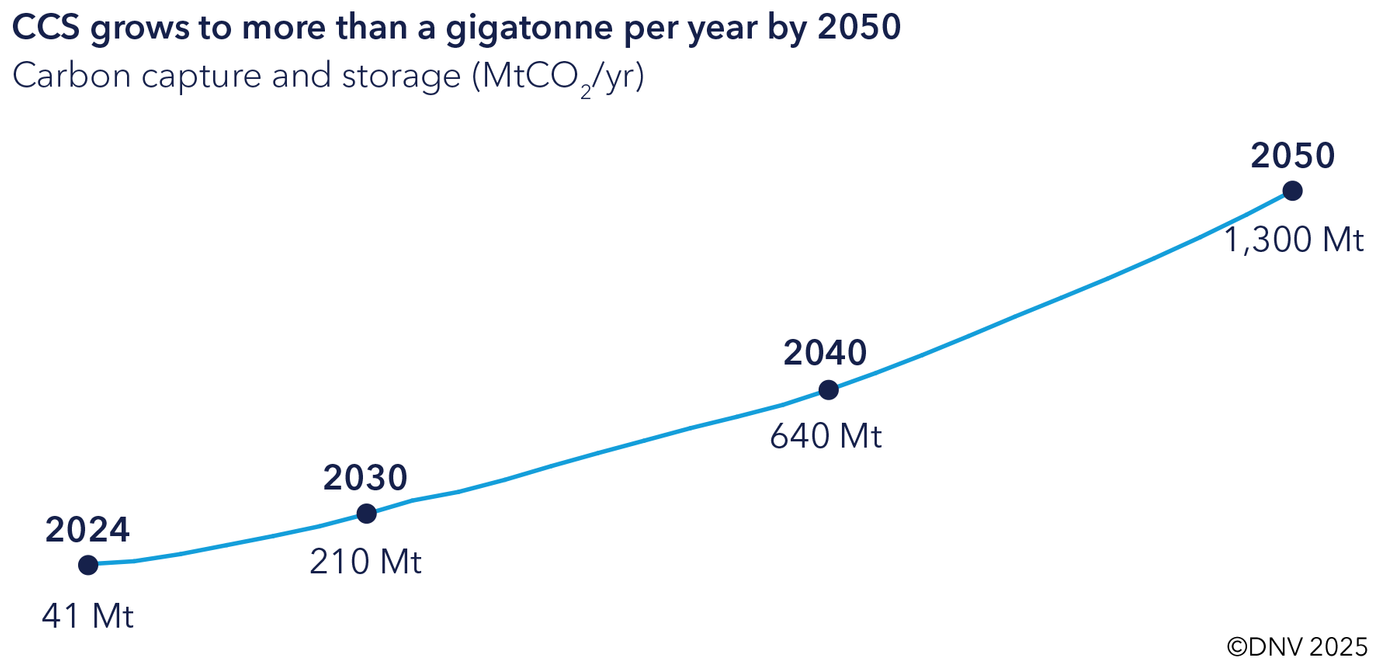
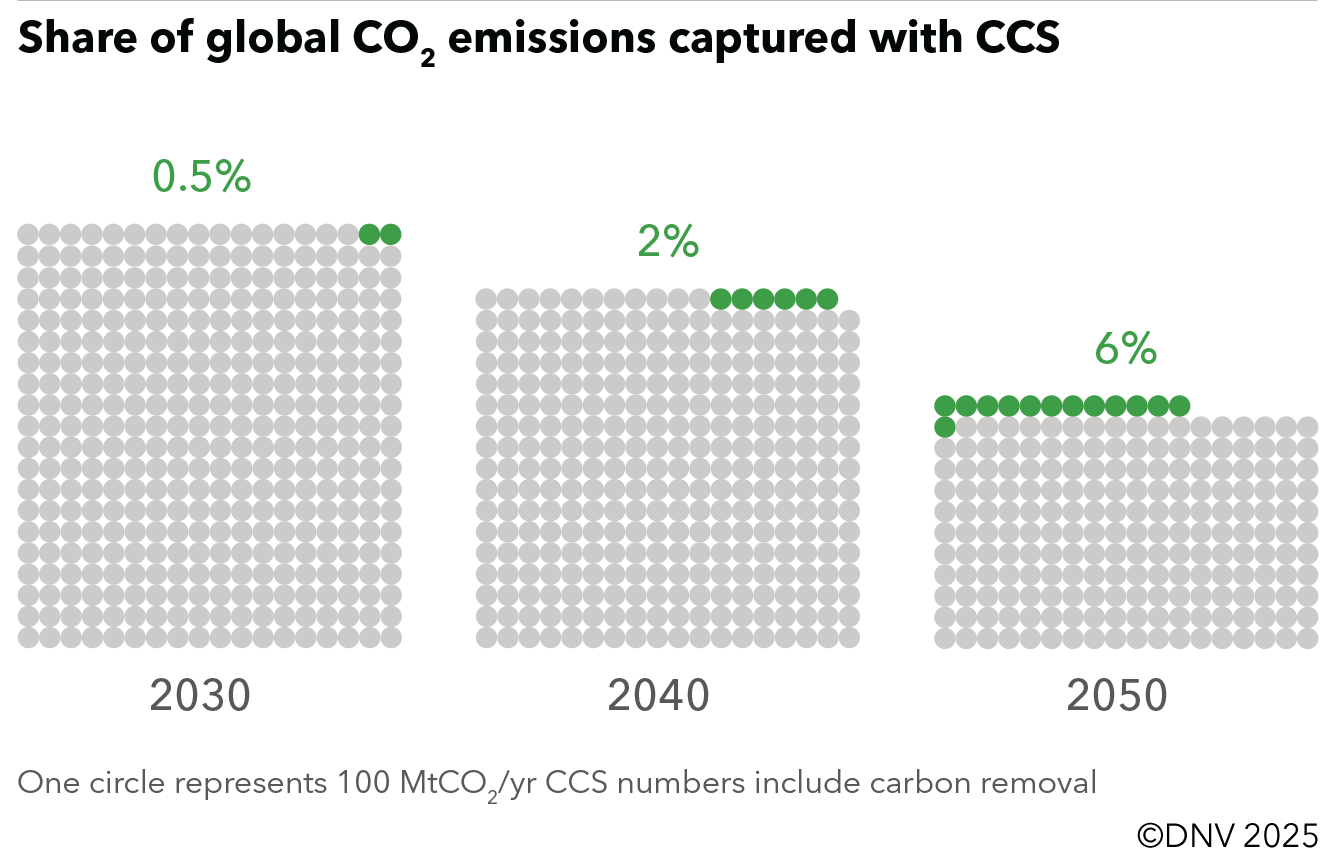
According to the DNV report, CCS is forecast to grow from 41 MtCO2 per year today to 1,300 MtCO2 per year by 2050, representing around 6% of global emissions at that point.
However, the report also stresses that this remains significantly short of what is required to reach net-zero emissions.
Hard-to-Abate Industry: Where CCS Delivers Maximum Impact
Burrows is careful to distinguish between where CCS is essential and where other solutions may be more appropriate.
“It's not a technology that should be used for every emission source – it's a technology that should be used for specific hard-to-abate emission sources,” he says.
Cement is the most frequently cited example – and for good reason.
“The cement industry generates around 7% of global anthropogenic CO2 emissions. There really isn't a good alternative to carbon capture to decarbonize cement manufacture today,” Burrows explains, adding that fuel switching alone cannot solve the problem.
“If you look at the cement manufacturing process, most of the CO2 emissions come from the chemical reaction itself. About 60% of emissions there are not from combustion – they come from the chemical reaction. If we switch fuel, electrify, or use hydrogen, at best we'll tackle 40% of the emissions. If we wish to decarbonize that industry, CCS is a much better technology to use. We can capture 95% of the emissions.”
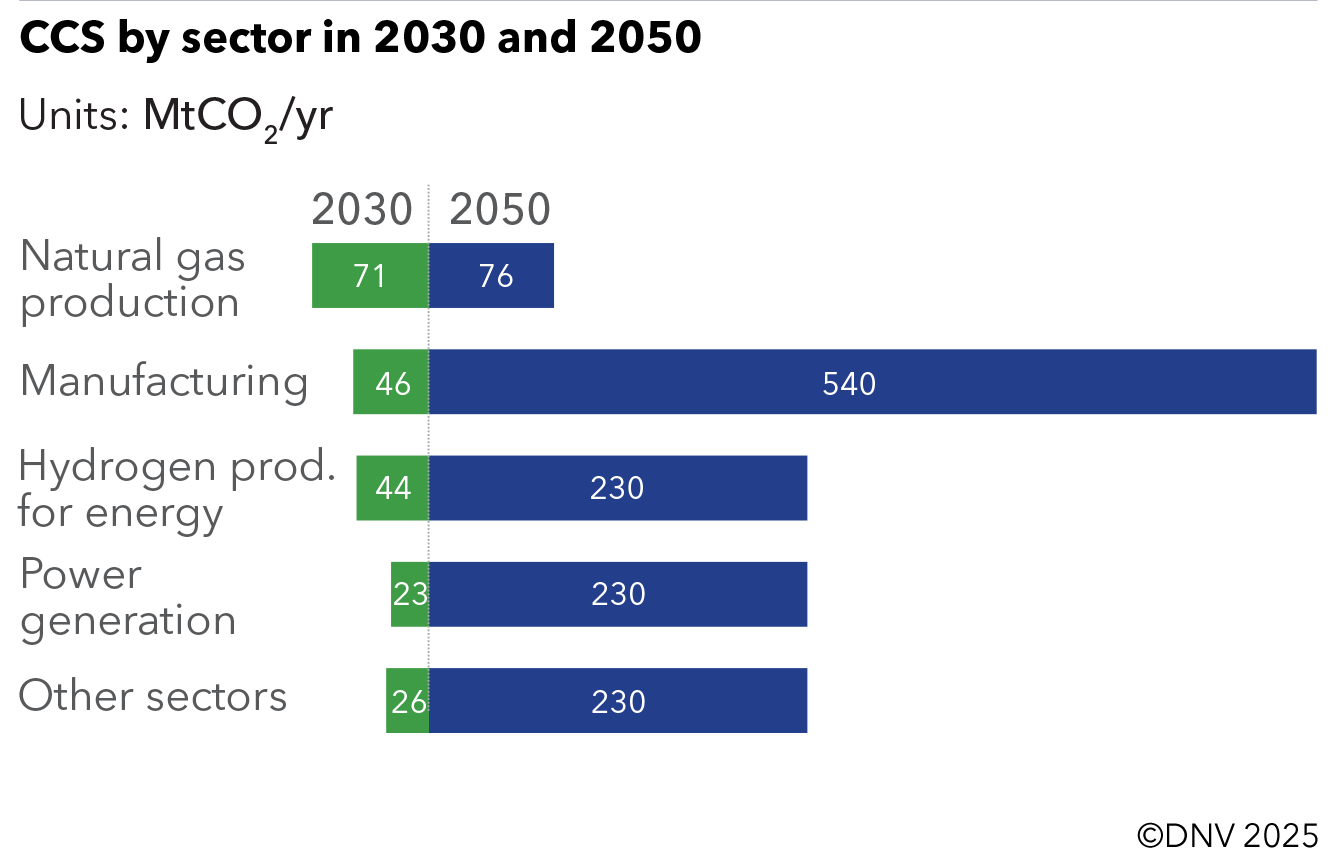
Steel and certain chemical processes fall into a similar category. According to the report, manufacturing sectors are expected to account for 41% of annual CO2 captured by mid-century, becoming the main growth driver from 2030 onward.
The power sector also retains a role for CCS, particularly in systems with significant adoption of renewables.
“If we look at very high penetrations of renewables, we know we will need dispatchable power alongside. It's not always sunny, it's not always windy. In jurisdictions like the UK, renewables are intermittent,” Burrows says. “Gas-fired power with CCS can provide the low-carbon dispatchable power that we know will be needed.”
Technically, capture rates can exceed 95%, but cost considerations remain decisive. “If we're looking at post-combustion capture – capturing CO2 from an existing emission source – we can capture in excess of 95%. It becomes a question of economics. Chasing the final few percent is typically more expensive.”
Offshore Storage, Infrastructure Reuse – and the Timing Constraint
Offshore oil and gas are increasingly intertwined with CCS deployment. Burrows points to fields with high CO2 content that is currently vented, as well as integrated energy companies assessing capture and storage across their value chains.
“A good example is Kasawari in Malaysia, where hydrocarbons containing high CO2 content are produced. Petronas has developed a CO2 store into which it will inject the separated CO2. We are also seeing integrated oil and gas companies examining CO2 capture opportunities elsewhere in their value chains. This includes onshore opportunities such as natural gas processing, refineries and blue hydrogen production.
“The industry also sees opportunity in transporting and storing CO2 for emitters – particularly around the North Sea.
“Beyond commercial drivers, there can be regulatory drivers. For example, through the EU Net Zero Industry Act, certain operators are obligated to contribute to developing a collective 50 million tonnes per annum of CO2 storage capacity,” Burrows says.
On storage availability, his assessment is unequivocal.
“Globally, we know that there is more than enough storage for our needs, both onshore and offshore,” he says. “When it comes to identifying and developing a storage site, we go through a very robust procedure. We select sites that are lowest risk and where we can be confident the CO2 will be contained.”
Burrows points out, however, that the bottleneck lies not in geology.
“So yes, there is enough storage. Where developed correctly, I'm confident there will be no problems around containment. The challenge is timing. It can take several years to develop a storage site, and we must ensure that capture, transport, and storage all become available at the same time.”
Public perception has influenced geographic choices for storage, particularly in Europe, where early onshore storage projects encountered opposition, resulting in most European CO2 stores now being developed offshore. “Today, globally, the majority of CO2 is being stored in onshore sites. In Europe and parts of Asia, offshore storage is prominent. We expect other regions to make greater use of offshore storage as the industry matures.”
Transport and infrastructure economics also play a critical role.
“The economics of CCS are challenging. If it is possible to repurpose infrastructure like pipelines, that can improve project economics,” Burrows says. At the same time, he stresses that reuse must follow strict qualification processes to ensure design integrity and safety compliance.
Transport modes are diversifying.
While pipelines remain dominant, projects such as Northern Lights have introduced ship-based CO2 transport. Rail and truck solutions are also emerging for specific use cases.
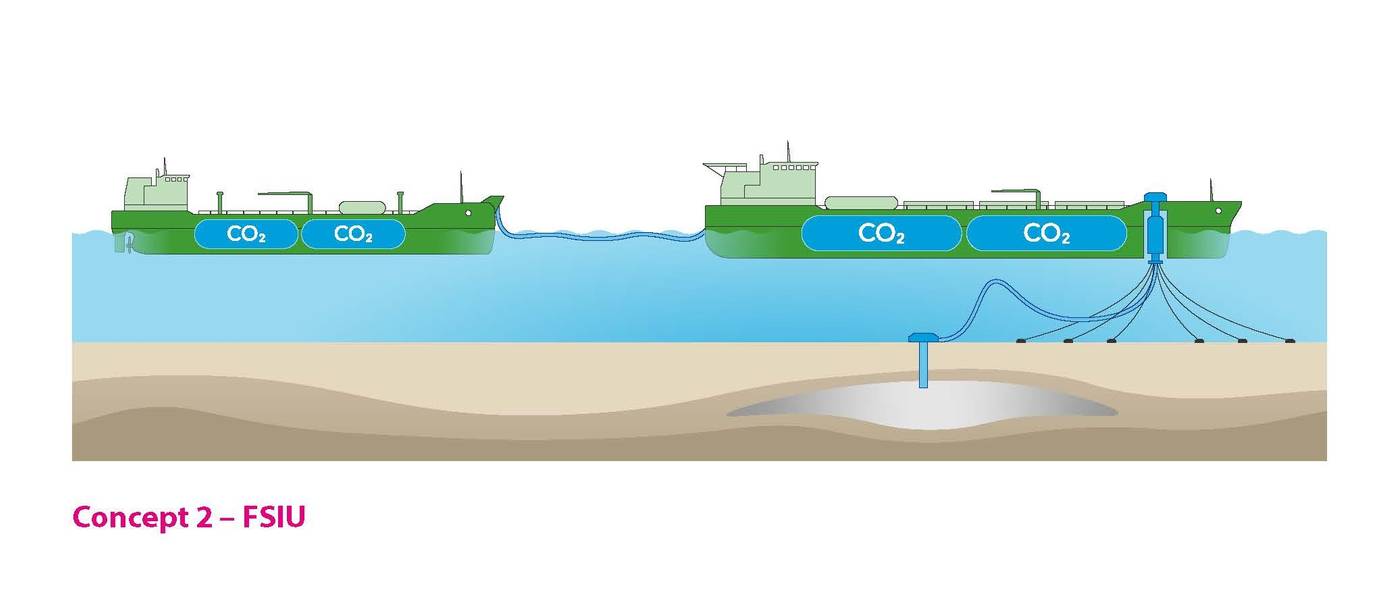
Looking ahead, Burrows notes growing interest in floating CO2 storage and injection concepts.
“We are starting to see interest in floating storage and injection units,” he says. “Rather than a fixed offshore facility, a floating vessel could receive shipments of CO2 and inject them into storage. Once the store is full, the vessel could relocate to another storage site. There are still technical questions around operations and equipment for such floating facilities, such as the use of flexibles for CO2. Such challenges have been examined in detail through DNV’s recent CO2 Offshore Injection Joint Industry Project”.
Maritime, Hydrogen and Carbon Removal: Extending the Value Chain
Beyond industrial applications, carbon capture concepts are extending offshore and into the decarbonization of the maritime industry.
“We are seeing more interest in capturing CO2 on floating production, storage, and offloading (FPSO) units.
For example, DNV performed a technology qualification for SBM to assess capturing CO2 from gas turbines on one of its FPSO designs. Petrobras separates CO2 from produced gas and reinjects it in the Santos Basin. In such cases, it may be cost-effective to also capture CO2 from power production onboard,” Burrows says.
Onboard carbon capture for ships is also gaining attention.
“Onboard carbon capture could be one of the more cost-effective means to decarbonize maritime vessels,” he notes. “Technical challenges remain, such as power requirements for capture, storage in high-pressure tanks, and offloading infrastructure in ports.”
According to DNV’s outlook, onboard carbon capture is expected to scale beyond 2040 and could capture a significant portion of maritime emissions by mid-century, assuming supporting infrastructure develops accordingly.
Hydrogen production further reinforces the need for CCS infrastructure, with carbon dioxide removal (CDR) adding another layer.
“Blue hydrogen involves producing hydrogen from natural gas, generating CO2 that must be transported and stored. Similarly, if we are going to remove CO2 from the atmosphere at scale, we will rely on CCS infrastructure to store it permanently,” Burrows explains.
The report forecasts that CDR could reach 330 MtCO2 in 2050, about one-quarter of total captured emissions, with bioenergy with CCS generally offering lower costs than direct air capture.
Policy as the Decisive Lever
DNV recognizes the importance of CCS technology for energy transition, recognizing it must scale significantly. DNV sees its role as helping to ensure early CCS projects are deployed successfully, which will enable the scaling up the technology, by delivering advisory and verification services to reduce risk and ensure projects succeed.
“For example, on the Greensands project in Denmark, we have performed CO2 storage certification considering the requirements of ISO 27914 – reviewing the work performed to develop the storage site and confirming it conforms to the standard using service specification DNV-SE-0473,” Burrows said.
Ultimately, Burrows point outs, the policy remains the determinant of scale.
“CCS deployment is entirely dependent on policy support. Generally, for projects to move ahead, the cost of emitting CO2 must be greater than the cost of capturing and storing it.” he said. “In North America, deployment is primarily driven by the 45Q tax credit. In Europe, it is driven by the EU ETS carbon price and supporting national policy.
Despite clear progress and what the report describes as a pivotal decade ahead, Burrows emphasizes that no single technology will deliver the transition alone.
“The reality is, if we look at energy transition, we need all solutions. There's no one correct solution. We'll need everything and lots of it.”
In his view, CCS is not a silver bullet, but without it, the arithmetic of decarbonization simply does not add up.
Further details of DNV’s CCUS activities, including access to DNV’s Energy Transition Outlook: CCUS to 2050 can be found on DNV’s website - https://www.dnv.com/focus-areas/ccs/
About the Author
Amir Garanovic
Amir Garanovic is managing editor of Offshore Engineer. He has covered offshore energy and maritime industry since 2014, with a special focus on renewable energy sector and emerging clean energy technologies.