Markets
Gulf NOCs and MODU Operators
Gulf NOCs and MODU Operators Look to Contractual Resilience to Ride Out Disruption
Continued idling of assets should the conflict persist would see wider MODU market tightening as drillers and NOCs manage capacity.
By Todd Jensen, Associate Director, MSI
The impact of the war in the Middle East on the offshore energy sector has so far received less attention than the attacks on ships and oil storage and loading facilities. Nonetheless, the violence has already directly impacted MODU owners with at least one operator announcing it had evacuated workers from four drilling rigs in the Middle East but confirming the rigs were still under contract and insured.
In its Q1 2026 MODU Market Report, MSI has constructed three scenarios to put the potential impact into context for OSV and MODU owners.
-
Quick resolution (<1 month)
Limited impact on OSV and MODU owners, the North Field being under force majeure would have seen OSV and MODU activity in Qatar reduced to a minimal role thus reducing utilization. However, the duration of the impact would have been brief enough to allow for a quick recovery, crews would be reduced to skeleton crews to allow essential work to be carried out but contract cancellations would not be expected. OSV owners may be requested to accept standby rates as operators look to cut costs. -
Mid-term conflict (~6 months)
A significant reduction in OSV and MODU demand in the Middle East as fields are shut-in. OSVs and MODUs would also be unlikely to be able to leave the Gulf with the Strait of Hormuz (SoH) closed to vessels. This would result in a significant impact on OSV and MODU owners with the contracts in the Middle East having quite aggressive convenience clauses, leaving many of the vessels subject to the 30-day convenience clause and thus without pay for a majority of this period. -
Long-term conflict (>6 months)
Long-term this Scenario would see a similar impact to that outlined in Scenario 2, however, once the SoH re-opened, activity would increase again. Delays would be likely for some oil & gas projects in the region, as oil production will be restored from shut-in fields first. The short- to mid-term impact on OSV and MODU owners would be significant, with the impact easing as the conflict plateaus, provided the SoH re-opens.The structure of the Middle East MODU market, where roughly one-third of the global jack-up fleet is concentrated and where activity is anchored by national drilling champions such as ADES Holding, Arabian Drilling, ARO Drilling and ADNOC Drilling, creates a contractual environment that is structurally more resilient to short-term geopolitical disruption.

Long-duration drilling programs tied to NOCs including Saudi Aramco, ADNOC, and QatarEnergy tend to incorporate strong termination and operational continuity clauses. As a result, we believe outright contract cancellations in the early stages of a regional escalation are improbable.
Operators typically prioritize maintaining reservoir management and development drilling continuity, meaning contractual remedies would more likely manifest through temporary suspensions, force majeure interpretations, or negotiated rate adjustments rather than full termination of drilling agreements.
Offshore drilling agreements with the NOCs typically include clauses allowing operators to temporarily suspend rigs while maintaining a reduced standby rate.
In a heightened security environment, particularly if maritime risks persist in the SoH for a sustained period, operators could be forced to use temporary suspension mechanisms to defer non-essential drilling campaigns without triggering formal contract termination.
The practical impact would therefore appear first through rising suspended-rig counts and precautionary operational measures, such as the recent decision by Borr Drilling to recall offshore personnel.
Operational exposure would also be uneven across drilling categories. Rigs deployed in short-cycle exploration, appraisal wells, or installation campaigns retain greater scheduling flexibility and therefore represent the first layer of activity that could be deferred.
Development drilling tied to mature producing assets is considerably less discretionary, particularly in fields operated by Saudi Aramco and ADNOC, where drilling programs are embedded within long-term production management strategies.
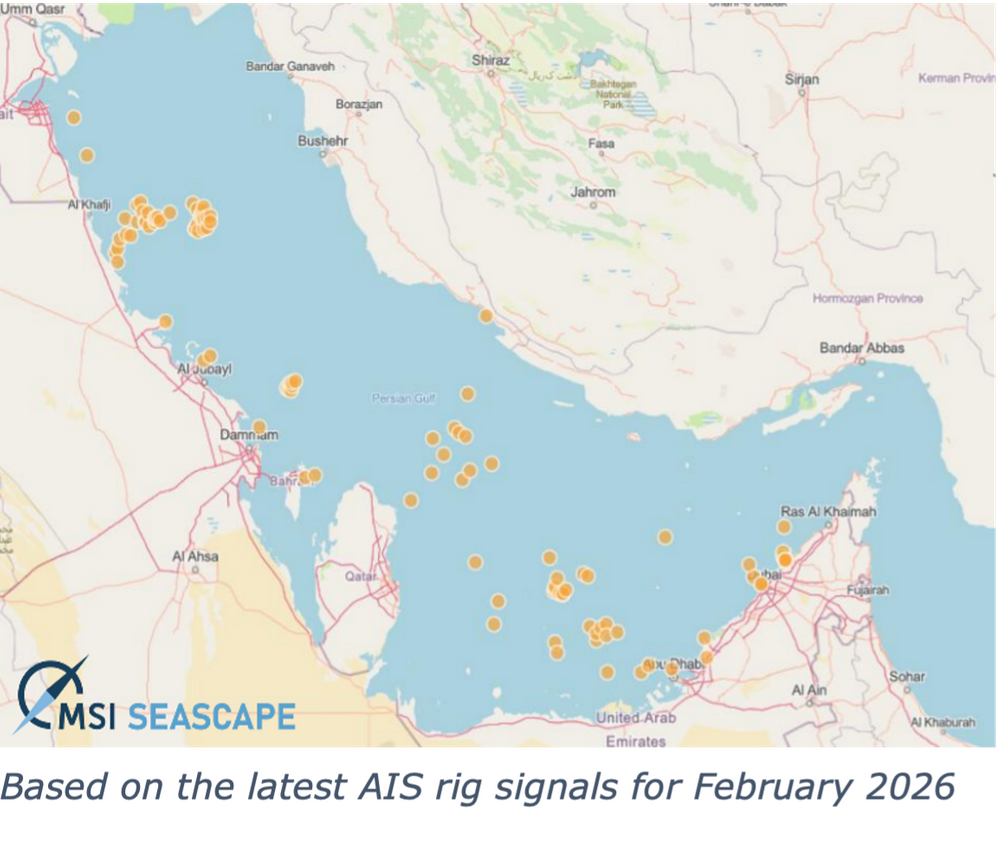
Consequently, any near-term demand softening would likely emerge through delays in new jack-up mobilizations or exploration campaigns, rather than through abrupt contract termination. This sequencing reflects the contractual hierarchy within offshore drilling programs, where exploration budgets are typically the most flexible component of upstream capital allocation.
If export disruptions were to persist, particularly through constrained tanker movements via the SoH, the use of suspension clauses could broaden across drilling programs. As storage capacity tightens and export volumes become constrained, NOCs may recalibrate upstream activity to match logistical limits on crude flows.
Under these conditions, discretionary drilling, especially exploration or incremental development wells, would likely be deferred first, leading to a wider pool of rigs temporarily idled under standby arrangements. This staged adjustment reflects the typical drilling-cycle response during downturns, where operators initially suspend flexible programs before considering contract non-renewals or early terminations if disruptions prove prolonged.
At the same time, any suspension-driven softening in the Gulf would likely have counterbalancing implications for the global MODU market. The Middle East has functioned as the primary sink for jack-up supply over the past decade; if part of that fleet becomes temporarily idle but remains contractually tied to regional operators, those units are effectively removed from the internationally mobile supply pool.
This could tighten availability in other offshore basins at a time when higher oil prices may stimulate incremental drilling demand in markets such as Brazil, West Africa, and Southeast Asia. Under such conditions, regional suspensions in the Gulf would not necessarily translate into a global oversupply of rigs with units not able to exit the Middle East Gulf. Instead, they could reinforce tighter utilization and stronger day-rate momentum in markets outside the Middle East while the region itself experiences a period of operational pause rather than structural demand collapse.
About the Author
Todd Jensen
Todd Jensen, Associate Director, leads MSI’s offshore energy market analysis and has a focus on oil and gas field development projects, alongside offshore renewables.