Markets
Exploration
Deepwater’s Playbook for Delivering Growth
Deepwater production continues to remain a core part of the long-term energy supply mix. While production from conventional onshore and shallow-water assets is expected to remain broadly flat under our base case, Welligence estimates that global deepwater oil production will grow from its current level of around 8 million bbl/d to close to 10 million bbl/d by the early-2030s.
by Gordon Hardie, Head of Sub-Saharan Africa Research at Welligence
One Guyana FPSO
©ExxonMobilHowever, post-2035, deepwater production is set to enter decline unless the hopper of pre-FID deepwater projects is replenished in the medium to long term. But this will require a tangible step up in exploration investment.
With IOCs maintaining a strong focus on capital discipline and applying strict criteria to new investment, only the most resilient and commercially attractive deepwater projects are progressing to FID. Operators are now leveraging on new technologies and contracting solutions to cut costs, shorten cycle time and improve project economics.
Standardisation and Consolidation
Standardisation is playing a key role in cutting project cycle times and costs and Welligence data highlights a clear correlation between improved project delivery and the deployment of standardised solutions. Both the Payara and Yellowtail deepwater projects in Guyana are based on SBM Offshore's Fast4Ward standardised hull design and TechnipFMC's standardised subsea trees — and both projects were delivered ahead of schedule, a remarkable achievement for deepwater developments of this scale and complexity.
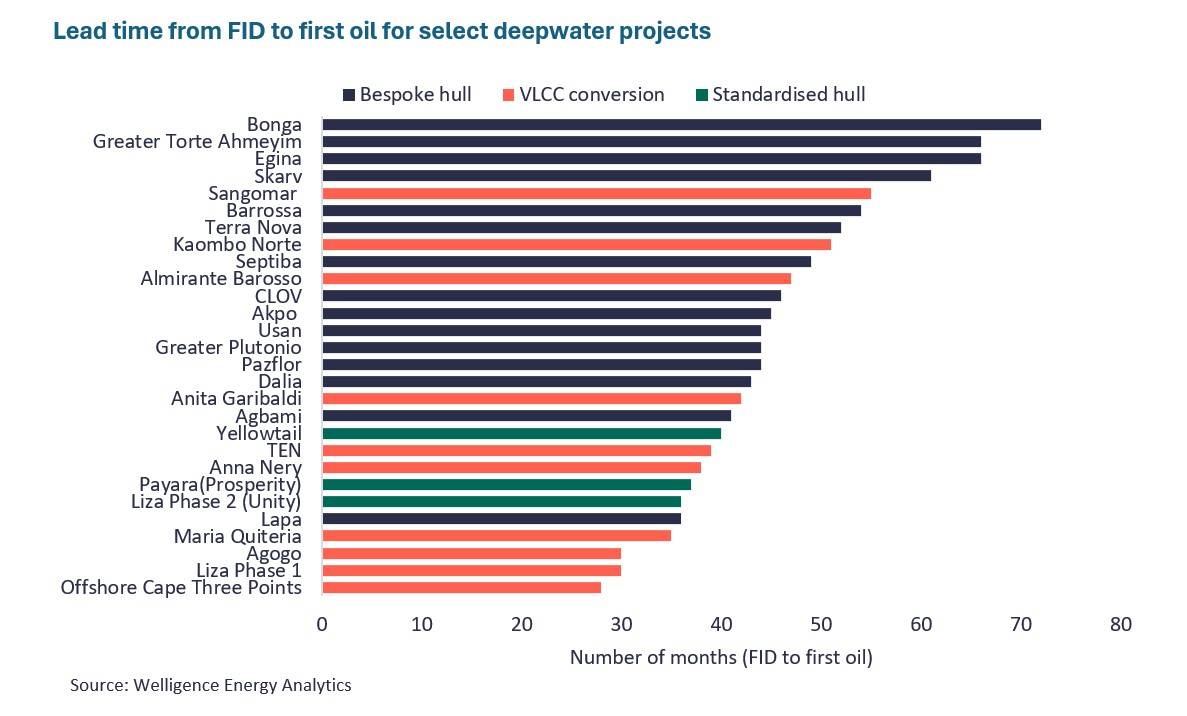
Building on the standardised approach, several IOCs are increasingly embracing the subsea integrated Engineering, Procurement, Construction and Installation (iEPCI) model, which drives stronger contractor engagement and collaboration during the early project phases. Projects such as Shell’s Gato do Mato (Brazil), TotalEnergies’ Gran Morgu (Suriname), and Equinor’s Bacalhau (Brazil) are all leveraging this approach, with schedule compression being the primary commercial driver. The merger of FMC Technologies, a subsea production specialist, with Technip, a leading SURF contractor, was key in enabling the iEPCI model. The proposed merger of Saipem and Subsea7 will also be looking to deliver integrated solutions.
Emissions Reductions Now Embedded in New Projects
New developments are now being assessed through a carbon lens as part of project screening, with emissions reductions built in, not just bolted on. However, while deepwater production can offer some of the lowest-carbon barrels in an operator’s portfolio, commercial viability remains a challenge.
In the ultra-deep water of Brazil’s Santos Basin, the Equinor-operated Bacalhau FPSO is the first to feature combined-cycle gas turbines. The technology generates more power using the same amount of gas, increasing energy efficiency and reducing CO2 emissions. While forecast emissions are set to be more than half that of the industry average, the topside weight requirement (around 50,000 tonnes) is a lot heavier than the conventional FPSO with a processing capacity of over 150,000 bbl/d (average topside weight of 30,000 to 40,000 tonnes). With FPSO topside costs estimated to cost between US$50,000 and US$60,000 per tonne, the incremental capital required can be in the hundreds of millions of dollars.

One emerging technology involves moving processing equipment subsea, which could ultimately reduce the operational footprint on the FPSO topsides. This solution could lead to overall reduction in emissions, while at the same time also cutting the topside weight requirement for the FPSO. But the potential costs and system reliability will be critical to adoption and for long-term operation.
Designing for Late-Life Operations Offers Long-Term Opex Savings
With late-life operations come integrity challenges, equipment reliability concerns and processing constraints. As the onstream batch of global deepwater projects mature – over 30 deepwater assets have been producing for over 25 years – life extension has become increasingly central to operator strategies. Designing for late life is now critical for long-term opex reduction, especially as decisions made at the early stages of a development will adversely impact the cost of operating an asset across its full lifecycle. But the recent trend has focused on disciplined capital spending, fast track and standardisation.
However, with the growing comfort of new technology, especially digitisation and artificial intelligence (AI), IOCs are looking at adoption of technologies like digital twins for real-time monitoring to enable early risk identification. With predictive analytics, operators can pre-emptively intervene rather than reactively fix. This new approach reduces process downtime by up to 30% in some deployments. AI can also streamline and eliminate waste. Logistics, spares management, optimised maintenance and inspection routines, and reduced specialist interventions can significantly reduce opex. Savings of between 10-20% have been projected and with early adoption by operators including bp and Shell in GoM, the industry will be watching closely.
As companies push the deepwater envelope and projects become increasingly more challenging, designing systems for remote operations not only reduces safety risk but can materially reduce the cost of crewed interventions over field life. While high initial costs have muted early implementation, with continual improvement in data processing and AI, tangible savings are likely and with that, a new addition to the deepwater playbook.
About the Author
Gordon Hardie
Gordon Hardie joined Welligence in March 2025 and currently leads the Sub-Saharan Africa Research team. He is responsible for the team's regional coverage, promoting thought leadership reports, investment/M&A trends and key producing country analysis. Prior to Welligence, he spent over 15 years in various upstream petroleum engineering roles, working for Talisman Energy, Repsol-Sinopec and most recently Apache North Sea.
 ©Weliigence