Engineering
OSV Design
The X-BOW Revolution: How a "Simple Question" Redefined Marine Engineering
Two decades ago, the ULSTEIN X-BOW redefined naval architecture, sparking a global success story for Ulstein Group. This is the story behind that revolutionary hull—and the philosophy of Chair of the Board Tore Ulstein on fostering a culture where creativity and audacity are hardwired into the company’s DNA.
It all began with a simple question: “What does the bow actually look like that?”
By Josefine Spiro
The visual evolution of a breakthrough: The Bourbon Orca, the first vessel to feature the X-BOW® design, alongside a traditional hull profile. Launched in 2006, the vessel immediately piqued industry curiosity by defying a century of naval tradition.
Photo credit: Tony Hall“None of us could give a proper answer,” admitted Tore Ulstein.
The Chair and co-owner of Ulstein Group smiled at the memory of that 2003 workshop—the catalyst for a new era. This turning point came five years after his family had sold their original design business, known for the UT designs (short for Ulstein Trading). Following the 1999 sale, Tore’s father, Idar Ulstein, announced the group would build its in-house design capabilities from scratch. Tore—an engineer with a Ph.D. in marine hydrodynamics—was tasked with leading the new team. In 2002, this unit became the subsidiary Ulstein Design AS.
“Our strategy was clear from day one: we had to differentiate,” Ulstein explained. “If we had tried to compete with the established UT designs by simply matching them, we would have always been playing catch-up. Instead, in 1999, we chose to lead through innovation. We wanted customers to choose us because we brought something entirely new to the table.”
To realize this vision, Ulstein initiated a workshop in 2003 with the Oslo-based agency Abry Design. Choosing a team with no maritime background was a deliberate move. Their “outsider” perspective prompted the question; “Why does the bow look like that?”—along with a series of other seemingly “dumb” inquiries that challenged the status quo.
“What they did know a lot about, however, was the design process itself,” said Ulstein. Through these interdisciplinary sessions, the designers were challenged to look beyond the industry’s traditional horizon. Following the workshops, Tore Ulstein was shown a sketch by the then 33 year old hull designer Øyvind Gjerde Kamsvåg that he found particularly intriguing. The concept was brought into the dialogue between the two teams, where it piqued their collective curiosity and challenged a century of naval tradition.
Surprise in the Tank
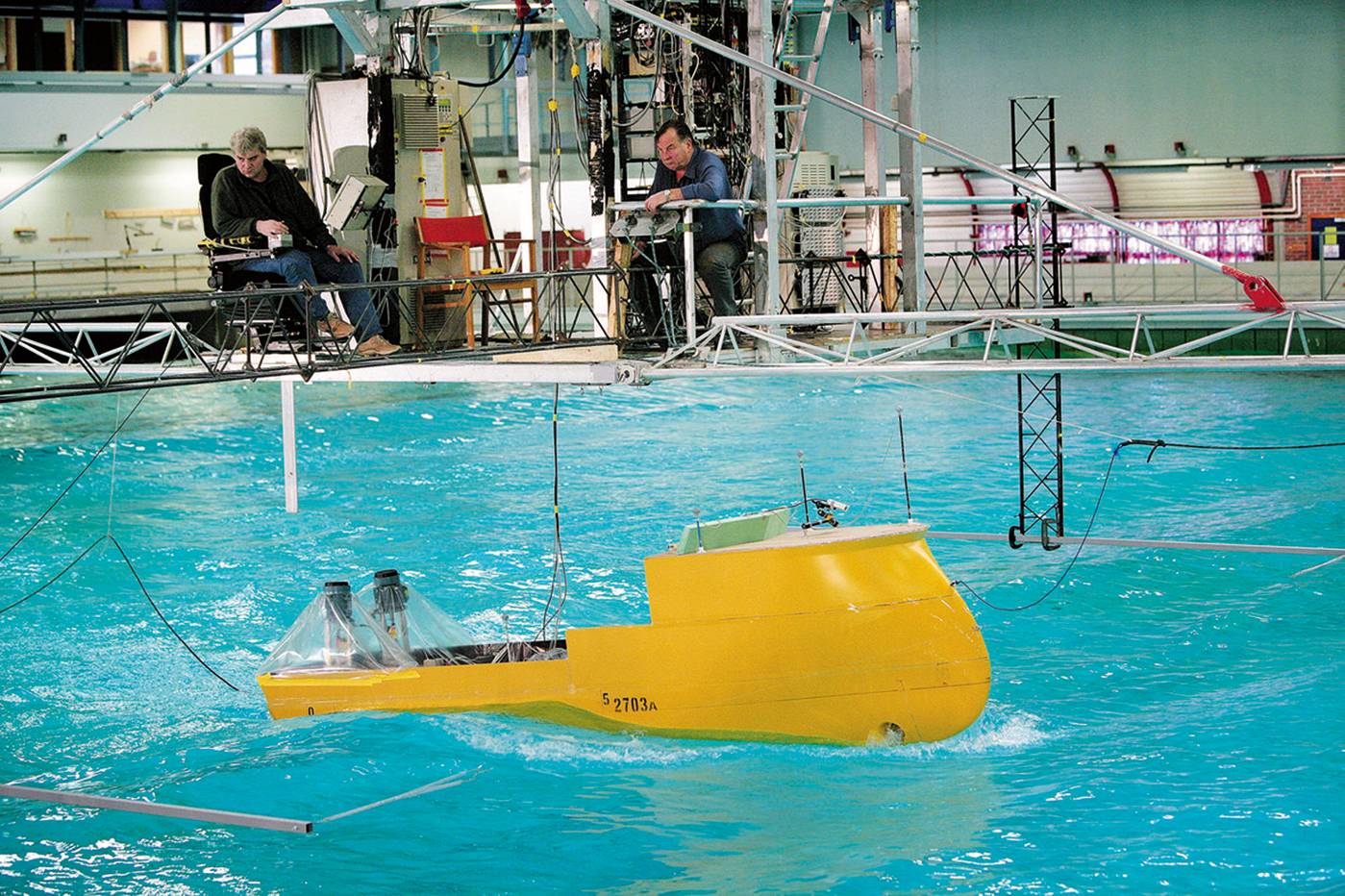
By 2005, the X-BOW® concept was ready for its first trial in the model tank at Marintek (now SINTEF Ocean) in Trondheim. At the time, scepticism from industry experts was palpable.
“The researchers had never seen anything like it,” recalled Tonje Øyehaug Ruud, Ulstein Group’s Head of Communications. “
The researchers in Trondheim took precautions before starting the machinery. "They mounted a Styrofoam plough on top of the model and wrapped the measuring equipment in plastic," Ruud remembered. “At the time, they had little faith in the concept.”
When the tests were completed, however, the warnings proved baseless. While researchers had expected high waves to climb the hull and impact the bridge deck, the model remained stable and buoyant. The slender bow allowed the hull to move gently through the waves without slamming, and the water was displaced along the side instead of being thrown upward and outward. In the end, there was not a single drop of water on the protected equipment.


From Invention to Innovation
"An invention only becomes an innovation when it succeeds commercially," Ulstein emphasized. "The X-BOW didn't spring from a finished problem definition, but from pure curiosity and a willingness to take detours. And then, you need a customer who dares."
That customer was Bourbon Offshore Norway. "They were brave," Ulstein added. "They challenged us based on some sketches they had seen in our customer magazine. Their primary motivation was the desire to differentiate themselves."
In 2006, the first X-BOW vessel, Bourbon Orca, was launched from the shipyard in Ulsteinvik, Norway. What skeptics feared would be a technical failure became a prize-winning triumph. The design went on to earn "Ship of the Year" honors in both Norway and abroad in 2006, as well as the prestigious "Engineering Feat of the Year" award.
While the awards provided confidence, the true validation came from those working at sea. The ship’s steward reported back enthusiastically: "I no longer have to call the bridge to ask them to slow down when I'm making dinner; the pots stay on the stove!"
Another striking proof of the hull's superiority surfaced on YouTube in 2007. A mobile phone video, filmed from the bridge of a supply ship in the rough North Sea, captures the contrast: As a traditional vessel hammers against the waves—crashing into the water, forced to slow down significantly—the Bourbon Orca appears in the frame. It glides through the swells without the characteristic slamming, effortlessly passing the conventional ship.

Resilience & Pivot
Since 1999, Ulstein Design & Solutions has delivered 169 designs. This portfolio includes 122 vessels featuring the original X-BOW, a number that rises to 132 when including its successors, the X-STERN and TWIN X-STERN.
But the journey was not always smooth. When the oil crisis hit in 2015, the maritime landscape was devastated; many large, publicly listed companies went bankrupt or were forcibly merged with more financially stable players.
Ulstein reflected on the choice they faced as a family-owned company when the market suddenly vanished. "We could have closed down, right? We could have said we're done. But instead, we chose to invest in finding new markets."
This strategic pivot involved a staggering 1.2 billion NOK—a commitment that included several years of losses as the company pushed into new markets. While a massive sum, it eventually led to the successful export of Ulstein designs into new segments, ranging from offshore wind and cable-laying vessels to expedition cruise ships and yachts.
"Having leadership and owners who provide the room and security to experiment and 'play’ a little' is crucial," Ulstein added. "Such a turnaround would be almost impossible in an organization governed by short-term corporate thinking and quarterly results."
By 2024, the strategy bore fruit as Ulstein Group returned to profitability.
Photo credit: Josefine Spiro/JoDa Media
Tore Ulstein, Chair of the Board, emphasizes that audacity and the courage to challenge the status quo remain hardwired into the company’s DNA.
The Art of Stimulating Creativity
How does Ulstein maintain this creative edge? The chairman points to three non-negotiable criteria: you must know something (competence), you must want something (drive), and you must be allowed (permission).
“You need the competence and the inner drive, but the deciding factor is having owners who give you the space to experiment,” he explained. He describes this as a balance between Yin and Yang—structure for productivity, but protection for "creative chaos."
An example of this playfulness is the ULSTEIN THOR, a visionary concept for a thorium-powered floating power station unveiled at the Seatrade Cruise Global convention in Miami in 2022. Designed as a mobile charging hub for electric fleets in sensitive regions like Antarctica, it eliminates the need for individual ships to return to port for fuel, dramatically reducing the industry’s environmental footprint.
"We knew the technology wasn't ready, but we chose to go public to bring the industry along on the journey and strengthen our brand as an innovator," Ulstein said.

Digital Horizons
The innovative spirit that began with the Bourbon Orca continues to open doors in new markets. Ulstein recently signed a contract with Malaysia’s OMS Group for the building of two next-generation cable-laying vessels for 2028. These SX252 designs incorporate the X-BOW® to ensure more comfortable motion for both the crew and the delicate cable equipment, alongside a reduction in fuel consumption. Furthermore, the enclosed cable hangar protects sensitive fiber-optics from the elements and significantly improves the working conditions for those on board.
But when asked about the next "big nut to crack," Ulstein looks beyond hull shapes.
“The next frontier is digitalization and Artificial Intelligence (AI),” he said.
By harvesting fleet data through proprietary systems, Ulstein aims to support real-time decisions to reduce emissions and enhance safety.
For Tore Ulstein, the mindset remains exactly as it was in 2003: the courage to challenge the established. “If we only tried to be as good as the others, we would always be a step behind,” he concluded. “We must have the desire to challenge the status quo.”
About the Author
Josefine Spiro
Josefine Spiro is an award-winning journalist with nearly 20 years of experience, specializing in feature journalism, business, technology, and innovation. She is based in the heart of the Norwegian maritime cluster.