Reimagining Subsea Cable Design: Seequent’s Integrated Approach to Thermal Modelling
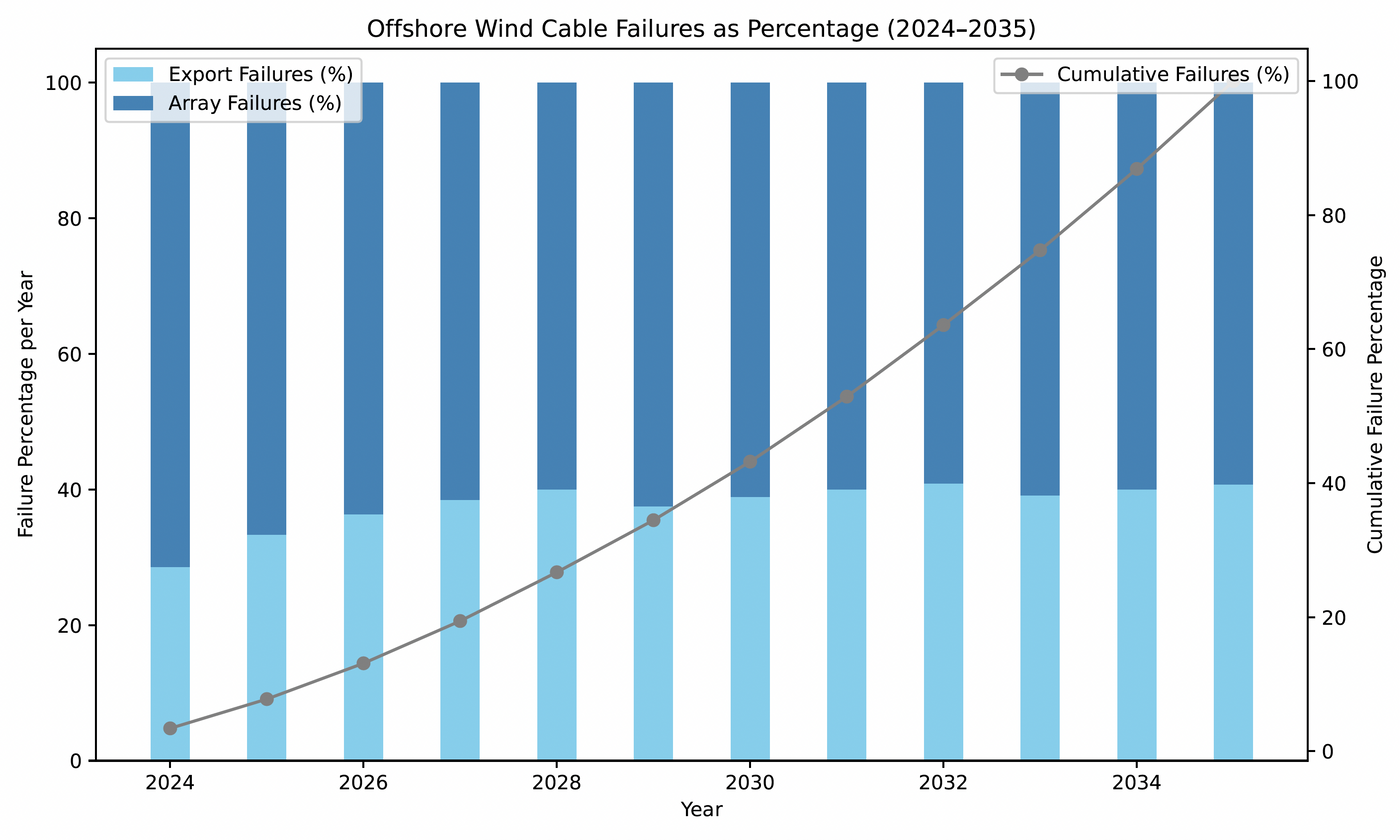
As the offshore wind sector accelerates toward ambitious global energy targets, one persistent challenge continues to undermine progress: subsea cable failure. With failure rates hovering around 30% for wind farms with extensive cabling, the industry faces significant financial, operational, and environmental risks. These failures are not only the leading cause of insurance claims in offshore wind but also a major contributor to delays in first power—jeopardising project timelines and investor confidence.
At the heart of this issue lies a critical gap in how we understand and model the seabed. Traditional cable design methods often rely on oversimplified assumptions about subsurface conditions, leading to either over-engineered systems that inflate costs or under-engineered ones that fail prematurely. Seequent, The Bentley Subsurface Company, is addressing this challenge head-on with a pioneering approach that integrates 3D geological modelling and transient thermal finite element analysis—ushering in a new era of precision and sustainability in cable design. Leveraging deep expertise in offshore and onshore subsurface environments, Seequent is uniquely positioned to deliver integrated solutions that enhance reliability and help organisations reduce risk.
The Cost of Oversimplification
Submarine power cables are the arteries of offshore wind farms, yet their performance is intimately tied to the thermal and mechanical properties of the seabed. Conventional design practices often assume homogeneous ground conditions, ignoring natural variability in sediment composition, moisture content, and thermal conductivity. This can result in overly conservative cable sizing, increasing material use and environmental disturbance—or worse, thermal hotspots that lead to insulation breakdown and failure.
A New Paradigm: Integrated Ground Modelling
Seequent’s workflow begins with the creation of a detailed 3D geological model using Leapfrog, capturing spatial variability in sediment types and thermal properties. This model is enriched with data from geophysical surveys, cone penetration tests (CPT), and surface mapping to build a comprehensive picture of the subsurface.
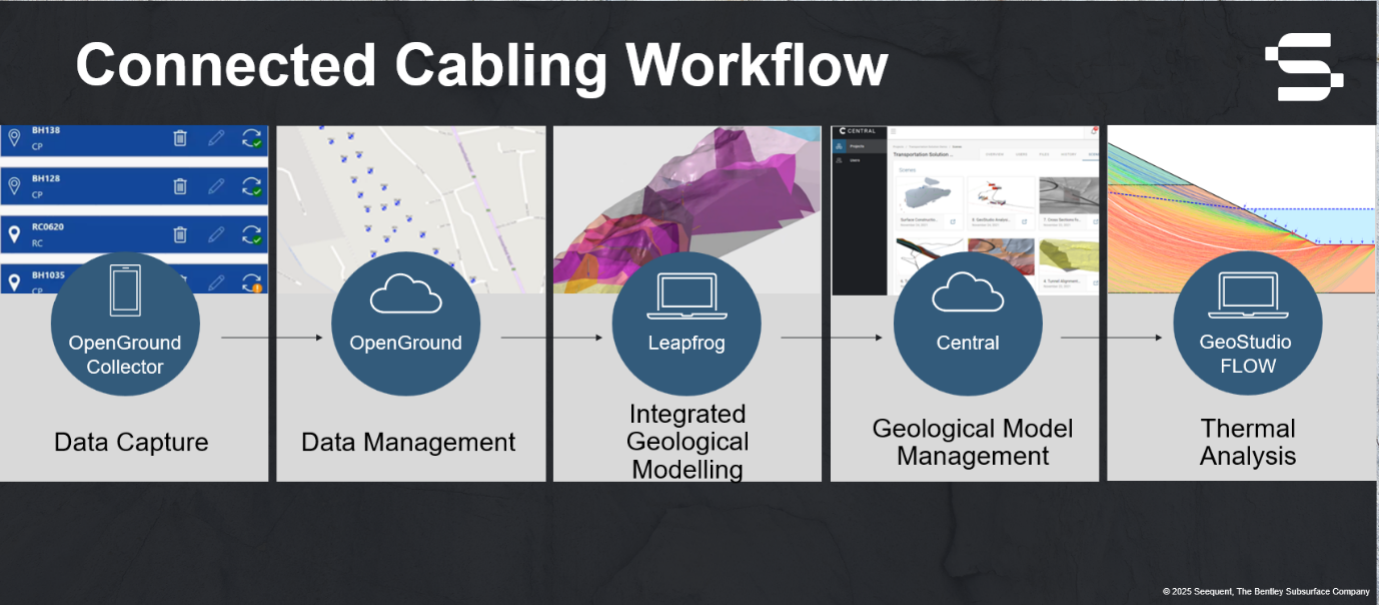
Thermal testing data are then evaluated within a 3D block model, enabling precise identification of zones with varying thermal conductivity. This model is seamlessly integrated with the geological model in Seequent’s 3D environment, supporting the development and visualisation of a unified ground model. The result is a more complete understanding of thermal behaviour, underpinned by a robust framework for assessing additional subsurface risks—including sediment mobility, scour potential, and geoenvironmental interactions.
Precision Through Simulation
Using Temp/W, a finite element software within Geostudio 2D FLOW, Seequent simulates transient thermal behaviour along selected cross-sections of the cable route. This enables accurate prediction of cable operating temperatures under varying load conditions and burial depths. Engineers can then optimise conductor sizing and reduce unnecessary material use—without compromising reliability.
This approach also supports back-analysis of existing infrastructure, offering insights into performance anomalies and opportunities for dynamic load management. By understanding how cables interact with their environment over time, operators can make informed decisions about maintenance, upgrades, and risk mitigation.
Beyond the Cable: Environmental and Economic Benefits
The benefits of this integrated approach extend beyond engineering efficiency. By accurately modelling thermal impacts on the surrounding seabed, developers can mitigate risks such as sediment fluidisation, geoenvironmental alteration, and habitat disruption—especially in sensitive marine environments under regulatory scrutiny.
Economically, the approach reduces the likelihood of costly failures and insurance claims, while streamlining the design process. By leveraging commonly available site investigation data, Seequent’s methodology delivers strong return on investment—supporting more resilient and sustainable offshore energy development.
Addressing the Industry’s Pain Points
This innovation comes at a critical time. The offshore wind industry is under pressure to scale rapidly while reducing costs and environmental impact. Yet cable failures continue to account for up to 80% of insurance claims in the sector, often linked to:
-
Inadequate seabed classification, leading to poor route selection and burial strategies
-
Under- or over-engineering, driven by fragmented project responsibilities and lack of integrated design frameworks
-
Overloading, as wind farms increase in capacity without corresponding cable upgrades
-
Delays to first power, resulting from installation setbacks and unanticipated thermal issues
Seequent’s integrated modelling approach directly addresses these challenges by providing a robust, data-driven foundation for decision-making across the project lifecycle.
Looking Ahead
This methodology will be presented at the 2nd Offshore Wind Symposium, 18–19 September 2025, at the Geological Society, London. The presentation, titled “Advancing Thermal Design of Submarine Cables through Integrated 3D Geological and Finite Element Modelling,” will showcase real-world applications and the transformative potential of this approach.
As the offshore wind industry evolves, the need for smarter, more sustainable engineering solutions has never been greater. Seequent’s commitment to innovation in subsurface modelling is helping to redefine what’s possible—reducing risk, improving performance, and supporting the global transition to clean energy.
To explore how Seequent can support your offshore projects, contact: Sales@seequent.com. For training and events in Europe, the Middle East and Africa, visit: Seequent Events.
Seequent operates in 145+ countries while proudly maintaining headquarters in New Zealand. Every day it helps organisations develop critical mineral resources more sustainably, design and build better infrastructure, source renewable energy, and reduce their impact on the environment.