Going Green
Biofouling Control
Biofouling Challenges
Coatings protect offshore structures against corrosion, but the need for regular inspection means they must also be regularly cleaned, and there’s no singular strategy for that.
By Wendy Laursen
ECOSubsea’s heavy-duty ROV solution removed over 78 tonnes of fouling from the West Hurcules.
Image courtesy Seadrill/EcoSubseaWhen Seadrill wanted to relocate the West Hercules from Norway to Canada, some 2,200 nautical miles away, biofouling was a concern for fuel efficiency and for the invasive species risk it posed. While in operation, the rig picked up seaweed and mussels that needed to be removed from its hull before moving the rig.
Kenneth Valen Ekløv, Marine Operations Manager at Seadrill, wanted to remove and dispose of the biofouling while the rig was quay side: efficiently and safely, without harming the local marine environment. He chose a robotic solution from ECOsubsea. “We did a pilot project with Hercules for ECOsubsea which was cost effective in this particular case, but divers are a more cost-effective choice in normal cases. The challenge was to be able to collect all the biofouling when released from the hull.”
ECOSubsea’s heavy-duty ROV solution was able to do the job – removing over 78 tonnes of marine growth.
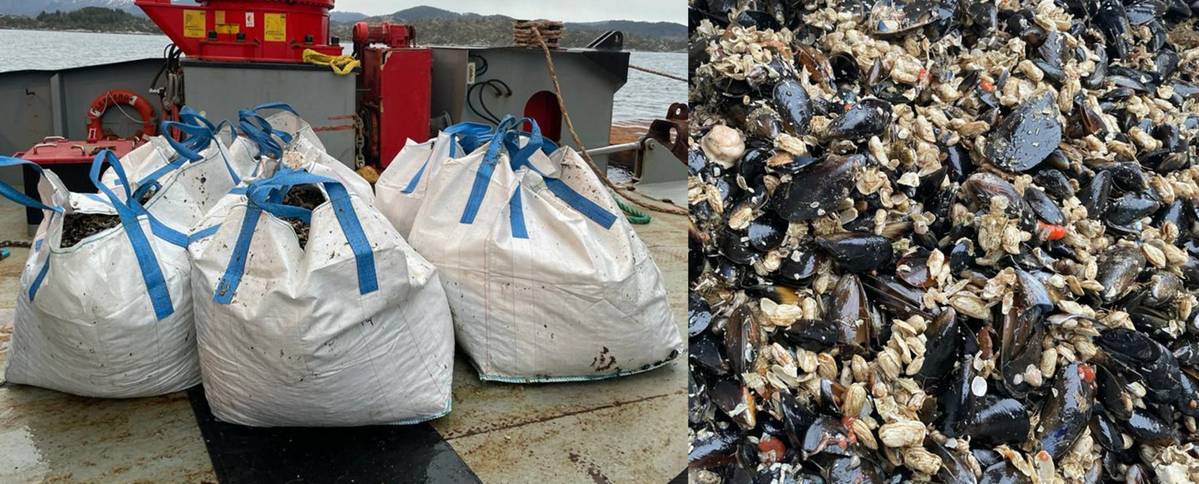
ECOSubsea’s heavy-duty ROV solution removed over 78 tonnes of fouling from the West Hurcules.
Image courtesy Seadrill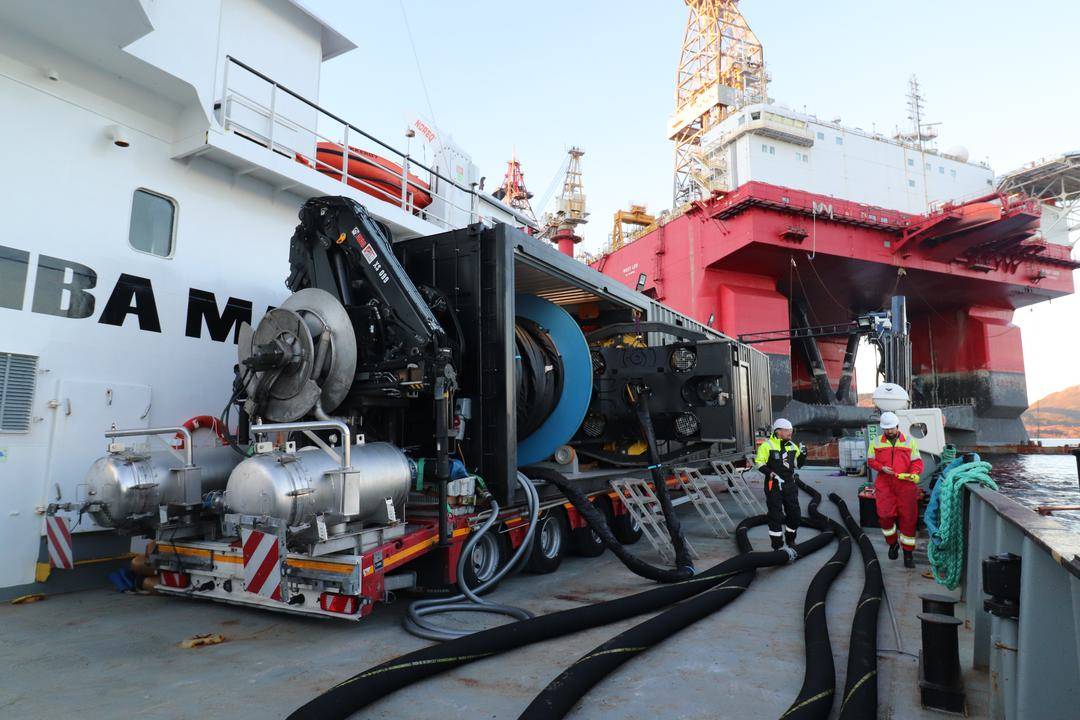
ECOSubsea’s heavy-duty ROV solution removed over 78 tonnes of fouling from the West Hurcules.
Image courtesy Seadrill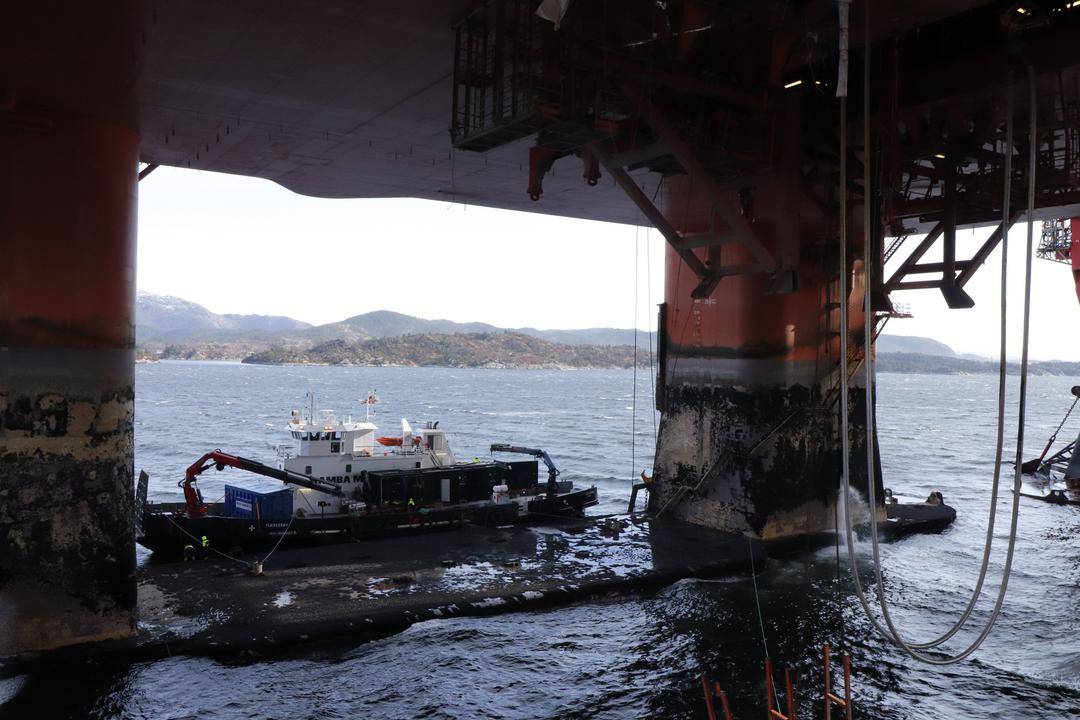
ECOSubsea’s heavy-duty ROV solution removed over 78 tonnes of fouling from the West Hurcules.
Image courtesy Seadrill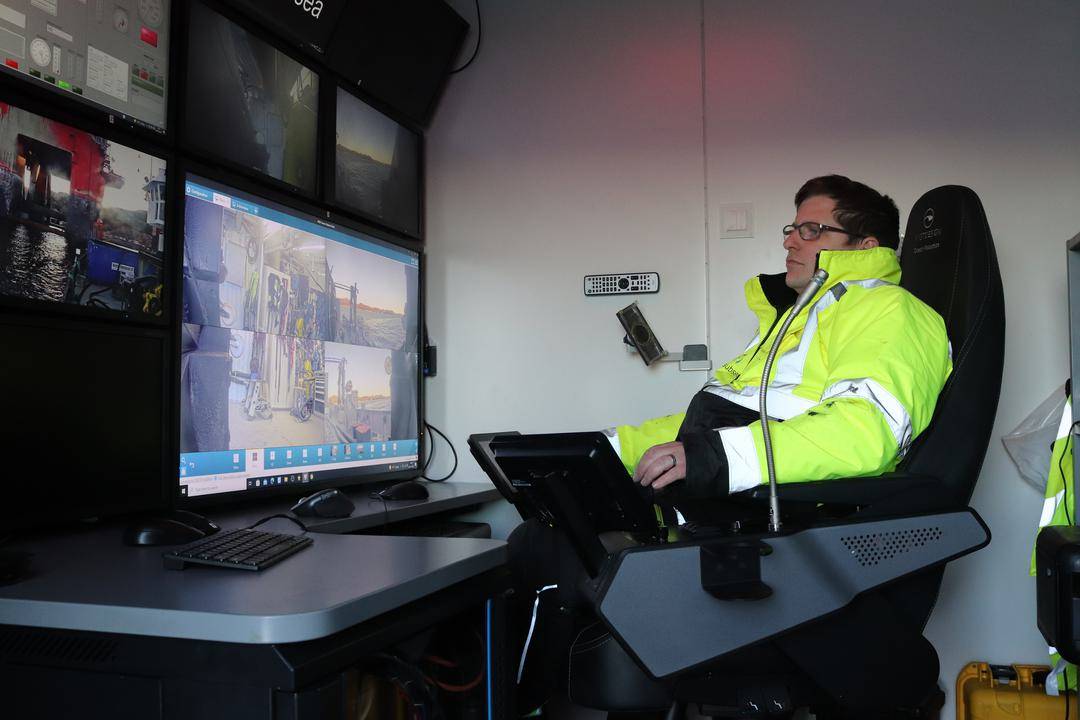
ECOSubsea’s heavy-duty ROV solution removed over 78 tonnes of fouling from the West Hurcules.
Image courtesy SeadrillEkløv is seeing increasing attention being paid to the invasive species risks of biofouling, but finance is also a concern. “If we have significant amount of marine growth on our hull and thrusters, this will impact fuel usage during transit and in operations but may also, under extreme cases, impact the performance of the vessel.”
The need for underwater inspections in lieu of dry docking (UWILD) drives biofouling management for static assets such as FPSOs. Mark Barnbrook, Technology Manager for FPSOs at SBM Offshore, says typically bands of conventional TBT-free self-polishing or polymer coatings are used on the hull. For sea chests, a silicone coating is used. “These are easy to clean, but very easily damaged, so they are not applied on the shell,” he says.
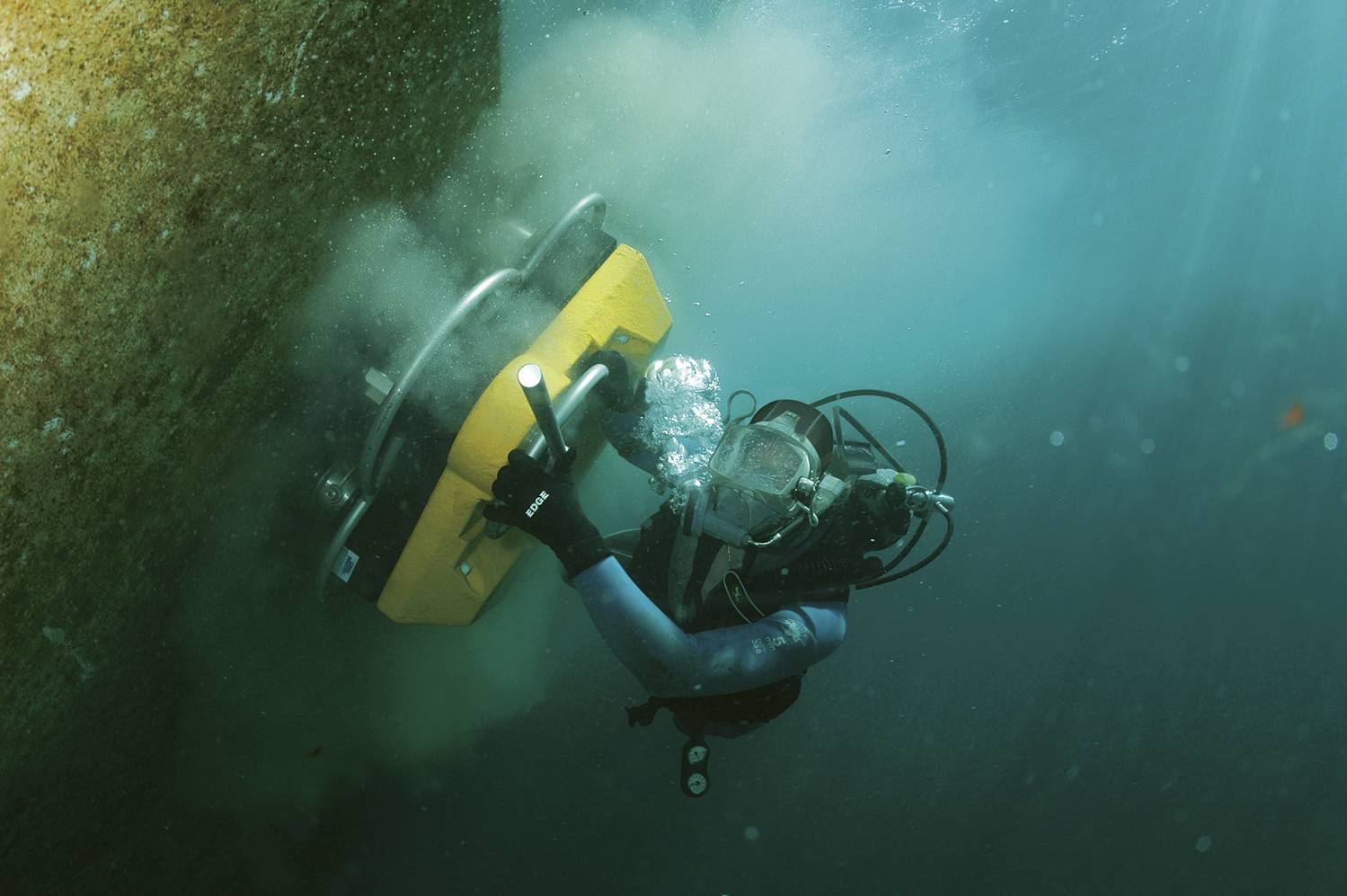
Inspections are typically done on fixed schedules of 2.5 or five years for FPSO conversions, but the company is moving towards risk-based inspections for its newbuild FPSOs. “Quite often we use high pressure water jets to remove biofilm,” Barnbrook says. “If you’re too severe with cleaning tools, then you start to damage the coating and risk corrosion.”
Image courtesy Hydrex
I've seen an FSO in Africa, which had been in the water for 13 or 14 years, and the ship’s bottom was completely perforated from stem to stern.”
- Boud Van Rompay,
Founder and CEO of the Hydrex Group
The root cause of corrosion is the use of coatings which are porous and fragile, says Boud Van Rompay, Founder and CEO of the Hydrex Group. “I've seen an FSO in Africa, which had been in the water for 13 or 14 years, and the ship’s bottom was completely perforated from stem to stern, straight through. And that was a 25-millimeter plate.”
Epoxy (polymer) coatings are very porous, he says. “That lets the water through, but also creates an opening for the secretions of the animal fouling. Their glues are very tenacious and they penetrate. They’re designed to penetrate because how do you cling to a rock?” This hard fouling cannot be removed without causing further damage to the coating, exposing more steel to corrosion. It is a vicious circle, he says. Van Rompay has found that impermeability can be achieved with a thick, glass-platelet reinforced vinyl ester coating.
Image courtesy Fugro
Marine growth cleaning campaigns are critical to our clients. They are often classified as priority 1 tasks when part of a larger campaign or scope, as they can uncover significant defects with their assets.”
- Dr. Stefania De Gregorio,
Principal Marine Ecologist at Fugro
The floating offshore wind industry faces some unique challenges. The diameter of mooring lines and dynamic cables are substantially smaller than those used in the oil and gas industry. Dr. Stefania De Gregorio – Principal Marine Ecologist at Fugro, says biofouling can cause fatigue life reduction, as it increases the effective mass of a structure without any significant change in stiffness, and hydrodynamic drag can be pushed beyond the original engineering design. Biofouling may also accelerate structure corrosion by creating oxygen depleted zones which then result in anodic sites by blocking compressed current distribution.
For cables on the seabed, biofouling may act as an added layer of insulation that prevents the cable from dissipating heat effectively. This creates a risk of overheating. Biofouling also affects multibeam and sonar surveys by signal attenuation and false bottom detection, says De Gregorio. Biofouling obscures a structure’s true dimensions in multibeam echosounder data and creates data gaps through shadowing effects.
Image courtesy PPG
Offshore wind platforms are typically uncrewed and remote, severely limiting the ability to perform regular inspections and maintenance.”
- Eric King,
PPG Global Segment Manager, Power & Mining, Protective and Marine Coatings
“Marine growth cleaning campaigns are critical to our clients,” she says. “They are often classified as priority 1 tasks when part of a larger campaign or scope, as they can uncover significant defects with their assets.” Having robust, site-specific data on the engineering effects of biofouling on submerged assets will allow action suited to the particular environment, she says.
Eric King, PPG Global Segment Manager, Power & Mining, Protective and Marine Coatings, contrasts offshore wind turbines with oil and gas platforms: “Offshore wind platforms are typically uncrewed and remote, severely limiting the ability to perform regular inspections and maintenance. This geographic and logistical isolation magnifies the impact of biofouling, as accumulation can go undetected and unaddressed for extended periods.”
And wind turbines are expected to operate for 35 years or more, much longer than the 25-year durability typically validated under current standards like NORSOK M-501 and ISO 12944-9. Operators therefore select advanced protective coatings for their performance across multiple stress factors including abrasion, corrosion, seawater immersion and mechanical impact.
"The splash zone is one of the most critical areas for offshore assets due to its complexity with fluctuating seawater levels and continuous exposure to seawater,” says Scott Kim, Global Solutions Manager for Wind Energy, Jotun Performance Coatings. This exposure can compromise the integrity of both offshore oil and gas rigs and wind farms. Coatings used in the splash zone must possess mechanical resistance properties that can withstand constant wave action and floating debris, as well as natural disasters like typhoons.
Image courtesy of Jotun
The splash zone is one of the most critical areas for offshore assets due to its complexity with fluctuating seawater levels and continuous exposure to seawater.”
- Scott Kim,
Global Solutions Manager for Wind Energy, Jotun Performance Coatings
“Cleaning in the splash zone is not a priority, as the focus is to equip assets with the right coatings to avoid corrosion – meaning less maintenance,” says Kim. “This is a proactive approach, which is proven over many years.” He cites as an example case where DNV inspected sections of jacket from a North Sea oil platform which was installed in 1972 and decommissioned in 2020. Jotun’s coating was applied to the platform in the late 1980s and, despite over 30 years’ exposure to the North Sea’s harsh environment, it was intact, still smooth and showing no signs of delamination.
If you don't have an asset that can last for a long, long time without maintenance, it is not really that sustainable, says Kim. “It is estimated that steel production is responsible for as much as 9% of global emissions, around 3.5 billion tons of CO₂ every year, so we are talking about a massive impact by just taking care of these assets.”