Autonomous Vessels
Military Spend Plans
Hybrid Navy Extravaganza
Technology companies and shipyards are vying for attention as the US unmanned navy grows in size and sophistication.
By Wendy Laursen
Saildrone has introduced Spectre, a 52-meter, 250 tonne USV capable of up to 30 knots.
Source: SaildroneNo too long ago, US Navy Secretary John Phelan said: “If the last few years of conflict have taught us anything, it is that we will not win the wars of the future with the platforms of the past.” The nation’s ability to deter future conflict or to prevail, if necessary, will benefit from high quantities of low-cost air, surface and subsea unmanned systems. These will be used for close-range reconnaissance or one-way strike missions along with lower numbers of high-cost sophisticated systems with surveillance and/or mid- to long-range strike capability.
Kraken Technology Group is one of many companies ready with solutions. Anduril will build the small, mass-producible K5 KRAKEN and K7 SABRE unmanned surface vessels (USVs) and integrate payloads and its AI-powered Lattice autonomy software in the US, configuring each vessel for the full range of Navy missions.
Blue Water Autonomy is one of many companies forming partnerships to scale production of USVs. The company recently introduced its Liberty Class, a 190-foot autonomous ship designed for the US Navy, currently under construction at Conrad Shipyard. It comes in support of the Navy's Medium Unmanned Surface Vessels program, the fleet's largest unmanned initiative with more than $6 billion of funding.
"Traditional shipbuilding doesn't scale, and pure software approaches don't deliver hardware," said Rylan Hamilton, CEO of Blue Water Autonomy. "We're doing both. Integrating proven marine systems with AI-driven manufacturing and operations to fundamentally rethink how ships are built. By distributing and parallelizing work across proven partners, we're creating a production system that can move at the pace required for a modern maritime industrial base."

Philip Lewis, Director of Research at Intelatus, sees the power of this approach taking hold around the world, with the US aiming to lead: “In the US, tech startups are raising billions of dollars, not millions, billions of dollars, and they are buying traditional shipyards. They are turning them into modern factories that are geared towards high production, low cost, rapid production.” He points to Magnet Defense’s acquisition of Metal Shark and Saronic Technologies’ acquisition of Gulf Craft as examples.
The U.S. 2026 budgets included a long-term forecast for fleet building until 2056 with a clear focus on medium USVs, says Lewis, after earlier spending on small vessels suited to intelligence, surveillance and reconnaissance. “The medium USVs are going to have modularized or containerized payloads, so basically swap in, swap out, and this could include rocket launching capability, surface to air, surface to surface or anti-submarine torpedoes.”
USVs are being built in large numbers and before the government places an order. “That means that there is probably going to be a few disappointed companies even though the US government has said it will buy multiple platforms.”

The risk is not deterring innovation. Among the new technologies emerging is Chaser and Comet USVs from BlackSea Technologies. Chaser is designed to expand payload capacity, range and mission flexibility while maintaining rapid deployability and ease of use (meeting the Navy requirement to fit in a 20’ shipping container). Comet is BlackSea’s larger, high speed combat ready platform, designed to bridge the gap between small tactical USVs and larger unmanned combat craft. The 13.1-meter vessel can exceed 45 knots, carry a 10,000-pound payload including fuel, and support advanced payloads for missions including counter drone operations, mine countermeasures, surface warfare, antisubmarine warfare, electronic warfare, maritime domain awareness and high value unit escort.
The Chaser launch highlights BlackSea’s work with key mission partners, including Lockheed Martin for the JAGM launcher, Echodyne radars for maritime domain awareness and high-fidelity threat targeting, Current for perception camera systems, and EOS Defense Systems USA for the gun system.

In April, HII announced plans for the production of four ROMULUS 151 vessels to be built by Breaux Brothers in Louisiana in addition to the ROMULUS 151 currently under construction. ROMULUS is a modular family of AI-enabled USVs designed to support a wide range of missions and to scale across multiple vessel sizes while maintaining a common manufacturing approach and autonomy baseline.
Earlier this year, Saronic released two new ASV models: the 40-foot Mirage and the 60-foot Cipher. The new vessels offer extended range and up to 10,000 pounds of carrying capacity. Mirage and Cipher join Saronic’s Spyglass (6’), Cutlass (14’), and Corsair (24’), as well as the recently introduced medium unmanned surface vessel, Marauder.
Leonardo DRS has selected Sea Machines Robotics new 8-meter USV developed for the defense market to demonstrate their maritime mission equipment package for counter-unmanned aerial system missions. Purpose-built for autonomous maritime patrols and interdiction, STORMRUNNER has a 40+ knot top speed, 700+ nautical mile endurance, and modular payload bay.


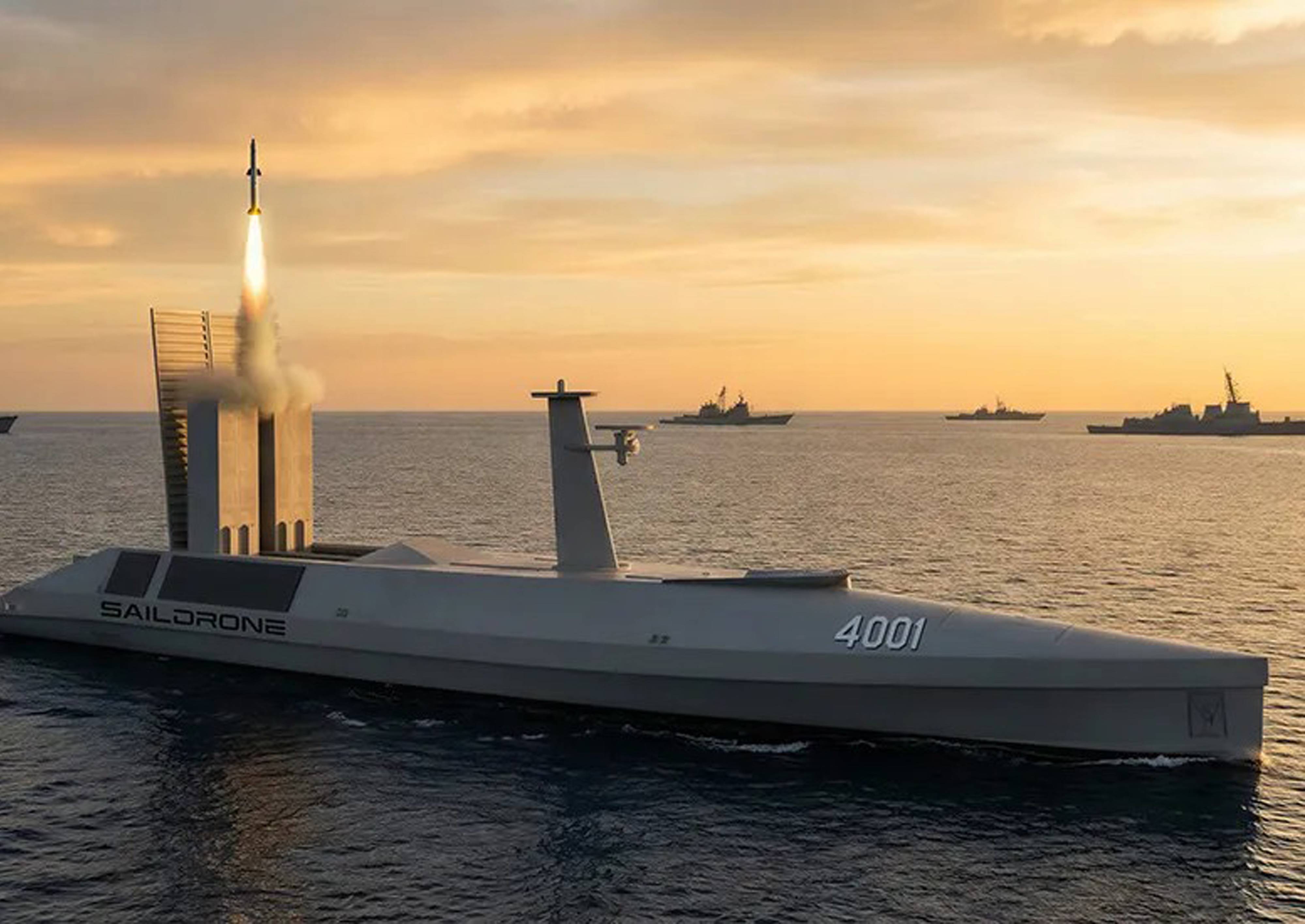


Saildrone has introduced Spectre, a 52-meter, 250 tonne USV capable of up to 30 knots.
Source: Saildrone
Saildrone has introduced Spectre, a 52-meter, 250 tonne USV capable of up to 30 knots.
Source: Saildrone
Saildrone has introduced Spectre, a 52-meter, 250 tonne USV capable of up to 30 knots.
Source: Saildrone
Saildrone has introduced Spectre, a 52-meter, 250 tonne USV capable of up to 30 knots.
Source: SaildroneSaildrone has introduced Spectre, a 52-meter, 250 tonne USV capable of up to 30 knots. Spectre is designed to deliver multi-mission operation above and below the surface. Fincantieri Marinette Marine will build the aluminum hull form at its Wisconsin shipyards which have the capacity to build five Spectre vessels per year. The vessel’s concealed payload deck provides room for dual 40-foot containers or up to five 20-foot containers. It allows easy deployment of payloads via the transom, while the bulwarks protect them from view and sea spray.
In the autonomous underwater vehicle (AUV) market, Cellula Robotics USA is delivering its commercial off-the-shelf, fuel cell-powered Guardian AUV under a contract awarded to Metron by the Defense Innovation Unit as part of the Combat Autonomous Maritime Platform initiative. The vehicle is designed for long endurance missions, with the ability to carry and deploy payloads at range. The company is collaborating with Schilling Robotics, Integer Technologies and General Dynamics Applied Physical Sciences to deliver the solution.
Innovation continues. Poseidon’s Forge has launched its DarkWake™ AUV, a flexible, mission-configurable platform. Engineered with a flooded architecture to reduce mechanical complexity, the platform is the first AUV to offer the option of an integrated solid-state battery technology outside a pressure tolerant housing, delivering improved safety using a solid electrolyte and higher energy density while contributing to overall system simplification and performance.
“Investment in unmanned systems is the new arms race,” says Lewis. “These systems are now being tested in combat, and this is drawing in a huge amount of capital from not just in the US, but Russia, China and in smaller navies around the world.”
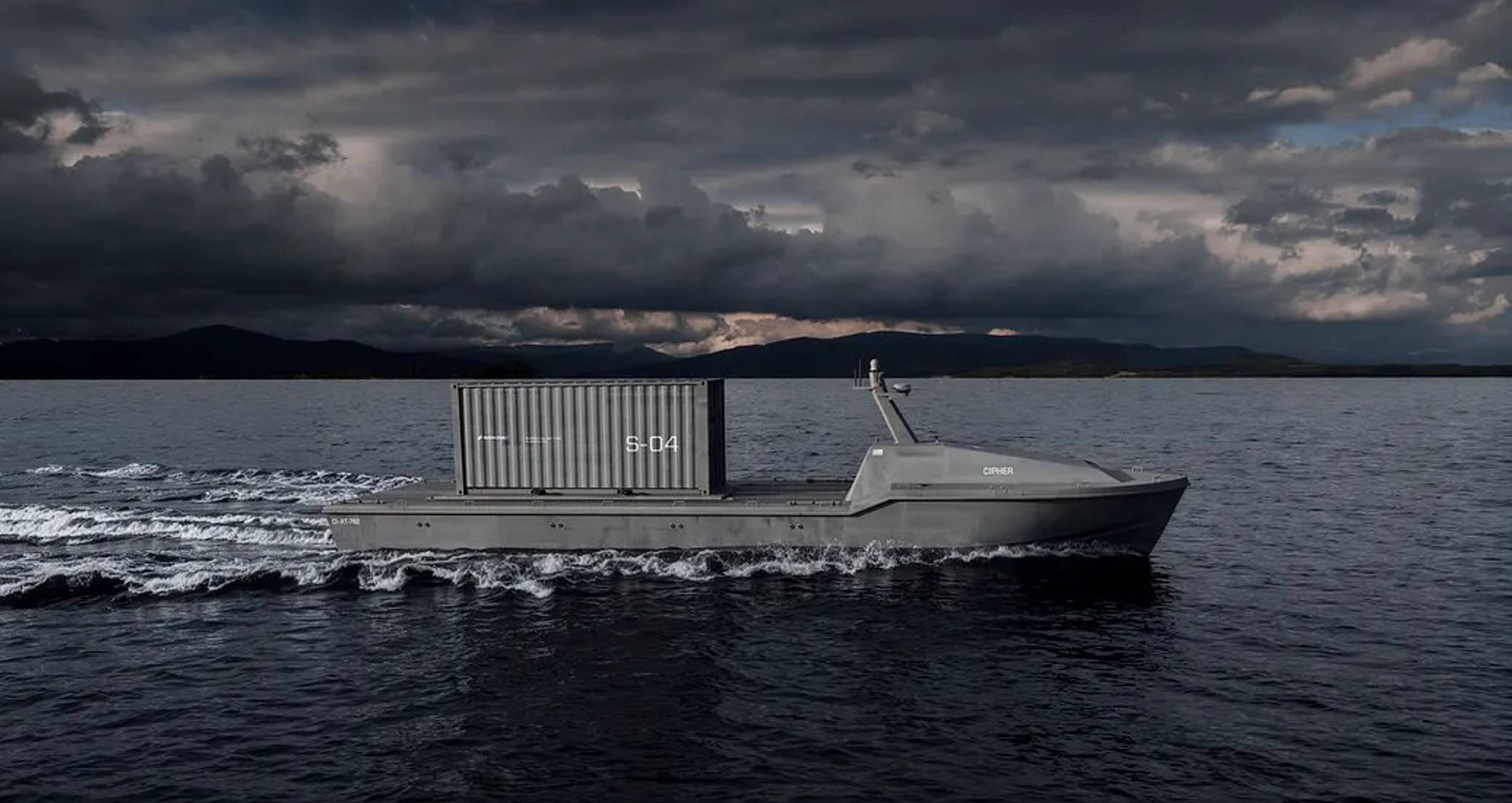


Saronic has released two new ASV models: the 40-foot Mirage and the 60-foot Cipher.
Source: Saronic
Saronic has released two new ASV models: the 40-foot Mirage and the 60-foot Cipher.
Source: Saronic
Saronic has released two new ASV models: the 40-foot Mirage and the 60-foot Cipher.
Source: Saronic