Tech Feature
Coatings & Corrosion Control
How Electrostatic Technology Moves from Experiment to Reality
By Bert Adema, Business Development Manager ESTA, PPG Protective & Marine Coatings
Shipyards face mounting pressure to align with the maritime industry’s decarbonization goals. As vessel owners and operators explore alternative fuels, better hull designs and route optimization to cut emissions, shipyards reevaluate their own practices to keep pace. One area of focus includes the coatings application. Among emerging innovations, electrostatic spraying is now gaining traction in global marine projects.
Unlike traditional airless spraying, electrostatic application (ESTA) charges paint particles and draws them to a grounded metal surface. The result proves a more even, precise coating with less rebound and significantly lower overspray. While the technology has seen wide use in automotive and aerospace applications, the marine environment poses challenges due to exposure, humidity and scale. That perception began to shift when a group of innovators applied it to a sailing vessel designed with sustainability in mind.
Innovation sparked by a sustainability challenge
The first major ESTA breakthrough came not from a large shipping line but from a small Dutch shipyard supporting a hydrogen-powered sailing vessel. The vessel’s project leader, a Dutch astronaut and engineer, approached a marine coatings company with a challenge. Could they apply a biocide-free hull coating with electrostatic equipment to reduce waste and improve sustainability?
The team saw the opportunity and worked with a small Dutch shipyard to build a semi-sheltered trial site. They borrowed equipment, tuned the air and pressure settings by hand and filmed the first trial using a phone. The footage revealed clean spray patterns, minimal rebound and strong adherence to the hull surface. The early test sparked internal interest and opened the door to more field trials.
The team collaborated with shipyards, applicators and technical partners to refine the technology for real-world conditions. They accounted for humidity, vessel size, changing weather and varying substrates. The process took time, but the results continued to validate the method. Of course, there were skeptics telling us it would never work in global yards, especially in China. Weeks later we got the first order to apply our premium hull coatings on five large commercial vessels. A recent project in Greece provides a clear example of how the method is now being applied at scale.
Case study: Electrostatic in Greek shipyard
ESTA is gaining momentum in shipyards around the world, from major yards in China to facilities across Europe. Following successful implementations, including results at EDR shipyard in Antwerp, where ESTA reduced overspray by up to 40%, shipyards are increasingly adopting the technology to improve coating efficiency and sustainability. Dynacom Tankers Management Ltd., a global manager of modern oil tankers with a fleet of 67 vessels, partnered with PPG to enhance the efficiency and environmental performance of its crude oil tanker Karolos during a dry docking at Skaramangas Shipyard in Athens, where PPG’s fouling release coating was applied electrostatically for the first time in Greece.
Using ESTA allowed charged coating particles to adhere evenly to the ship’s surface, creating an ultra-smooth, durable film while reducing overspray and material waste. The fouling release coating applied during the project delivers up to 20% power savings and up to 35% emissions reductions compared to traditional antifouling coatings, helping improve vessel efficiency and sustainability. The success of the project demonstrated the effectiveness of electrostatic coating application in the maritime sector and set a new benchmark for coating efficiency and sustainable dry docking practices in Greece.
Cleaner results for yards and crews
As demonstrated in these projects, ESTA can deliver measurable value to ship owners and shipyards when used under the right conditions. Compared with traditional airless application, it offers better control of film thickness and material usage while reducing overspray, masking requirements and emissions. Shipyards using the method also report higher material transfer efficiency, meaning more coating reaches the hull and less is lost to the air or dock floor.
Reduced overspray lowers masking and cleanup time, with some owners reporting up to 50% reductions in overspray and faster turnaround during dry dockings. To date, electrostatic application has been successfully completed on more than 250 vessels.
The future
Its rise reflects a broader trend in the marine industry. Shipyards increasingly adopt embrace solutions that improve sustainability, workforce safety and operational efficiency.
From the trial on a Dutch sailboat to full-scale projects in global shipyards, they have worked side-by-side with applicators, engineers and owners to prove what’s possible. Electrostatic application now plays a role in some of the world’s most advanced fleets, and it all started with a question no one knew how to answer.
About the Author
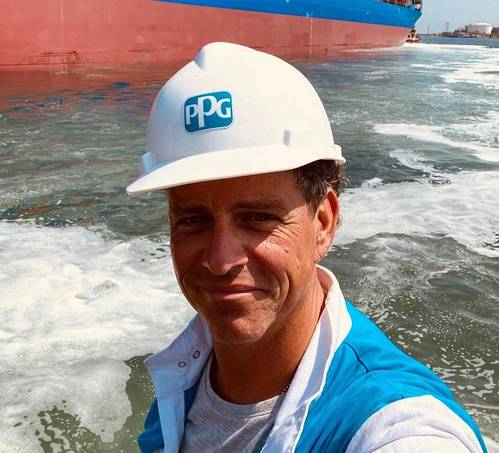
Bert Adema
Bert Adema is a PPG Business Development Manager, ESTA, for Protective & Marine Coatings. With more than 20 years in the marine coatings sector, he focuses on driving innovative application technologies and helping shipyards and owners optimize coating performance.