Digitalization
Watchkeeping
Time to Rethink Watchkeeping
It’s time to consider the role of “digital watchkeepers” as the become an increasingly complex tool for bridge teams.
By Wendy Laursen
Robosys Automation’s VOYAGER AI platform has continued to evolve, with enhancements in fully autonomous navigation, COLREGs-compliant collision avoidance, dynamic path planning and remote operation functionality.
Releasing its annual report in July 2025, the UK Marine Accident Investigation Branch said that significant collisions between merchant vessels show no sign of reducing. The collision between Scot Explorer and Happy Falcon, the fatal collision between Verity and Polesie and the dramatic and tragic collision of the Solong into the anchored Stena Immaculate indicate a need to radically rethink the role of human watchkeepers in the digital age.
Humans do not make good monitors and if under-stimulated they will find other things to occupy themselves, states the report, and humans can also be reluctant to utilize system functions that will alert them to impending problems.
The impact of human-technology interactions on the bridge has been a topic of research at ABB. Working at ABB’s Intelligent Shipping Program, Kalevi Tervo, Corporate Executive Engineer and Global Program Manager at ABB Marine & Ports, has worked extensively on developing autonomous ship control technology, including electronic lookout and autonomous collision avoidance.
“The more we work with the topic, the clearer it becomes that humans and automation are fundamentally different. So different that the International Convention for the Safety of Life at Sea (SOLAS) regulations’ demand for automation systems to deliver ‘equivalent or better’ performance than humans loses its meaning –at least on a function level,” he says.
Tervo was deeply involved in the Enablers and Concepts for Automated Maritime Solutions (ECAMARIS) project, led by VTT Technical Research Centre. The collaboration has deepened the understanding of what shipping does and does not need from automation.
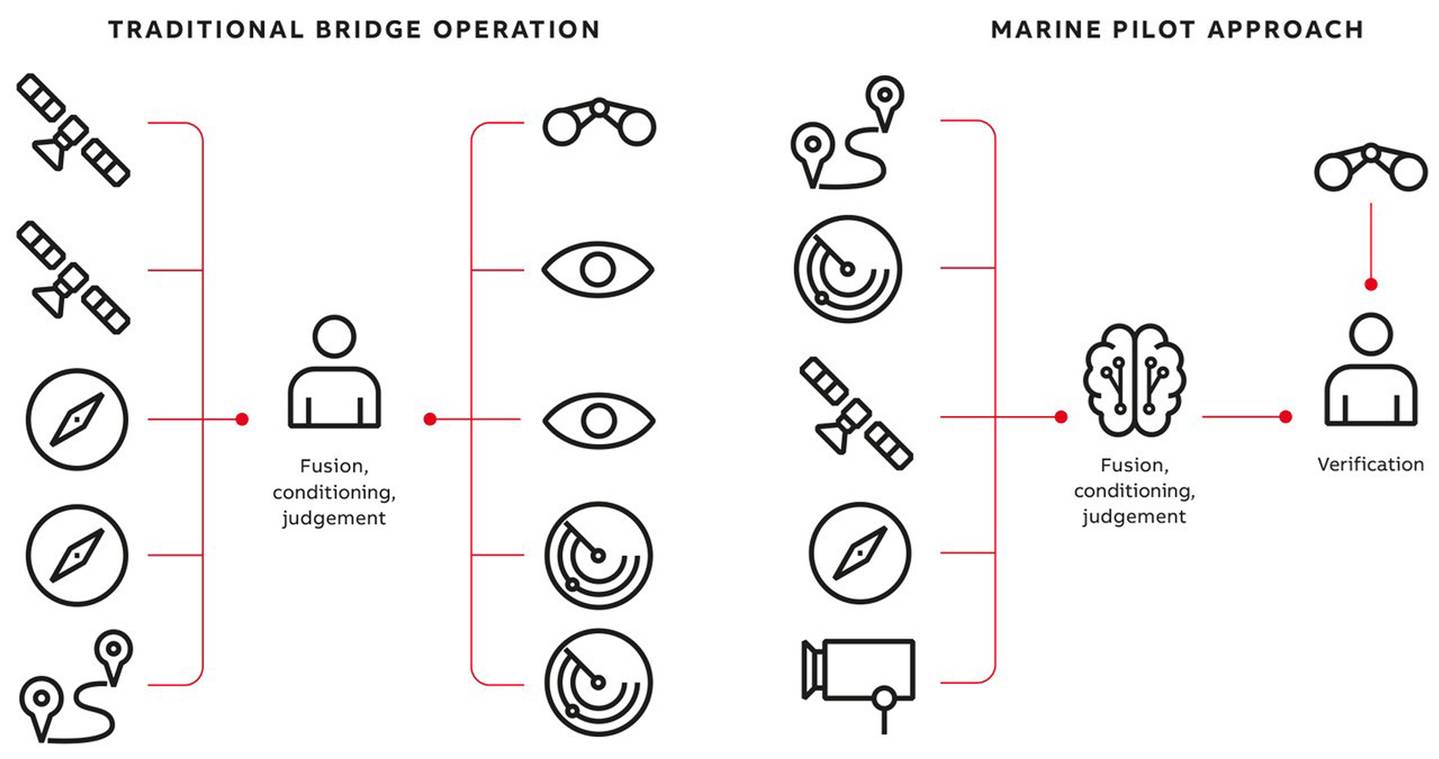
“While autonomous systems may seem easy to comprehend, the rapid advances in the introduction of automated functionality alongside human crew mean that the relationship between humans and technology is increasingly complex and fast-evolving,” Tervo says.
Extensive interviews conducted for the project confirmed what seafarers already know: effective operations rely on teamwork as well as technology. However, as Tervo observes, by focusing on specific roles, the testimony gathered for the project teased out how seafarers at the sharp end experience the impact of automation.
“When we automate part of the work that was previously done by a human, in one sense we create a ‘digital crew member’ to work relentlessly alongside the humans on board,” he says. “But automated systems always work within their operational envelope, while people don’t necessarily, or at least their operational envelope is harder to define.”
There is more to the role of the human lookout than simply relaying information to the OOW in an orderly fashion with the best possible accuracy, says Tervo. People also perform undocumented tasks, use initiative and take responsibility when they need to. While humans use formal procedures and hazard checklists to counter risk, they also look beyond the bullet points. A human may also decide that additional information is relevant that needs passing on.
“A human bridge team will have a common understanding of what the ship is going to do – the passage plan, the navigational hazards, the weather forecast and the traffic ahead,” says Douglas Owen, a Human Factors Consultant at Risk Pilot and project participant. “But circumstances change and challenges arise that take the attention of the OOW, at which point the human lookout might step in to compensate to maintain safety margin. A digital crew member of that caliber would need to be very sophisticated indeed.”

Instead, the operational envelope filled by the electronic lookout will be of most use when little is changing – for example during good weather on open seas. For human crew, fatigue and/or boredom can result in mistakes or oversights during these long hours of inactivity.
This is the “automation sweet spot,” says Tervo, when the capabilities of the electronic lookout, the operational safety imperative and opportunities for crew rest coincide. In such circumstances, the bridge could be unattended on a conditional basis.
Trust is a key issue with the adoption of a growing range of digital systems. In July last year, Anschütz developed an automatic collision avoidance system, but beyond the technological innovation, Anschütz placed strong emphasis on gathering user feedback and fostering acceptance of the autonomous navigation system's functionality and decision-making processes.
More than 250 collision scenarios were validated in high-traffic, narrow waters such as the Kiel Fjord to confirm the reliability of the system. The results were consistent: target detection, situation analysis, risk visualization, trajectory calculation, confirmation and integration functions all performed excellently, said the company.
The technology needed to support autonomous operation is developing rapidly. Robosys Automation’s VOYAGER AI platform has continued to evolve, with enhancements in fully autonomous navigation, COLREGs-compliant collision avoidance, dynamic path planning and remote operation functionality. In 2025, the company retrofitted the VOYAGER AI autonomy suite into a 26-metre Damen crew transfer vessel for offshore wind operations. The project marked Robosys’ first major entry into the offshore renewable energy sector, demonstrating practical deployment of autonomous navigation and remote-control capabilities in demanding industrial environments.

Nigel Lee, Chief Strategy Officer at Robosys Automation, emphasizes the need to build trust across the industry – seafarers, ship managers, flag states and insurance companies. Working with Australian Maritime College, the company has used their bridge simulators to conduct trials that compare human voyage course setting to that of the VOYAGER AI system – with the participants asked to identify which ones were set by humans. Each had different reaction times or more appetite for risk, so the paths chosen were all a little different. “The AI choices were in the middle of the pack, with the humans showing the more extreme behaviors,” says Lee. “This sort of exercise is building up trust: ‘Oh, this software is behaving the same as we behave.’”
With autonomous operation still in its infancy, industry developments are benefiting human operators. In January, SEA.AI partnered its computer vision with BRNKL's monitoring platform for maritime incident detection to enable objective post-voyage review. In November 2025, Orca AI has launched Co-Captain which enables vessels to share data with each other, in real time, to enable them to be better prepared for emerging risks such as non-AIS targets, high traffic, GPS interferences and severe weather. In October 2025, NAVTOR and Risk Intelligence released a real-time maritime security risk system layered on to electronic charts. This, say the companies, will allow navigators and relevant shore-side teams to plan and understand voyages with safety and simplicity.