Digitalization
Cost Management in the Fuel Transition
Fuel Transition: Emissions Targets and Cost Management
ClassNK’s Fleet Cost Simulation service is reducing the heavy burden on shipping companies attempting to estimate the costs of transitioning to low- and zero-emission operations.
Over more than two decades, regulators have worked towards providing the frameworks within which low- or zero-carbon fuels, energy efficient ship design, operational data and new technologies can support maritime decarbonization. Over that time, it is fair to say that there has often been tension between shipping’s agreement in principle to tightening regulation and its cost concerns.
Certainly, estimating the cost of switching to greener operations has become an increasing focus in budgeting, whether relating to alternative fuels, ROI on energy saving devices or other emissions-related measures. Accurate analyses will allow companies to assess the feasibility of particular decarbonization solutions and to evaluate total cost of acquisition in the context of potential impacts on charter and freight rates. This is valuable information which can be shared with clients and other supply chain partners.
As Hiroyuki Watanabe, Green Transformation Center, ClassNK, explains: “Fleet deployment planning and cost management are expected to become more complex than ever. Due to the progressive strengthening of the IMO’s mid-term measures, regulatory costs are expected to rise year by year, surpassing fuel costs in the 2030s.”
Market Value
Understandably, developing predictive models to accommodate such a broad range of factors is complex, and involves extensive number-crunching and data integration. For instance, shipowners face overlapping emissions regulations, including the IMO mid-term greenhouse gas (GHG) restriction measures and the Europe-focused EU ETS and FuelEU Maritime frameworks – each incorporating different methodologies and timelines.
Making accurate, long-term cost calculations is also a challenge for fleets that incorporate various trade routes and vessel types (including purpose-built newbuilds and retrofitted ships), and especially for those that rely on vessel pooling arrangements to meet FuelEU Maritime requirements.
Adding to these complexities, shipping companies may find themselves ‘guesstimating’ outcomes related to volatile and unpredictable factors such as fuel prices, emission behaviors (for example, methane slip in LNG engines), or even regulatory measures. And while they may wish to decarbonize in principle, doing so may not look compelling in any given financial year if profitability or attracting new investment are at risk.
In consequence, Mr. Watanabe highlights: “The ability to use specific fuels and the relative efficiency of ship performance are likely to become key determinants of market value. From an investment perspective, companies are increasingly evaluated based on the clarity of their decarbonization strategies, and such evaluations may in turn influence ship prices and financing conditions.”
Calculating Costs
To help shipping companies reduce the heavy workload of cost estimation and compliance analysis, ClassNK has rolled out its Fleet Cost Simulation service to estimate the financial impact of GHG regulations including the IMO's mid-term GHG fuel intensity measures, EU ETS and FuelEU Maritime.
Launched in July 2025 as part of its ClassNK Transition Support Services, ClassNK emphasizes that the Fleet Cost Simulation package is compatible with all vessels, regardless of classification society registration. Already, the tool has been put to use by many shipping companies, shipyards, and cargo owners, with its cost analysis applied to over 200 vessels. The service has also secured recognition from an independent panel of judges through a ‘Best Project Innovation Award’ at Saudi Maritime Awards for its contribution to industry in facing challenges including sustainability and zero emissions. The Fleet Cost Simulation service includes two core components.
-
The first is the Fleet Cost Calculator, an Excel-based tool that simulates total costs, including cumulative future expenses, for individual vessels or entire fleets. Cost structure information is visually produced in easy-to-read graphs, to simplify GHG intensity analyses and cost comparisons between vessels that burn conventional and alternative fuels. The Fleet Cost Calculator also allows users to adjust inputs such as vessel cost, fuel prices, vessel replacement schedules, energy efficiency improvement rates, fuel consumption levels and GHG conversion, for more personalized cost forecasts. As the Fleet Cost Calculator is Excel-based, users can access it while working offline, or during connectivity drop-outs. In addition, ClassNK continually refreshes the tool with updates on evolving regulatory changes, to maintain its relevance.
-
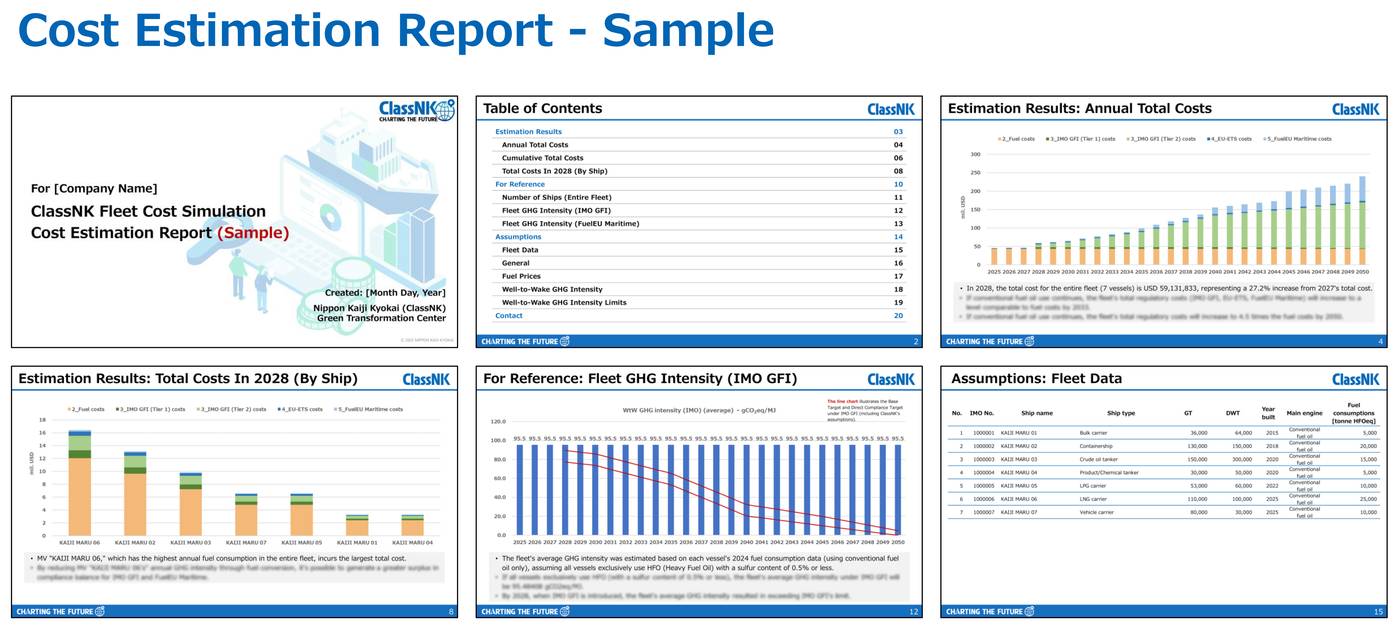
The second core component of the package is the Cost Estimation Report tool, which provides a clear visual summary of the fleet's total cost outlook up to 2050, using graphs and tables based on actual fuel consumption data. This feature accounts for cost drivers such as shipbuilding and fuel overheads, plus compliance with IMO, EU ETS and FuelEU Maritime measures. Reports are delivered in PowerPoint format, making them ideal for internal presentations and management team reports. Users can also request an advanced, customized version of the Cost Estimation Report feature that simulates different fuel transition timings and strategies in a bid to optimize costs. The service offers not only shipowners and operators but also shipbuilders and charterers the means to extract actionable, fleet-specific data that can optimize their business strategy while removing the headaches associated with cost forecasting for the greener future. In addition, ClassNK points out, its use reduces the workload required to evaluate the viability of achieving green goals.
“It will be important for stakeholders to develop a clear view of the cost implications of achieving a smooth transition to lower and zero-emission fuels, so that they can maintain competitiveness as they stay ahead of regulatory requirements,” Watanabe said. Fleet Cost Simulation provides an adaptable ROI-based point of departure.