Maritime Power
Batteries
Battery Breakthroughs at Sea: The Next Wave of Maritime Electrification
By Michael Kei, ABS Vice President, Technology
Shipowners and operators are accelerating the search for propulsion solutions that combine regulatory compliance, operational efficiency, and commercial viability. Amid a sea of alternative fuel contenders, the latest ABS Sustainability Outlook 2025, Beyond the Horizon: Vision Meets Reality, casts a spotlight on how one technology reshaping both portside and deep-sea operations – the marine battery.
Currently, most marine battery applications are hybrid configurations. This reflects inherent limitations in energy density—battery weight and volume can significantly reduce cargo capacity on deep-sea vessels. Additional challenges include the absence of charging infrastructure to support long voyages. As a result, hybrid systems represent the most practical solution for deep-sea operations in the near term.
Looking further ahead, full electrification could become feasible as technology and infrastructure mature. Potential enablers include modular battery-swapping solutions and the development of extensive shore-side charging networks at ports along major trade routes.
Beyond its origins in short-sea ferries and harbor craft, battery-electric propulsion is now making inroads into long-haul, deep-sea shipping. What was once dismissed as an auxiliary solution is increasingly being viewed as an important pillar of the future maritime energy landscape.
Electrification Anchors the Decarbonization Agenda
According to ABS, vessel electrification is one of the most viable and rapidly deployable decarbonization pathways available to shipowners today. Despite questions over chemistry, energy density, and lifecycle economics, battery systems deliver immediate environmental and operational advantages.
Hybrid and fully electric systems are already proving their worth in the short-sea segment, delivering up to 30 percent reductions in greenhouse gas emissions in hybrid configurations and complete elimination of emissions for short-range all-electric operations. In hybrid setups, battery systems provide power redundancy, stabilize load fluctuations, and support load-following strategies, collectively cutting operational fuel costs.
The environmental dividends extend beyond carbon. Electrified vessels operate with lower radiated noise, reduced particulate emissions, and fewer moving components, which translates into lower maintenance and longer equipment life. For port cities dealing with air quality concerns and noise constraints, these co-benefits make batteries an attractive proposition for both shipowners and local governments.
From Niche to Necessity
ABS’ 2025 Outlook presents compelling data showing that maritime battery adoption is no longer a niche activity. Installations on deep-sea vessels from cargo ships to offshore support vessels, are rising steadily, with installed capacity growing year-on-year since 2011. The numbers point to a structural shift: batteries are evolving from experimental add-ons to essential components in vessel design.
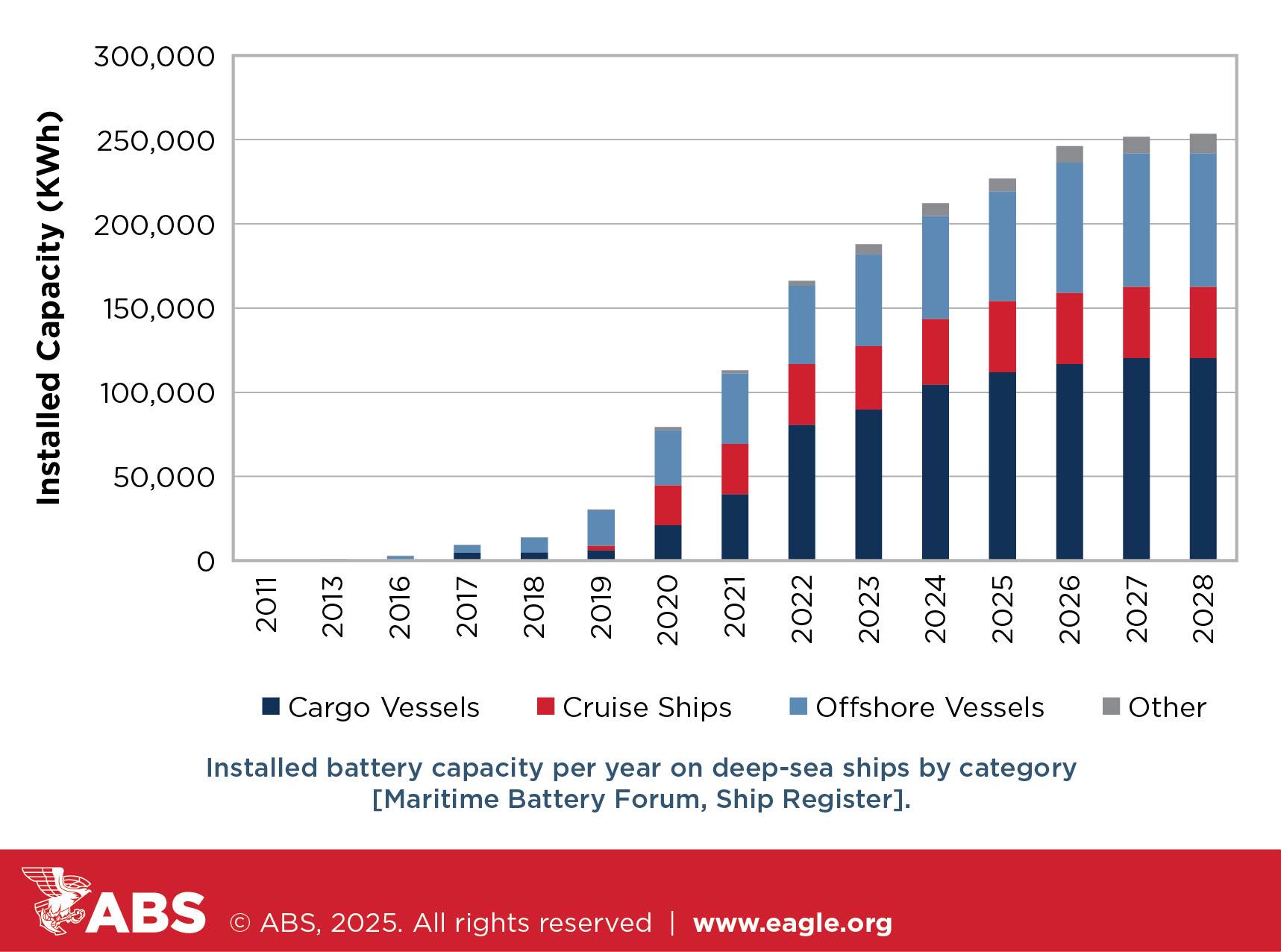
ABS highlights several drivers behind this growth:
-
Safety and redundancy: Batteries provide critical backup power and enhanced system reliability.
-
Operational efficiency: Batteries enable load balancing and peak shaving, improving energy use and reducing engine wear.
-
Environmental performance: They deliver measurable cuts in greenhouse gas and pollutant emissions.
These advantages explain why, despite the limitations of current lithium-ion technology, batteries are increasingly viewed as a necessity to maritime decarbonization; not just as an endpoint, but as an enabler of fully electric and hybrid systems and emerging fuels such as hydrogen, methanol, and ammonia.
Engineering Realities: Energy Density Meets Economics
The leap from coastal to deep-sea electrification, however, remains a formidable challenge.
Today’s marine-grade lithium-ion batteries offer energy densities in the range of 0.25 to 0.3 MWh per cubic meter. For a large container vessel undertaking a long-distance voyage, the total energy demand typically reaches several thousand megawatt-hours, far exceeding the few hundred megawatt-hours required for short-range operations. At present energy density levels, meeting this requirement would necessitate thousands of cubic meters of battery volume and several thousand metric tons of mass, introducing substantial design and operational constraints.
It is important to recognize that a vessel’s total energy requirement is influenced by multiple factors, including ship size and type, cruising speed, operational profile, depth of discharge, and redundancy provisions for safety. These variables can significantly alter the overall energy demand.
Although battery-electric propulsion for long-range shipping is technically feasible, the associated weight, space, and cost implications render it impractical under current technological and infrastructure conditions.
The deep-sea sector’s diversity, spanning containerships, bulkers, cruise ships, and offshore units, means that the business case varies across vessel classes. “Developing compelling business cases for each sector remains a formidable task,” but not an insurmountable one, the report concludes.
Designing for Diversity: Matching Batteries to Missions
A central theme in ABS’s analysis is the importance of operational profiles in determining the right battery technology. The choice between high-energy and high-power batteries depends not only on the voyage duration but also on how and where the vessel operates, and the safety systems that are integrated with the battery technology.
Short-sea ships benefit from high C-rate batteries capable of rapid charge and discharge cycles, ideal for peak load conditions such as manoeuvring or docking. Long-haul vessels, by contrast, require low C-rate batteries optimized for slow, steady discharge over extended durations. However, these require longer charging times, prompting ABS to recommend redundant cascading systems that can maintain power reliability during prolonged operations.
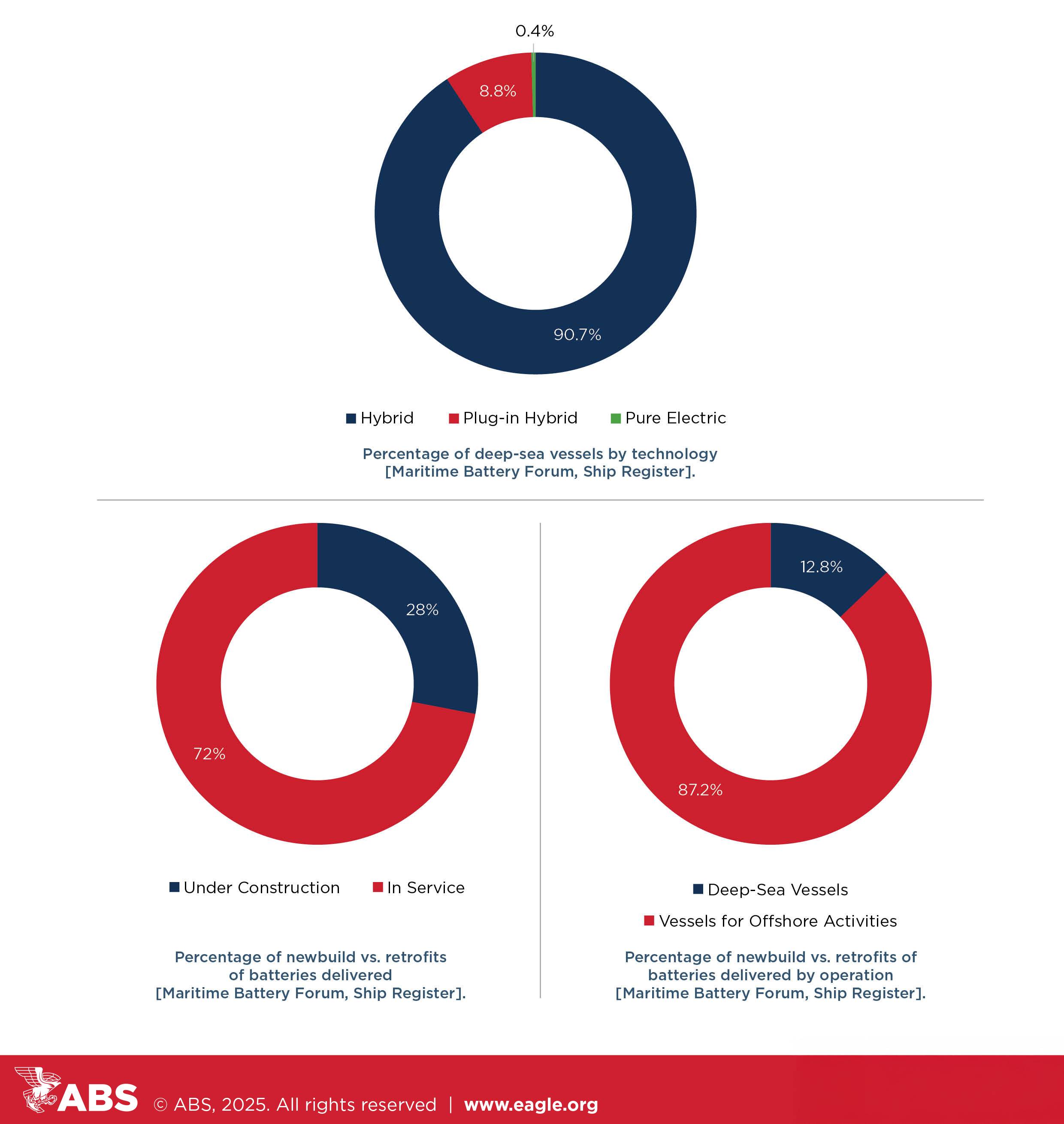
Regional differences also play an important role. The emergence of “electrification corridors” particularly in Northern Europe, East Asia, and parts of North America, reflects a growing alignment between ship electrification and port infrastructure investment. The availability of Onshore Power Supply (OPS) and fast-charging capabilities has become a key determinant of where and how battery-electric shipping can expand.
The Infrastructure Imperative
Even as battery technologies mature, the report cautions that progress could be hampered by fragmented infrastructure and regulatory inconsistencies. While the International Maritime Organization (IMO) and IACS offer overarching guidance, a patchwork of national and Class society regulations still complicates global adoption.
ABS identifies several critical regulatory gaps:
-
Lack of standardized rules for battery integration across Classification societies.
-
Uneven OPS standardization across EU and non-EU ports.
-
Limited OPS infrastructure in developing and emerging markets.
-
Gaps in crew training and safety protocols for handling high-energy systems.
The report recommends accelerated harmonization of standards and proactive regulatory updates to reflect emerging technologies which is an essential step for investors and promoting global scale-up.
Lessons from the Front Lines
While the deep-sea transition is just beginning, ABS points to valuable lessons from more than 50 global battery-electric vessel deployments to date. Successful projects share several common features:
-
Modular battery architectures that allow for scalable integration across different vessel types.
-
Load-following strategies that enhance fuel efficiency by 10–20 percent during variable demand phases.
-
Strong regulatory and financial support for OPS adoption, particularly in regions like Scandinavia and Canada.
-
Early stakeholder engagement and crew training , which have proven critical to safety and operational success.
Case studies from Norway, Canada, and China demonstrate that coordinated collaboration between shipowners, yards, technology providers, and regulators, yields faster learning curves and better outcomes. Norway’s ferry electrification program, for example, has become a global benchmark for short-sea decarbonization through battery integration, driving down both emissions and operating costs.
Innovation on the Horizon
Technological innovation continues to redefine what’s possible. Advances in solid-state batteries, novel lithium-ion battery systems, and emerging sodium-ion chemistries promise to raise energy density, charge faster and improve thermal stability. Integration innovations such as hybridization with alternative fuels or renewable onboard generation, could make deep-sea electrification more economically feasible within the next decade.
The potential of hybrid architectures that blend batteries with alternative power sources, can create flexible, resilient propulsion systems capable of balancing efficiency with endurance. These designs not only cut emissions but also enable the adoption of emerging fuels as they become commercially available.
A Call for Collective Action
Perhaps the most important message in ABS’ Beyond the Horizon: Vision Meets Reality is that electrification’s success depends as much on governance as it does on technology. “Harmonization and updated standards are essential to accelerate adoption,” ABS emphasizes. Without coordinated frameworks, investment in battery systems and supporting port infrastructure risks stalling at the pilot stage.
The report makes clear that the battery revolution is not a question of “if,” but “how fast.” Hybrid-electric systems are serving as bridges to future fuels. In this sense, batteries are not competing with alternative fuels, they are complementing them, providing the flexible backbone for a multi-fuel maritime ecosystem. From supporting zero-emission port calls to stabilizing hybrid powertrains, the electrification of shipping is fast becoming a cornerstone of the next-generation fleet.