Ship of the Year
R/V David Packard
R/V David Packard
By Celia Konowe
R/V David Packard.
Credit: Freire ShipyardIn 2010, the Monterey Bay Aquarium Research Institute (MBARI) began the process of replacing its research vessel, R/V Western Flyer. With Glosten at their side as vessel designer, MBARI considered three types of ships for their new project. The Western Flyer was a small waterplane area twin hull (SWATH), but the parties agreed on a monohull design for the new vessel. In 2021, Freire Shipyard won the bid to build the vessel, and R/V David Packard came to life.
There is no “I” in Team
Will Moon, who's been at Glosten for more than 20 years, spent the past three at Freire's site in Spain, first as design lead of the David Packard, and later as project manager during the construction period.
Luis Santos Orden, technical manager at Freire Shipyard, also boasts more than two decades with the shipyard. He served as production manager for the first 13 years, working with all research vessels built there, including the David Packard. He supported the vessel at all production phases, especially during critical periods like commissioning and trials.
Projects of this size require significant trust, Moon explained. Conflicts can become confrontational when not handled in a collaborative manner. "That was really my focus as an onsite owner-supervisor, to make us all one united team. The MBARI-Glosten collaboration had developed mutual trust, so now we had to roll the shipyard into that broader team. For any problem that came about, the focus was, how do we work together here to solve this and give MBARI the best vessel possible?"
Classification society Det Norske Veritas (DNV) also played a significant role in delivering the vessel with frequent onsite inspections. "The collaboration between Glosten and Freire was incredible, and even though there was a significant geographic and time difference in between, it was easier than some past projects," said Santos Orden. "This was also our first time working with the U.S. Coast Guard, and they supported us in adapting and understanding each internal process, as well as the DNV rules."
"When all three parties have the same target and they speak the same language, technically speaking, it is easy to reach a final agreement," he added.


The David Packard.
Credit: Freire Shipyard
Keel laying.
Credit: Freire Shipyard
Construction of the David Packard.
Credit: Freire Shipyard
Construction of the David Packard.
Credit: Freire ShipyardDesign Requirements
R/V David Packard, aptly named after MBARI's late founder, had enormous shoes to fill, with demanding technical capabilities and scientific research goals. At its core, the vessel needed to be able to launch and recover MBARI's six-ton remotely operated vehicle (ROV). But MBARI was also looking for broader purpose scientific capabilities, like launching and recovering autonomous underwater vehicles (AUVs), conducting mooring deployments off the stern, and collecting conductivity, temperature and depth (CTD) measurements.
"The ROV requires a very large hangar. It requires a winch below the main deck, which has 5,000 meters of one-inch diameter umbilical on it. It requires a huge control room with a whole bank of monitors and a pilot, a co-pilot and a chief scientist to sit there and run it. It's a huge operation and a huge investment in the capability of the vessel," said Moon. "I like to say when you're designing a tugboat, you first figure out how big the engines need to be to do the project? And then I wrap a boat around that. And in this case, it's how big does this whole launch and recovery system (LARS) and the winch need to be? Where does that need to go in the vessel? And then everything else fits around that whole thing."
The result is nothing short of epic.
The vessel weighs about 1,200 tons and is 50 meters long and 12.8 meters wide. It is diesel electric, with two main azimuth propulsors at 500 kW. The power plant is based in a DC grid package supplied by ABB with three gensets of 640 ekW. Transit speed is typically around 10 knots but varies during research activities. Range is about 4,000 nautical miles and the vessel can stay out at sea for up to three weeks with 30 people on board, eating, sleeping, living and working.
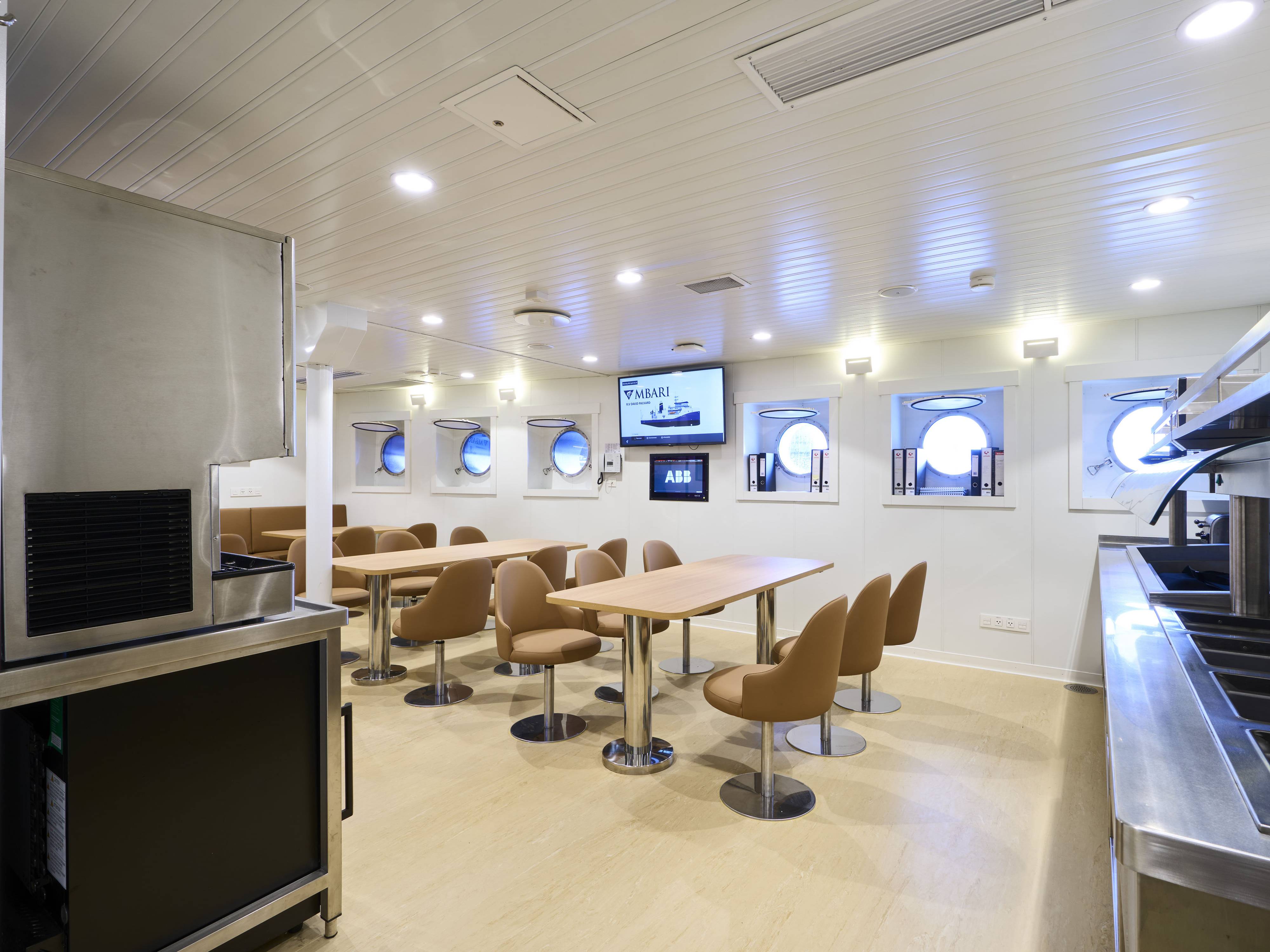
"The vessel arrangement is divided into machinery and technical spaces below the main deck where the engine, drive, auxiliary machinery, main winch, stabilizers and forward thruster rooms are distributed, as well as other technical areas," explained Santos Orden. "The main deck is where working and common spaces are distributed. In the aft, there is a full beam working deck with an A frame. The deck is prepared to store and attach containers or other loose equipment. Moving forward, in the center of the main deck, is the hangar, surrounded by the different equipped laboratories: wet lab, auxiliary lab and ROV control room. Then, galley, mess room and provision stores are placed forward."
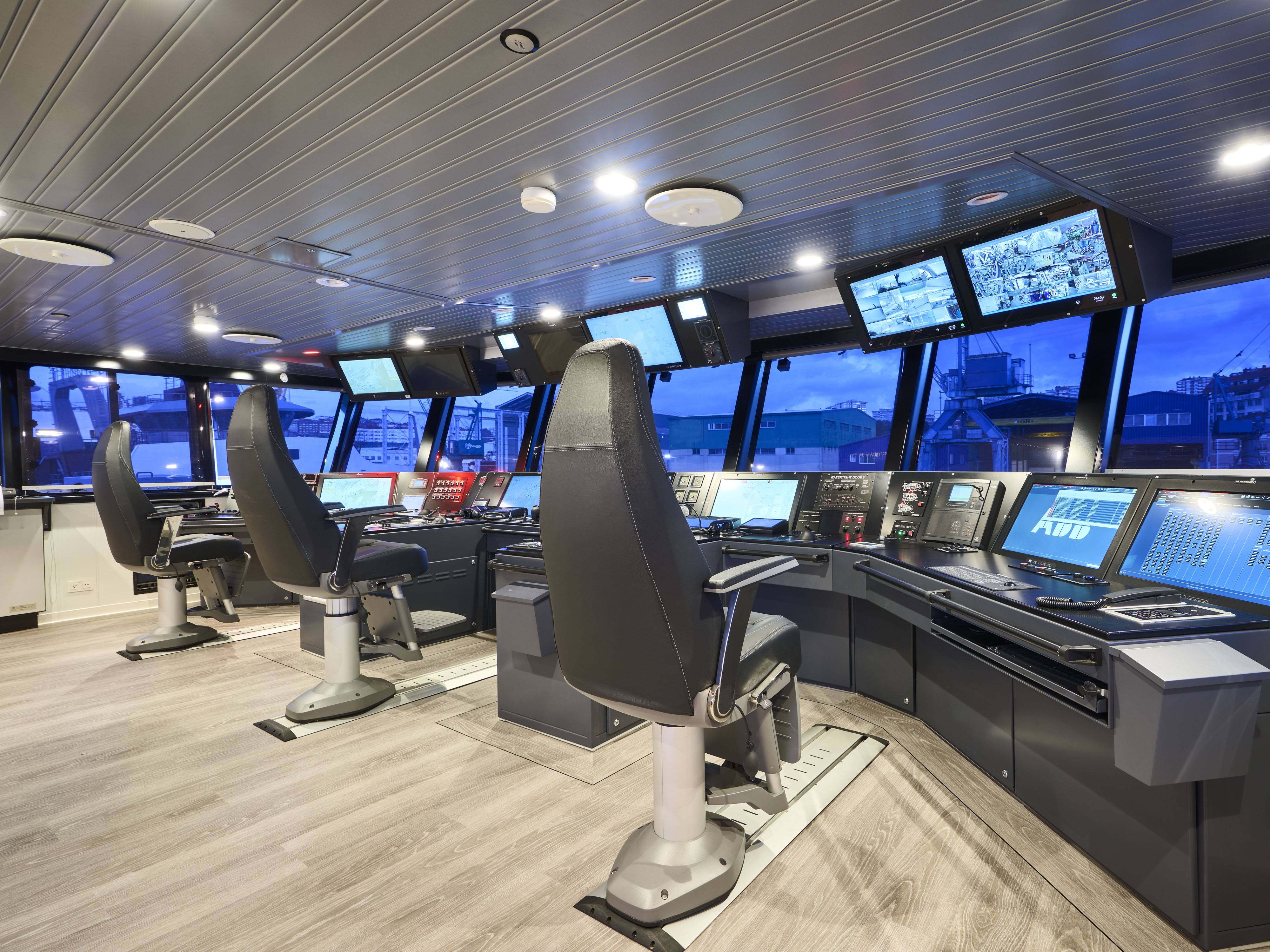



Kongsberg supplied the vessel’s integrated navigation system.
Credit: Freire Shipyard
A trio of AN D 2862 LE427(IMO Tier III) generators.
Credit: Freire Shipyard

Living spaces onboard the David Packard.
Credit: Freire Shipyard
Living spaces onboard the David Packard.
Credit: Freire ShipyardWithin two decks of accommodation, there are also the CTD winch and frame, a winch control room, the main crane, rescue boat and emergency genset. Above this is the pilot house with the main console and 360-degree vision.
"Several things about the vessel are unique," added Santos Orden. "First, the hull shape developed by Glosten, which had great results during sea trials in terms of efficiency and bubble sweep down — the latter of which is very important for the scientific bottom equipment installed. Then the LARS system, supplied by MacGregor, which is integrated with a winch and 5,000 meters of data cable. Additionally, a stabilizer system allows a more comfortable platform, which is unusual in these types of vessels."


Meeting the Challenges
Building of the David Packard was not without its challenges. Construction of the vessel fell squarely within the COVID-19 pandemic, posing organizational and supply chain problems. Additionally, the intensive equipment integration and commissioning, which was longer and harder than previous vessels built by Freire, tested the organizations involved.

The grandest challenge, however, was including all necessary technical capabilities into a vessel that would fit in MBARI's harbor, Moss Landing. "They have a very shallow entrance into the harbor, and then their pier sits a certain distance from the channel. The vessel was really constrained in length, in breadth and in draft. We had to push the limits of that confined box," explained Moon.
"I asked multiple times during the design, can I make this boat five meters longer? Can I make it wider or deeper? They said, no, no, no, that's it. At some point, you have to find balance between capability and what the client wants. As boats get tighter and tighter, they get more and more expensive and more difficult to construct. So, I was there every day with Freire, trying to figure out, okay, this one piece of equipment is larger than it was supposed to be. Now it doesn't fit. How do we deal with that? It was a good experience for me to see; I got to see my mistakes firsthand."
The vessel also faced equipment failure early on, with all three alternators requiring replacement. Nonetheless, the vessel arrived at MBARI in March and promptly deployed, with a few missions under its belt to date.
Vision Fulfilled
Despite a bumpy start, R/V David Packard has had a dedicated support team since day one. "In this kind of project, you can be sure that you will face challenges. Full confidence between the different actors is crucial. Of course, this confidence must be earned with knowledge and good workmanship, but it's rare to find such a good and easy collaboration with full transparency," Santos Orden said.
"For me, seeing the vision that I drew on that original napkin come to life after a decade was super powerful and a wonderful experience," added Moon.
From napkin to delivery, David Packard is well on its way to living up to its namesake and carrying MBARI into the next generation of ocean research.
R/V David Packard Main Particulars
| Ship Name | R/V David Packard |
| Flag | USA Flagged, SOLAS Special Purpose Ship |
| Ship Type | Research Vessel |
| Ship Builder | Freire Shipyard |
| Ship Owner | Monterey Bay Aquarium Research Institute (MBARI) |
| Ship Designer | Glosten |
| Delivery Date | March 2025 |
| Classification | DNV |
| Length (o.a.) | 164 ft. (50 m) |
| Breadth | 42 ft. (12.8 m) |
| Depth (molded) | 18.5 ft. (5.65 m) |
| Draft (designed) | 12 ft. (3.65 m) |
| Speed | 10 knots cruise, 12 knots max |
| Complement | 30 (12 crew + 18 scientists) |
| Endurance | 21 days |
PROPULSION
| Type | Diesel electric propulsion (DC-Grid) |
| Propulsion Package | ABB |
| Propulsion | 2 × Azimuth thrusters SCHOTTEL SRP 260L FP |
| Bow Thrusters | ZF AT 3011 RT FP D Retractable tunnel thruster |
| Propellers | 2 × Schottel, 4 blade, 5’-9” dia, NiBrAl |
| Main Generators | 3 × MAN D 2862 LE427 (IMO Tier III) |
| Emergency Generator | 1 × CATERPILLAR C7.1 (163 ekW @ 1800 rpm) |
| Stabilizers | 2 × QUANTUM MAGLIFT ML380 (retractable) |
ELECTRONICS
| Integrated Navigation System | Kongsberg |
| Weather fax receiver | FURUNO FAX-410 |
| Radio direction finder | RHOTHETA RT-300 |
| Barometer | AIRMAR 120WX |
| Dynamic Positioning | KONGSBERG K-Pos DP12 |
| Ultrasonic Wind Sensors | Gill |
| MF/HF radio w/DSC Class A | SAILOR 6310 |
| VHF radio w/DSC Class A | 3 × SAILOR 7222 |
| Mini-C GMDSS w/SSAS & LRIT | 2 × SAILOR 6110 mini-C |
| Navtex | SAILOR 6391 |
| Emergency radio beacon | TRON 60S |
| Radar transponders | 2 × TRON SART 20 |
| UHF ATEX portable phones | 4 × SAILOR SP-3965 |
| UHF portable phones | 14 × Motorola R7A UHF |
| UHF Repeater | Motorola SLR5500 |
| Iridium Certus L-Band | INTELLIAN C700 |
| Cellular signal booster | Stella Doradus |
| Cellular modem | DIGI |
| CCTV | PELCO |
| Batteryless telephone system | ZENITEL |
| PA & GA system | ZENITEL |
| Automatic telephone system | ZENITEL |
CAPACITIES
| Fuel Oil | 160.77 m³ |
| Lub Oil | 1.35 m³ |
| Hydraulic Oil | 2.22 m³ |
| Fresh Water | 29.20 m³ |
| Ballast Water | 150.30 m³ |
| Black / Grey Water | 1.89 m³ / 11.14 m³ |
DECK EQUIPMENT
| Electric driven CTD winch | MacGregor HW515T90, 6650 m of cable 8.18 mm Rochester A301592 |
| Electric driven ROV winch for AHC |
15 T traction winch (TRW-4004E-L1) Combined Level Wind + Slack Wire Compensator Storage drum: 5000 m Fibron 20 mm umbilical Slipring: Focal 176/291 |
| Stern A-frame | MacGregor, 100 kN with 170° stroke |
| ROV LARS (Crane) | MacGregor 200 kN, max ROV weight 6 t |
| CTD davit | MacGregor |
| Knuckle boom crane | MacGregor 2.5 T SWL @ 13.6 m |
LAB EQUIPMENT
| Pure & ultrapure water purification | MERCK MILLI-Q IQ 7005 |
| Fume Hood | FRONTIER ACELA |
| Low safety cabinet (NFPA30) | ASECOS |
| Upright freezer −86°C (729 L) | PANASONIC |
| Refrigerator +5°C (651 L) | THERMO FISHER |