The Future
Digitalization Meets Decarbonization
MSC’s Decarbonization at Scale
How the World’s Largest Boxship Fleet Is Squeezing More Miles from Every Molecule
It’s trite (but true) to say that in the maritime industry’s quest to cut emissions, there is no ‘silver bullet’ solution, rather a series of small step changes that cumulatively add up over time. Maritime Matters: The Marinelink Podcast, recently hosted Giuseppe Gargiulo, Head of Newbuildings, MSC and Daniel Bischofberger, CEO, Accelleron, to specifically discuss the development and delivery of Accelleron’s FITS2 technology, and automation technology built with MSC and premised on Accelleron’s cumulative 100+ years of turbocharger experience. While the focus of the tech talk was FITS2, both leaders shared with Maritime Matters a much broader look inside MSC – its current fleet of 900 ships with 120 more on order – and how it balances and rationalizes the integration of new technology on newbuilds and existing ships to help meet ever tightening emission reduction goals.
By Greg Trauthwein
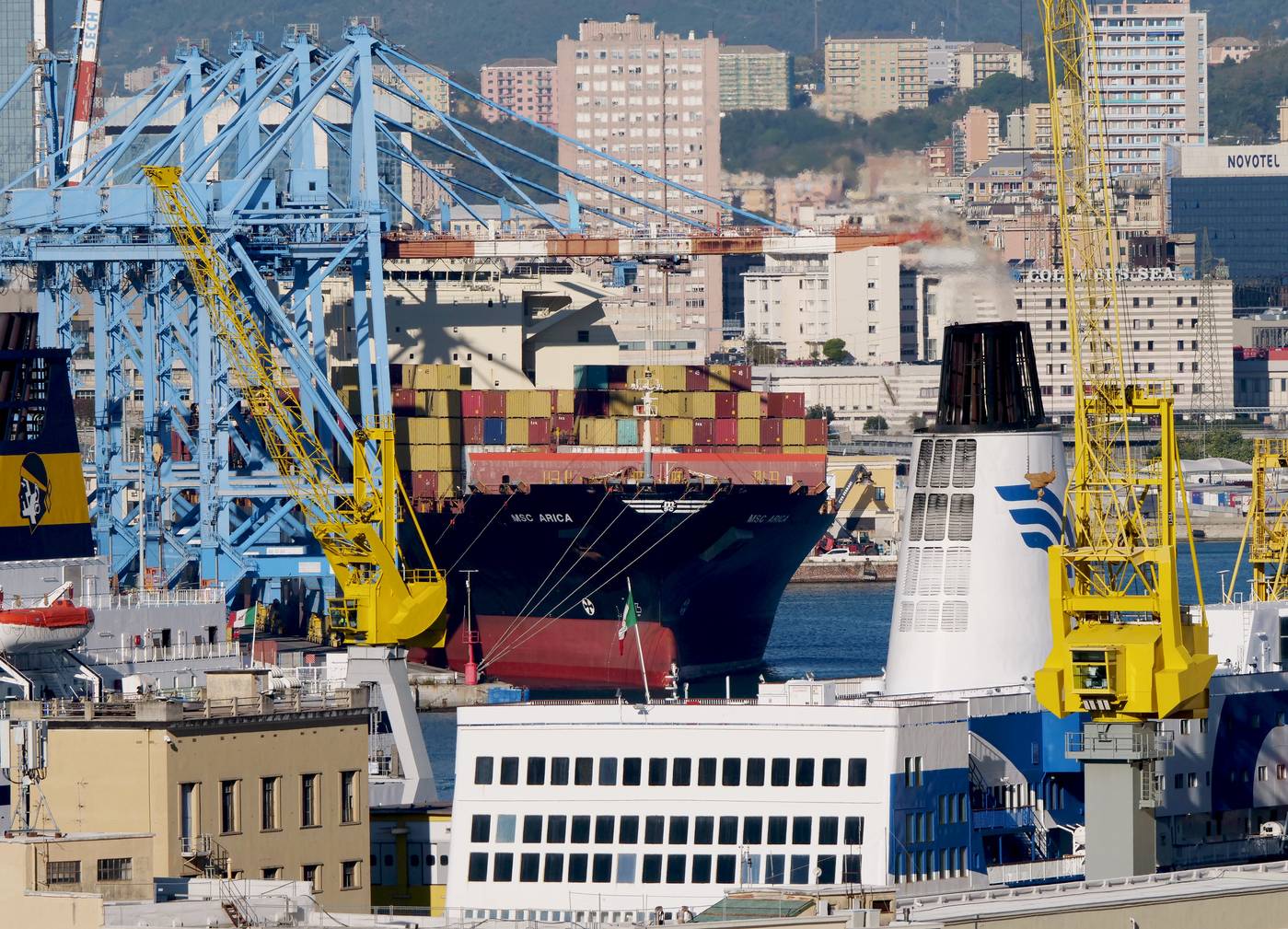
In an era where liner shipping must deliver more with less—less fuel, less carbon, less cost—Mediterranean Shipping Company (MSC) is attempting something few carriers can match: decarbonization at true global scale. With a network touching 520 ports in 155 countries, more than 300 liner services, and a fleet that Giuseppe Gargiulo, MSC’s Head of Newbuildings, characterizes as ~900 vessels with 120+ newbuilds in the pipeline, the company’s margin for error is thin and its ambitions outsized. Gargiulo leads the carrier’s fleet renewal and decarbonization program, a twin-track strategy that treats retrofit and newbuild pathways as inseparable parts of the same equation: every technical decision must raise existing ships closer to the performance of the newest deliveries.
A System View
Gargiulo frames MSC’s program as a systems optimization problem rather than a single-technology bet. The company has pursued a rolling campaign of mechanical upgrades (reprofiled propellers and rudders, engine tuning), electrification measures (shaft generators, variable-frequency drives), and hull/air-drag reductions (advanced coatings, superstructure streamlining). MSC couples this with operational profile management—slow steaming where it works, speed-ups where it pays—and a heavy investment in digitalization so that real-time data informs real-time decisions.
Crucially, he points to documented peaks of up to ~40% CO₂ reduction on specific ships after structured retrofit packages and operating-model changes. That headline number doesn’t rest on a single lever; it’s the sum of many. And because trade lanes and demand patterns are volatile, MSC insists on flexibility: optimization must hold under different speeds and routes, not just on a model voyage.
Image courtesy MSC
With a fleet of about 900 ships and 120 newbuilds on the way, MSC is fanatical about ship efficiency optimization. Gargiulo leads the carrier’s fleet renewal and decarbonization program, deploying multiple technologies and operational management to get the job done. ”
- Giuseppe Gargiulo,
Head of Newbuildings, MSC
Fuel Strategy: Invest for Today, Prepare for Tomorrow
On fuels, MSC’s stance is pragmatic and sequential. The carrier is adding a large tranche of dual-fuel LNG vessels now, Gargiulo says more than 150 ships will be dual-fuel capable, because LNG is available today, reduces regulated pollutants immediately, and provides a path to bio-/e-LNG blends that lower lifecycle carbon without redesigning the ship. At the same time, newbuild specifications are future-fuel ready (tank volume, segregation, safety systems) for ammonia or methanol if/when safe, scalable and economical supply chains emerge.
The logic is straightforward: don’t wait for a perfect fuel that may not be widely available this decade; bank certain emission reductions now and keep options open for the next step. For a fleet of MSC’s size, that optionality is an insurance policy against regional fuel availability constraints and the risk of stranded asset configurations.
Gargiulo is plain about it: retrofit is strategic.
The aim is to “level” legacy ships toward newbuild performance. That’s not just about sustainability optics; it’s a business imperative. Every day a vessel is out of service to install new tech is a day of lost revenue, and often a day that must be “paid back” later with higher speeds (and higher fuel burn). MSC therefore prioritizes interventions that fit into normal port stays and deliver measurable savings against known operating profiles.
That requirement shaped MSC’s collaboration with Accelleron, the Swiss-listed turbocharging and engine-optimization specialist (spun out of ABB in 2022). Accelleron brings a century of turbocharging heritage (dating back to Alfred Büchi’s 1905 patent), ~3,000 employees, 100 service stations in 50 countries, and, critically, a portfolio aligned to efficiency: turbochargers, fuel injection, and digital performance solutions. CEO Daniel Bischofberger notes that Accelleron has been expanding into dual-fuel fuel-injection systems (with new capacity investments) and voyage/plant optimization (via acquisitions), because “efficiency is the fastest path to decarbonization—and it will matter even more when carbon-neutral fuels arrive at a higher cost.”
Image courtesy Accelleron
Don’t let perfect be the enemy of good. There’s no silver bullet that works for every route and every decade. Start now; let efficiency go viral.”
- Daniel Bischofberger,
CEO, Accelleron
FiTS2: Small Kit, Big Leverage
The flagship of the MSC–Accelleron cooperation today is FiTS2—Flexible Integrated Turbocharger System for two-stroke engines—a retrofit that automates turbocharger cut-out at low and part loads. Many owners know the older, manual flap systems: they promise savings by improving scavenge pressure and boosting efficiency when the main engine runs below design load, but they also demand highly disciplined operation and regular attention to avoid sticking or improper settings. In practice, human-factor variability often erodes the theoretical gains.
FiTS2 solves for that variability. Accelleron designed the system to:
-
Automate cut-out engagement/disengagement based on actual engine condition and load, not guesswork—so the bridge can change speed for weather or security without reconfiguring machinery.
-
Include a self-exercise “gymnastics” routine on the flaps (during safe windows) to prevent sticking and reduce maintenance snags over time.
-
Install during normal port stays—not drydock—using a compact scope: some piping, compressed air, a few pneumatic valves, a small control unit, software integration, and class approval. Accelleron’s global network of 500+ trained service engineers handles the work where the ship trades.
The result is a crew-light, set-and-forget intervention that aligns with MSC’s operational reality. Bischofberger pegs the typical outcome at up to ~4% fuel savings and roughly 1,000 tons of CO₂ avoided per ship per year (vessel-dependent), with payback in ~1.5–4 years. There are on the order of 2,000 global candidates — two-stroke main engines with two or more Accelleron turbochargers — that could benefit.
From MSC’s perspective, the value is threefold. First, the savings are predictable, because the automation ensures the system works the same way every day, ROI modeling is math, not hope. Second, no schedule disruption: the retrofit fits container-terminal choreography. Third, the benefits are compounded in today’s regulatory stack: fuel saved improves CII grades, reduces EU ETS exposure, and supports FuelEU Maritime compliance.
Digital as a Force Multiplier
Underpinning the hardware is a data backbone. Gargiulo stresses that real-time operational data lets MSC automate and tune, monitor KPIs, and correct drift quickly. Accelleron’s recent digital expansion — voyage optimization, advisory from seasoned mariners — recognizes that data alone doesn’t create value; embedding insights into decisions does. For owners without MSC-sized technical organizations, packaged analytics plus consultancy closes that gap and accelerates adoption.
MSC’s newbuild cadence is relentless, and Gargiulo says the company is taking five to eight vessels per month at times, including 16,000-TEU classes such as the MSC Nerano delivered from Hanwha Ocean. The recipe: lock in proven energy-saving devices, specify dual-fuel engines and future-fuel-ready arrangements, and leverage design simplifications that make autonomous efficiency more repeatable. On the machinery side, Accelleron is evolving the platform as well; the new X300-series turbochargers pursue not just peak thermodynamic performance but serviceability, cartridge concepts that allow overhaul during a port stay rather than waiting for the next drydock window.
Lessons Learned
Both leaders offer pragmatic counsel to peers. Gargiulo believes IMO 2030 targets are achievable by applying today’s measures at fleet scale. Waiting for a perfect fuel is a losing strategy; instead, sequence your steps: adopt the proven (propulsion/hull/plant upgrades), retrofit the easy wins that pay back quickly (FiTS2, EPL optimization, digital performance), and specify optionality into new tonnage. He is blunt that decarbonization is not a trade-off between “green” and “profitable”, the two are linked when you pick measures with logical paybacks and minimal operational disruption.
Bischofberger adds that speed of adoption is the limiting factor, not the availability of useful technology. Efficiency upgrades reduce CO₂ and future fuel bills—especially critical as carbon-neutral fuels arrive with higher production costs. His parting line: “Don’t let perfect be the enemy of good. There’s no silver bullet that works for every route and every decade. Start now; let efficiency go viral.”
MSC’s decarbonization program is notable not because it bets on a single headline technology, but because it threads dozens of proven levers through one of the industry’s most complex operating networks, and insists each lever be installable, automatable and bankable. The partnership with Accelleron around FiTS2 exemplifies the ethos: small kit, big leverage, and no disruption to the sailing schedule.
In a market where capacity is rising and demand looks patchy, fuel efficiency is the carrier’s best hedge, against both costs and carbon. For MSC, squeezing more miles from every molecule is no longer an experiment. It’s the operating system.

Watch the full Maritime Matters: The MarineLink Podcast featuring Giuseppe Gargiulo, Head of Newbuildings, MSC and Daniel Bischofberger, CEO, Accelleron discussing the connection between digitalization, fuel economy and emission reduction.
FiTS2 FAQ
FiTS2 optimizes engine fuel consumption at part and low load while maintaining the flexibility to go to full engine output immediately.
By increasing the efficiency of your engines, we help you reduce fuel consumption, costs, greenhouse gas emissions, and air pollution for the lifetime of their operations