Vessels
AL ZUWAIR

On August 18, the liquefied natural gas (LNG) carrier Al Zuwair was completed and delivered at the HHI Ulsan Shipyard of HD Hyundai Heavy Industries Co., Ltd. (HHI). The vessel will be deployed under a time-charter contract with QatarEnergy, one of the world's largest LNG producers. Al Zuwair is the third of 12 new LNG carriers being built for QatarEnergy by a joint venture comprising NYK, Kawasaki Kisen Kaisha, Ltd., MISC Berhad, and China LNG Shipping (Holdings) Limited. This delivery marks the first of these vessels built at HHI. Al Zuwair also represents the first instance in which the NYK Group will provide ship-management services for the consortium. The ship is powered by two X-DF 2.1 iCER engines, highly fuel-efficient dual-fuel engines capable of using fuel oil and boil-off gas as fuel. Additionally, the vessel is equipped with an air lubrication system and a reliquefaction device that effectively uses surplus boil-off gas. These innovations promote efficient navigation and help reduce greenhouse gas (GHG) emissions, thereby minimizing environmental impact.
WILLIAM E MORAN

William E Moran recently entered service in New York, the first vessel in Moran’s next-generation class. Built by Master Boat Builders in Coden, Alabama, and designed by Robert Allan Ltd., the William E Moran belongs to the RApport 2800 series. It is an ASD Tractor tug engineered for high-performance escort and ship assist ops. Measuring 92 x 40 ft., it delivers more than 80 metric tons of bollard pull.
William E Moran is ABS Escort-rated and powered by Tier IV Caterpillar 3516E engines, producing a combined 6,770 hp. It is LEV (Low Emission Vessel) certified, significantly reducing NOx emissions and supporting Moran’s long-term sustainability goals. The tug features twin Z-drive propulsion units for enhanced maneuverability and operational precision. The vessel includes expanded accommodations, improved working spaces, and modern on-board systems, as well as a fully integrated Rose Point Electronic Chart System (ECS) for precision navigation and Starlink satellite connectivity.
SEVERN
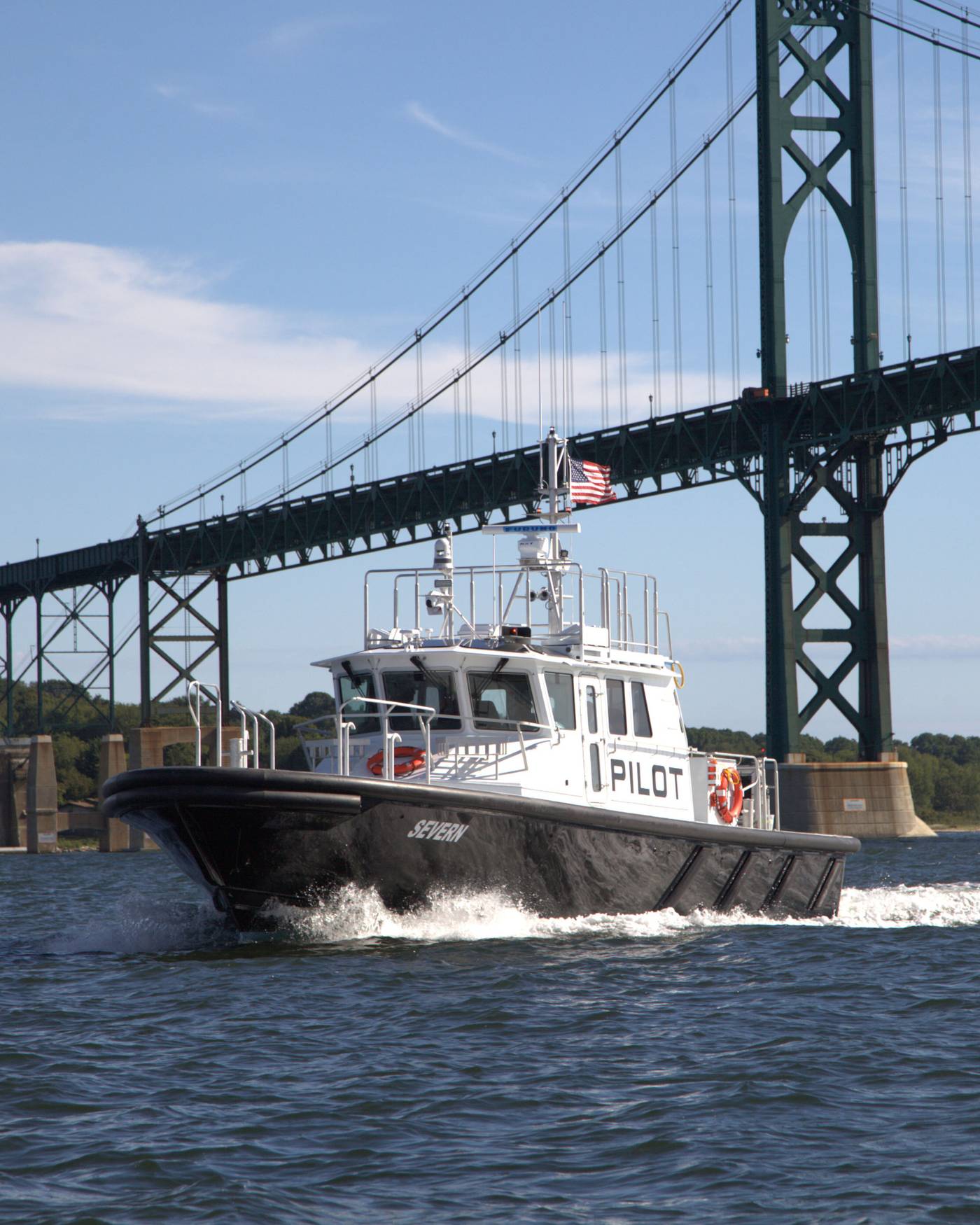
The Association of Maryland Pilots took delivery of its fifth Chesapeake Class launch from Gladding-Hearn Shipbuilding, Duclos Corporation since 2002. With a deep-V hull designed by Ray Hunt Design, the new all-aluminum high-speed launch measures 52.6 ft. overall, with a 16.8-ft. beam and a 4.8-ft. draft. Powered by twin Volvo Penta D16, EPA Tier 3-certified diesel engines, each producing 750 Bhp at 1900 rpm. The vessel’s top speed is more than 27 knots. A Humphree interceptor trim control system, with its Automatic Trim Optimization, is installed at the transom. The engines turn 5-blade Bruntons NiBrAl propellers via ZF500-1-A gearboxes. The launch is equipped with a Northern Lights 12 kW genset.
The vessel’s wheelhouse, with a small trunk, is amidship on a flush deck. With electrically heated, forward-leaning front windows, the wheelhouse is outfitted with five Norsap shock-mitigating reclining seats, a baggage rack, and three weathertight doors. The forecastle includes a porta-potty, a split upholstered settee/bunk, and a custom storage rack for immersion suits and other safety gear. The vessels’ interior is heated and cooled by two 16,000 Btu reverse-cycle HVAC units, in addition to electric heaters located in the wheelhouse and forecastle.
Outside the wheelhouse, heated decks and handrails prevent ice accumulation. A Harken TR-31 safety rail system was installed on the wheelhouse handrail. An aft wheelhouse ladder leads to hinged boarding platforms on the roof. A control station at the transom features a hydraulically powered J-Basket rescue system, capable of retrieving a pilot from the water to the main deck in less than 10 seconds with a single operator, said Duclos.
ARCTURUS CG-114
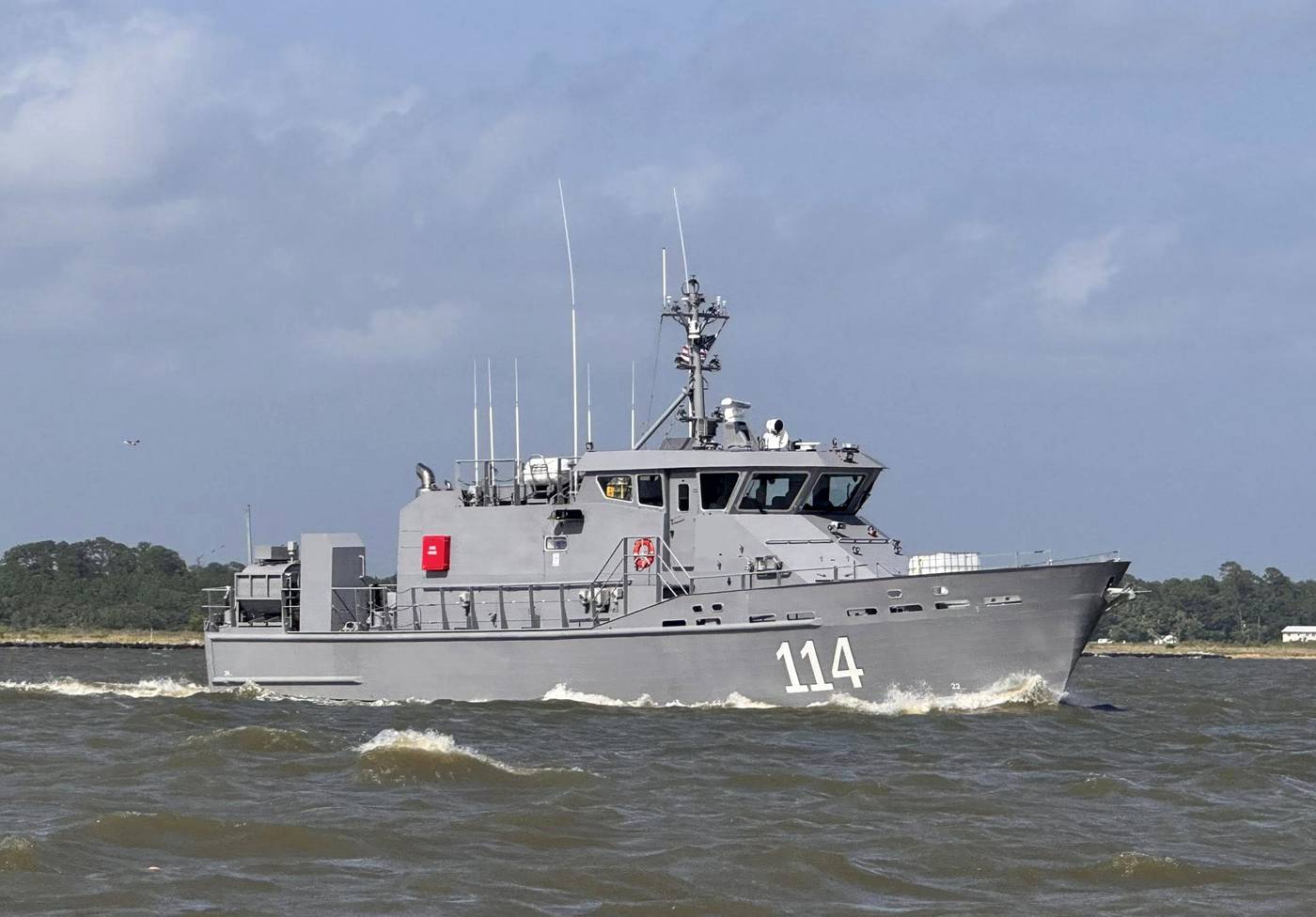
The Dominican Navy received its second 85 x 19.5-ft. welded aluminum Near Coastal Patrol Vessel (NCPV), built by Metal Shark. It was christened ARCTURUS CG-114 in keeping with the Dominican tradition of naming military vessels after constellations and celestial bodies. The delivery of ARCTURUS CG-114 follows the delivery of the Dominican Navy’s BETELGEUSE CG-102 in 2020.The vessel was acquired by the Dominican Republic under a $54 million U.S. Navy Foreign Military Sales contract awarded to Metal Shark to produce up to thirteen 85-foot Defiant-class patrol craft for U.S. partner nations in support of regional defense initiatives. The NCPV is a monohull vessel utilizing the parent-craft hull form of Damen Shipyards’ 2606 Standardized Patrol vessel, which was optimized by Metal Shark to suit the requirements of the NCPV mission. Powered by twin 1,600-hp Caterpillar C-32 marine diesel engines turning fixed-pitch Michigan Wheel propellers through Twin Disc MGX-6599 transmissions, the NCPV achieves speeds in excess of 25 knots. The NCPV carries a 5.6-meter Metal Shark-built aluminum RIB, powered by twin 50-horsepower Mercury four-stroke outboards.
LEGEND OF THE SEAS
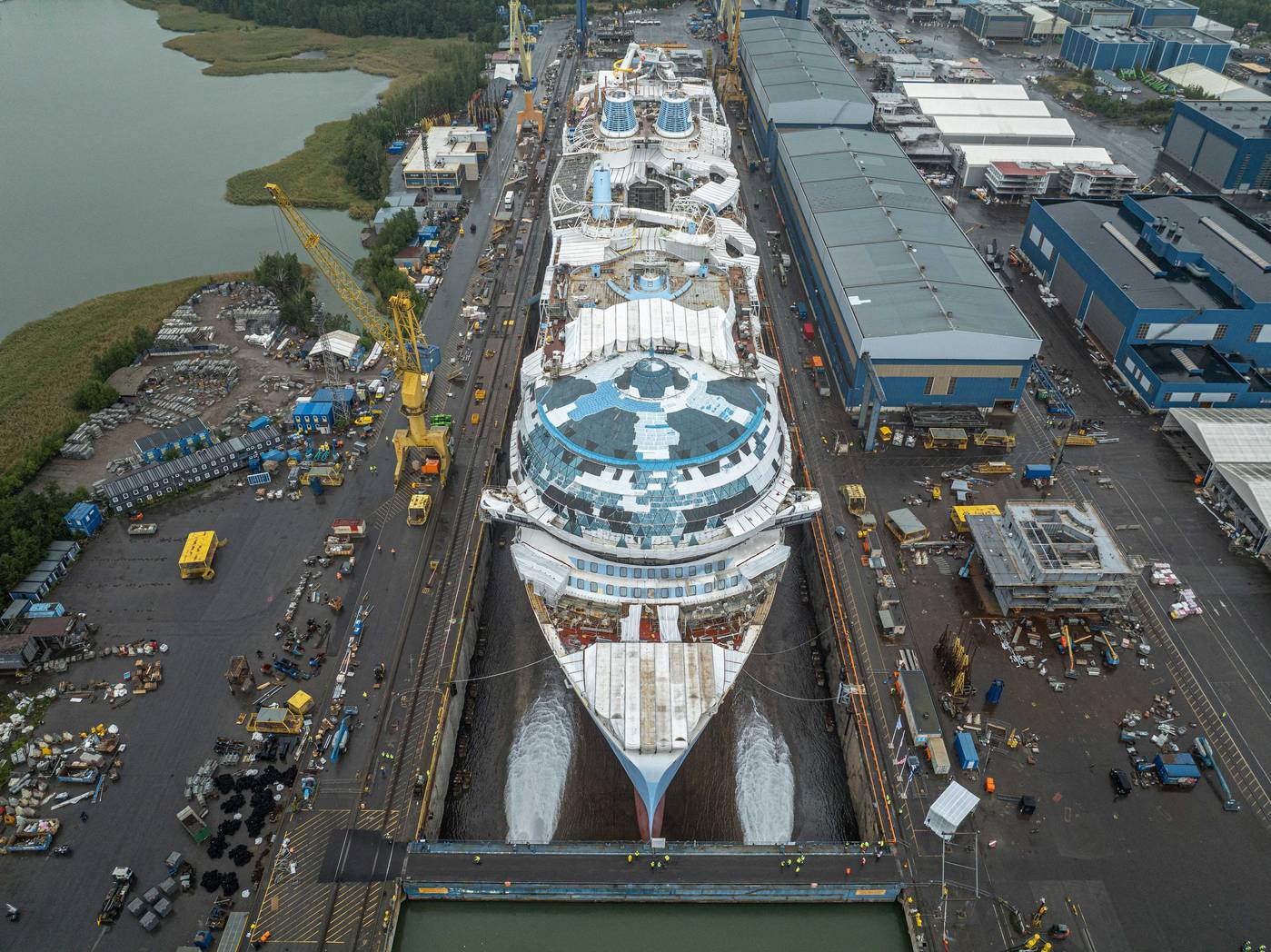
The third ship in the Icon Class, Legend of the Seas, floated for the first time ever at the Meyer Turku shipyard. The completed ship will be delivered to Royal Caribbean in summer 2026.
Measuring nearly 1,200 ft. long and 164-ft. wide and with a gross tonnage of approximately 248,000, Legend of the Seas is the third ship in Royal Caribbean’s Icon Class. The first ship in the class, Icon of the Seas, was delivered to the brand in November 2023, and the second, Star of the Seas, in July 2025. The fourth Icon Class ship, currently under construction at the shipyard and yet to be named, will be completed in 2027. Royal Caribbean’s agreement also includes options to build fifth and sixth Icon Class ships. The Icon Class ships are the first ships in the fleet to run on natural gas. Icon’s energy efficiency in Legend has been further improved with new-generation TSDF main engines, among other things. Together with other features, such as shore power connections and waste heat recovery systems, they are pioneers in sustainable development.
Watch the launch ceremony in the video below:
Bunker Vessels for Bapco Refining Launched
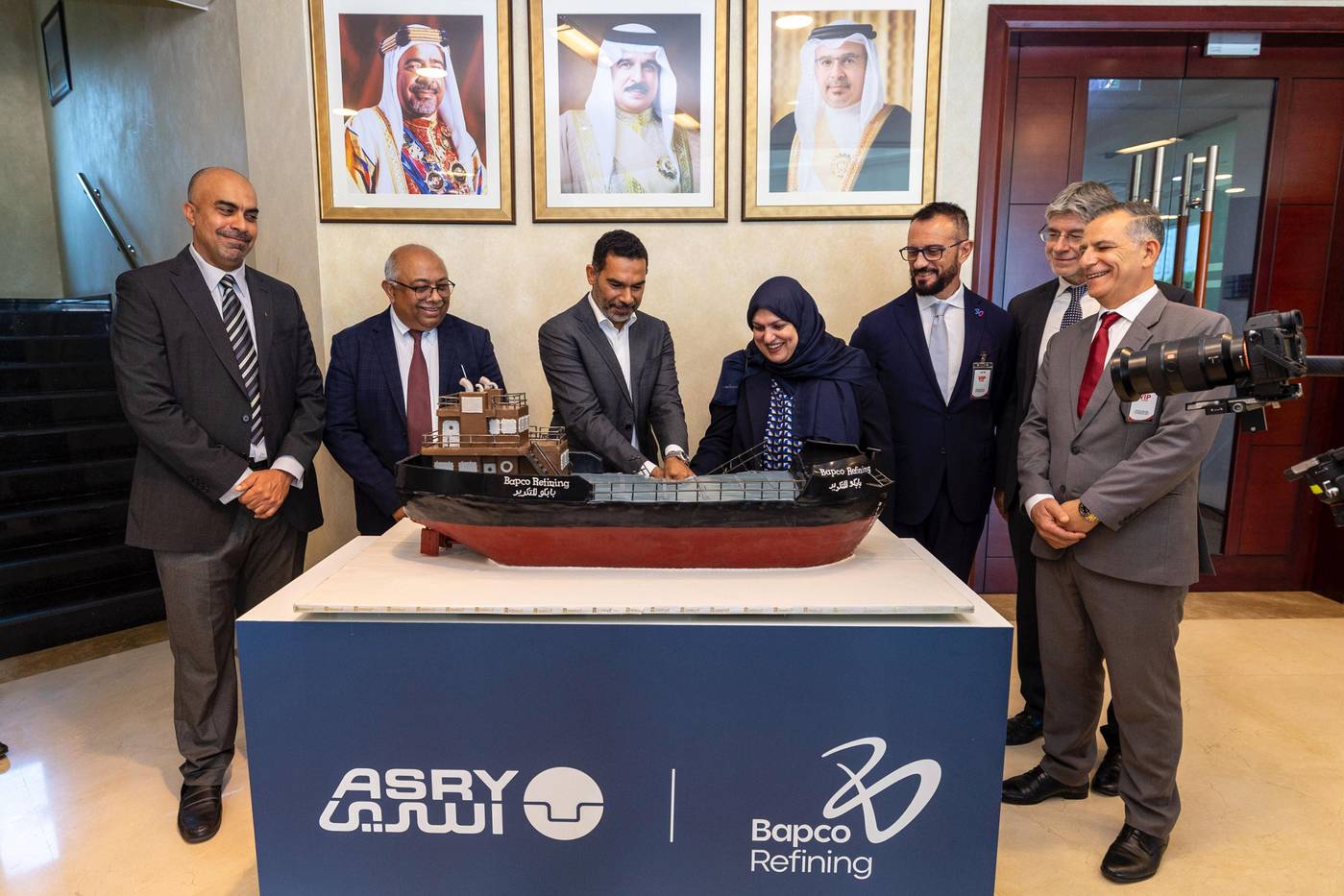
The Arab Shipbuilding and Repair Yard Company (ASRY) launched two bunker vessels for Bapco Refining, a subsidiary of Bapco Energies, at a ceremony held recently. The event featured the formal launch, with both vessels lowered into the water for the first time, marking completion of a main stage of the project and showing ASRY’s ability to deliver major marine projects to the highest engineering, technical, and safety standards. At the ceremony, Dr. Ahmed Al Abri, CEO, ASRY, said: “This project is the result of a strong strategic collaboration between ASRY and Bapco Refining. It also shows both sides’ backing for building national skills and for delivering innovative marine solutions that serve the Kingdom’s energy and sea-transport sectors.” The launch is part of a wider project to build and hand over two self-propelled fuel vessels for Bapco Refining.
Fleetzero, Glosten Team
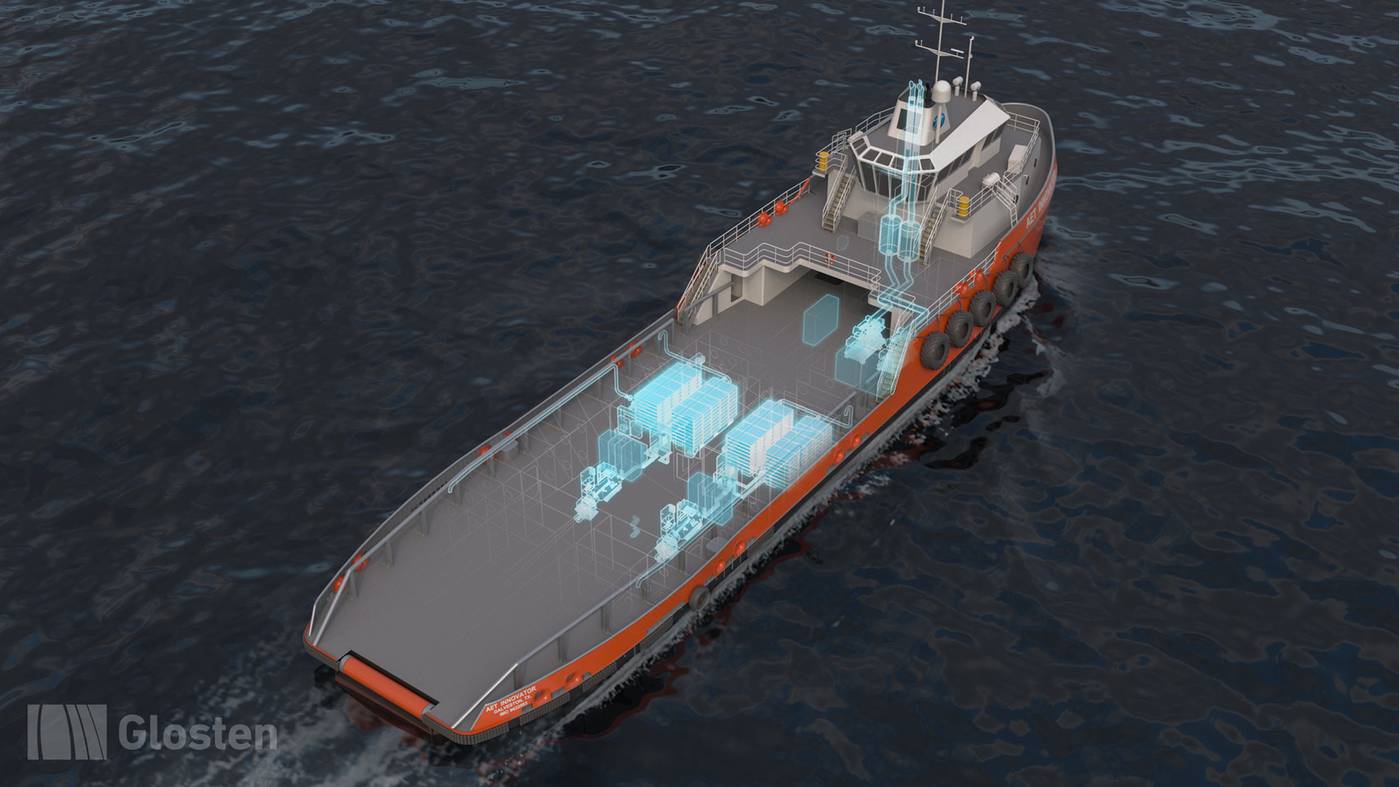
As battery technology evolves at speed, so too do developments on maritime's increasing use of the energy packs for hybrid and pure electric applications. Fleetzero, a developer and manufacturer of modular propulsion platforms for hybrid and electric ships, selected Glosten to design what is expected to be the world’s longest-range hybrid electric vessel.
Glosten has been working with Fleetzero on the retrofit of a Lightering Support Vessel owned and operated by AET. This vessel is being outfitted with a plug-in hybrid-electric propulsion system and will transit primarily on battery power once the conversion is complete. “This vessel will be a major milestone — not just for us, but for the entire industry,” said Steven Henderson, CEO of Fleetzero. “Partnering with Glosten allows us to showcase how our propulsion technology can enable economical, cleaner, and more efficient operations, while pushing the boundaries of what’s possible in shipping.”
“We’re excited to support Fleetzero in transforming this vessel,” added Morgan Fanberg, CEO & President of Glosten. “It’s a bold move toward the next generation of marine technology, and exactly the kind of advancement we’re proud to support.”
With the vessel design already underway, Fleetzero and Glosten will transition into detailed engineering in the coming months, with construction expected to begin in mid-2026.
Pure Battery Harbor Tug

Tokyo Kisen Co., Ltd. and Marindows Inc. launched Japan’s first pure battery-powered EV harbor tugboat development project. This EV harbor tugboat will be operated in the ports of Yokohama and Kawasaki. In January 2023, Tokyo Kisen put into service “TAIGA” which was the Japan’s first series-hybrid electric-powered tugboat equipped with a large-capacity 2,486 kWh battery. Building on two and a half years of operating experience with electric-powered tugs, this project advances to the next stage—enabling truly zero-emission (zero CO₂) operations—by developing and constructing a pure battery-powered EV tugboat. This could be possible by the combination of a large-capacity onboard battery system (6.66 MWh) and MW-class fast chargers.
Project and Vessel Overview
-
Project Owner | Tokyo Kisen Co., Ltd.
-
Project Coordinator | Marindows Inc.
-
Technical Support | e5 Lab Inc.
-
Vessel Type | Harbor tugboat
-
Propulsion Source | Pure battery powered (operates solely on onboard Li-ion batteries)
-
Scheduled Completion | 2030 (planned)
-
Planned Operating Area | Port of Yokohama and Kawasaki
-
Speed | 14 kn (approx. 26 km/h)
-
Bollard Pull | Max. 53 ton
-
Propulsion Power | 2 x 1,500kW (total 3,000kW)
-
Onboard Battery Capacity | 6,660kWh (6.66MWh) – under study
-
Onshore Battery Capacity | 2 x 2,000kWh – under study
-
Fast Chargers (Shore to Ship) | 2 x 1,000kW (1,000VDC) fast chargers