On the Drawing Board
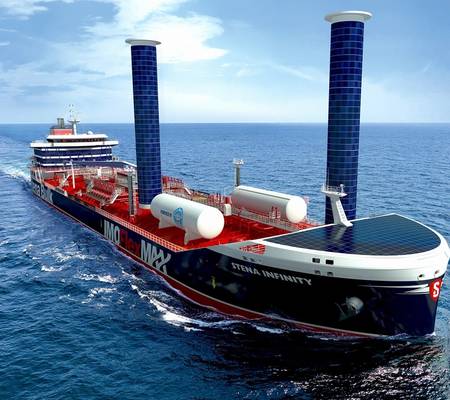
Stena Bulk’s IMOFlexMAX
Stena Bulk continues its IMOIIMAX design with a prototype for a new chemical tanker, the IMOFlexMAX, which will be designed to reduce greenhouse gas emissions by more than 25% compared to modern product tankers. IMOFlexMAX has been designed by naval architects at Stena Teknik. From hull design to vessel propulsion, these ships will incorporate the latest technology, including Flettner rotors and solar panels to harvest energy from wind and sunlight. They will be powered by dual-fuel engines that can run on LNG as well as conventional low-sulfur fuels, but will be flexible to consider alternative fuels based on client and regional demand.
Ammonia-Fueled Tugboat
A trio of marine powers in Japan seeks to develop the world’s first ammonia-fueled tugboat. A joint R&D agreement was signed by NYK, IHI Power Systems, and ClassNK recently to put the world’s first ammonia-fueled tugboat into practical use. To start, in fiscal 2020 the companies will tackle themes such as technological development of the hull, engine, and fuel supply system, and development of safety navigation methods. After evaluating the practicality of the R&D results, the JV will begin study of the construction of the ammonia-fueled tugboat and the plan for construction. NYK Line will focus on R&D of the hull and fuel supply system; IHI Power Systems will address R&D of engine and exhaust gas aftertreatment devices; and ClassNK will focus on safety assessment of ammonia-fueled tugboat
Battery-Powered HS Ferry
A Washington State team was selected for funding from the U.S. Department of Transportation’s Federal Transit Administration. Kitsap Transit is a public-private partnership team is being led by Washington Maritime Blue to advance the fast foil ferry design and the business case for sustainable operations. The funding from FTA, which will provide $372,910 as part of the Accelerating Innovative Mobility initiative, and other funding will help to complete the preliminary design for a high-speed passenger ferry powered by battery-electric, low-emission technology. The hydrofoil design will use lightweight carbon fiber construction and batteries to speed up travel between urban centers and suburban and rural communities, reducing and perhaps eliminating fuel use compared to conventional fast ferries.
Program partners include: naval architecture and marine engineering firm Glosten; Anacortes-based Bieker Boats; DNV GL; as well as public sector stakeholders.
AiP for CTV
BAR Technologies and Chartwell Marine earned Approval in Principle (AiP) from the American Bureau of Shipping (ABS) for the design and construction of the new BAR 30m crew transfer vessel (CTV). Vessels servicing the expanding U.S. East Coast offshore wind development areas will increasingly need to travel further for longer, while navigating deeper waters and greater wave heights. To meet this challenge, BAR, with the support of Chartwell, developed a 30m CTV, making use of FOSS technology (foil optimized stability system) to enhance seakeeping and maneuverability, while reducing vertical acceleration by up to 70% in 2.5m wave heights. While offering greater levels of availability in rough seas, the BAR 30m CTV also demonstrates up to 50% fuel efficiency savings at 15 knots, keeping emissions at bay in line with stringent EPA Tier 4 guidelines.
Monomaran Crewtender
Coastwise Offshore Services and Next Generation Shipyards signed a contract for the building of a new type of vessel, an aluminum vessel for the offshore wind-industry, with an option for three additional vessels.
The new boat aims to combine the stability of a catamaran with the speed and fuel efficiency of a monohull, and the building of the vessel was at the initiative of Coastwise Offshore Services, the new shipping enterprise owned by Eelko Wijdieks, Douwe van den Berg and Onno Nienhuis. Harlingen-based SeaZip Offshore Service will be responsible for the commercial management of the vessel.
The combination of monohull and catamaran is reflected in the new vessel type name: the 30 Pax Monomaran Crewtender- Endurance class NG2727. The
New Fishery Inspection Vessel
Danish naval architects OSK-ShipTech A/S designed, and Hvide Sande Shipyard will build a new $27m fishery inspection vessel for Danish Fisheries Agency. Ny Vestkysten will replace the existing MV Vestkysten from 1987. In addition to its main purpose as fishery inspection vessel for the North Sea and Skagerrak area, the new vessel is designed to fit future inspection challenges, e.g. by the use of large drones, and cover service functions such as emergency towing assistance, salvage, and surveys.