Underwater Conversations: The Next Wave in Hydrographic Communications for Renewable Energy
By Houssem Sadki
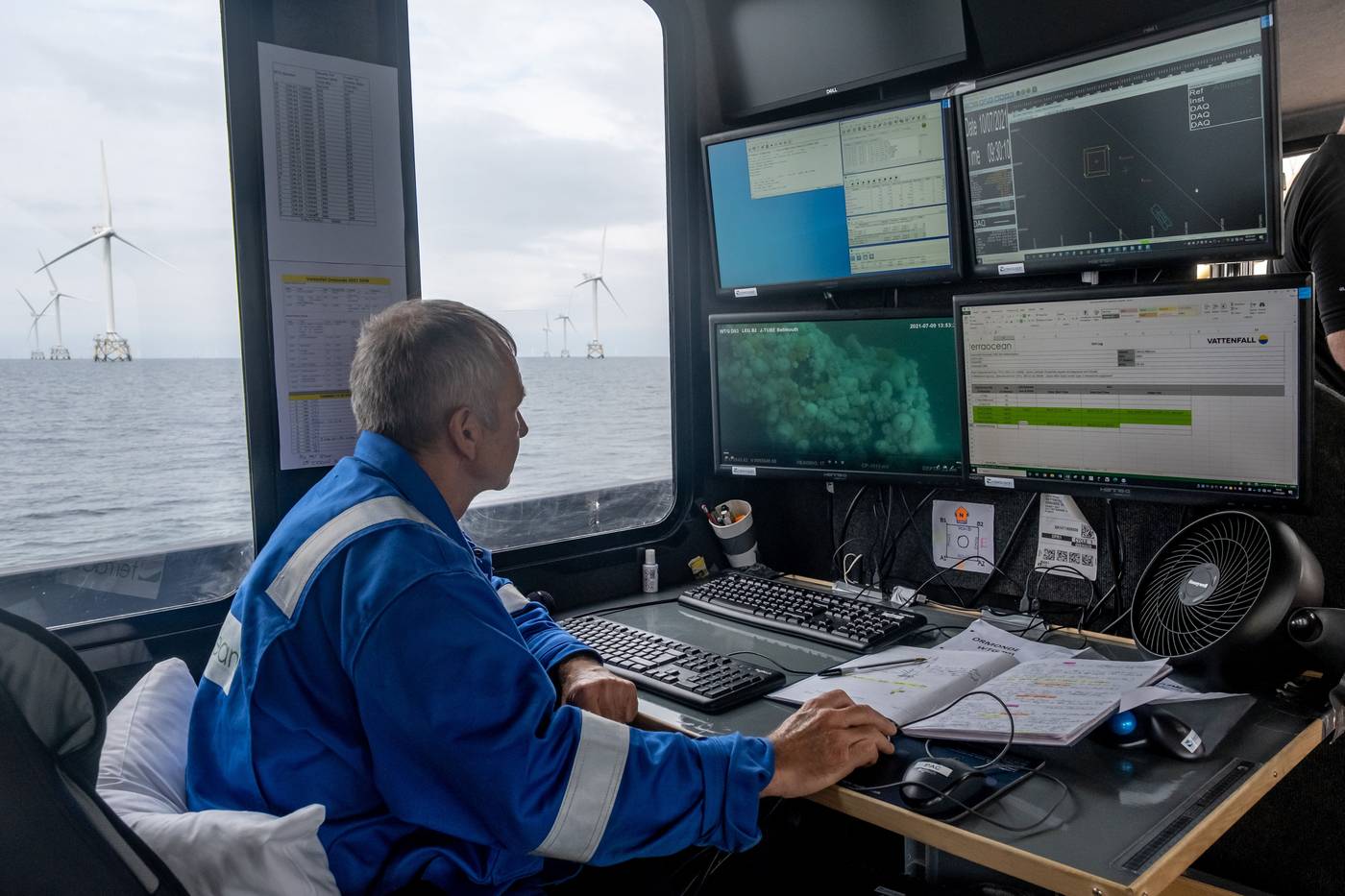
Interocean offers windfarm development services.
Credit: InteroceanBeneath the restless surface of our oceans, a silent dialogue unfolds, one of echoes and photons, algorithms and currents, powering the charts that guide tomorrow’s clean‑energy giants.
Echoes in the Deep: Acoustic Foundations and AI-Driven Adaptation
Underwater acoustic modems remain the steadfast backbone of seabed mapping and survey operations, carrying crucial multibeam, sub-bottom profiler, and positioning data where light cannot reach. Devices like the EvoLogics S2CR 18/34 pair a horizontally omnidirectional transducer with sweep-spread carrier technology to achieve up to 13.9 kbps over 3.5 km, enabling reliable links even in reverberant shallow waters. Yet the ocean is a fickle medium: thermocline layers, Doppler shifts from moving platforms, and the clamor of marine life can warp or fragment signals.
To conquer these challenges, researchers leverage deep learning to model and predict the channel itself. In “Underwater Acoustic Communication Channel Modelling using Deep Learning,” Onasami et al. demonstrate that Deep Natural Networks (DNNs) and Long Short-Term Memory (LSTM) networks trained on real-world tank and lake datasets can model impulse responses with under five percent mean absolute percentage error, surpassing classical analytical approaches.
These AI-driven enhancements translate directly into time and cost savings offshore. During the Hornsea One pre-installation survey, XOCEAN’s DriX USV completed a 120 km round-trip mission in just six hours, compared to 24 hours for comparable platforms. Integrating real-time channel prediction and adaptive equalization could cut mission duration by another 20 percent, shaving nearly five hours off each leg. At a typical USV charter rate of USD$6,700 (£5,000) per day and a crew cost of USD$2,680 (£2,000) per day, saving even a single day can net over USD$9,386 (£7,000); extrapolate across multiple survey legs, and operators might reclaim USD$67,000-$102,000 (£50,000–£80,000) per campaign. Moreover, reduced acoustic retries, and packet loss lower fuel burn and engine hours on support vessels, trimming both carbon footprints and operating expenses.
Companies like Interocean Marine Services (Interocean) are at the forefront of maximizing such efficiencies through advanced survey and subsea capabilities. Operating from dedicated survey vessels equipped with multibeam echo sounders, side scan sonar, seabed profilers, and gradiometers, Interocean maps seabed topography and sub-seabed geology to chart potential hazards, such as UXO or debris, that might hinder construction. The company’s integration of UAV-mounted LiDAR and photogrammetry also bridges sea-to-shore mapping, enabling holistic and high-resolution cable route and wind farm layout planning.
Illuminating the Depths: Optical Wireless and Hybrid Networks
When distance permits, light outpaces sound by orders of magnitude. Sonardyne’s BlueComm 200 harnesses high-power LEDs and sensitive photomultiplier receivers to push 2.5–10 Mb/s across 150 m, ideal for live HD video, bulk data offload, and untethered control at depths to 4,000 m, all on the energy of a single D-cell battery. Yet optical links stumble in turbid or non-line-of-sight conditions.
Enter hybrid networks, where deep-reinforcement-learning agents monitor signal quality and seamlessly toggle between BlueComm optics for high-volume bursts and EvoLogics acoustics for extended reach. Researchers describe such ML-driven transceivers that feed real-time channel estimates back to modulation selectors, optimizing throughput while guarding against sudden channel fades.
Imagine a pilot at the Fundy Ocean Research Centre for Energy (FORCE) test site in the Bay of Fundy. As an ROV clamps onto a tidal turbine for weld inspection, the system streams 4K footage over BlueComm when waters clear, then reverts to acoustic fallback as suspended sediments from jet-driven scour tests rise. This autonomic handoff preserves sub-100 ms control latency, eliminating the need to surface for data offload.
Here, the subsea inspection capabilities of Interocean become particularly valuable. The ROV systems, deployed from Interocean or client vessels, can perform weld inspections, cathodic protection assessments, marine growth removal, scour monitoring, and 3D photogrammetry of mooring and cable systems. By integrating these inspections with high-speed data transmission, operators can compress five-day inspection campaigns to three, saving time, reducing vessel days, and minimizing environmental impact.

Charting the Future: Surveying and Renewable-Energy Operations
Pre-construction campaigns for offshore wind and tidal farms demand both speed and pinpoint accuracy. At a renewable energy project off the Irish coast, a geotechnical services company’s eight-week geotechnical investigation aboard DEME’s jack-up vessel Neptune delivered seabed profiles to inform monopile design. Had hybrid comms streamed sub-bottom profiler and cone-penetrometer logs in real time, daily data-offload pauses could have been eliminated, potentially saving one DP-vessel day per week. At a rate of USD$231,000 (€200,000) per day, that’s up to €1.6 million in mobilization savings across the campaign.
Interocean’s windfarm development support services are precisely geared toward this phase of renewable projects. Its baseline surveys, using drones for onshore topography and specialist vessels offshore, enable accurate mapping for initial site selection and layout planning. The integration of all spatial and survey data into a centralized GIS ensures a living map of the site, constantly updated to support planning, maintenance, and expansion.
The company’s marine operations team ensures safe and efficient vessel mobilization, overseeing everything from vessel inspections and load-outs to personnel monitoring and permit-to-work systems, minimizing delays and reducing HSE risk across project lifecycles.
Once turbines stand or float, inspections and maintenance likewise reap the rewards. Hywind Scotland, the world’s first floating offshore wind farm with five 6 MW turbines at a total cost of USD$354 million (£264 million), requires regular ROV surveys to check welds, anodes, and moorings. Traditional campaigns span 30 days offshore at USD$134,000 (£100,000) per day, costing USD$4 million (£3 million).
Interocean supports the development and maintenance of floating offshore wind through a full-service offering. The company’s team of naval architects and geotechnical engineers deliver mooring design, dynamic analysis, and anchor-type selection. Its vessels conduct seabed and cable route surveys for pre-installation planning, while the marine operations team manages mooring installation, turbine tow and hook-up, and final as-built surveys. This vertically integrated approach, combined with next-gen underwater communication, allows for tighter coordination, real-time decision-making, and shorter campaign durations, unlocking significant cost savings.
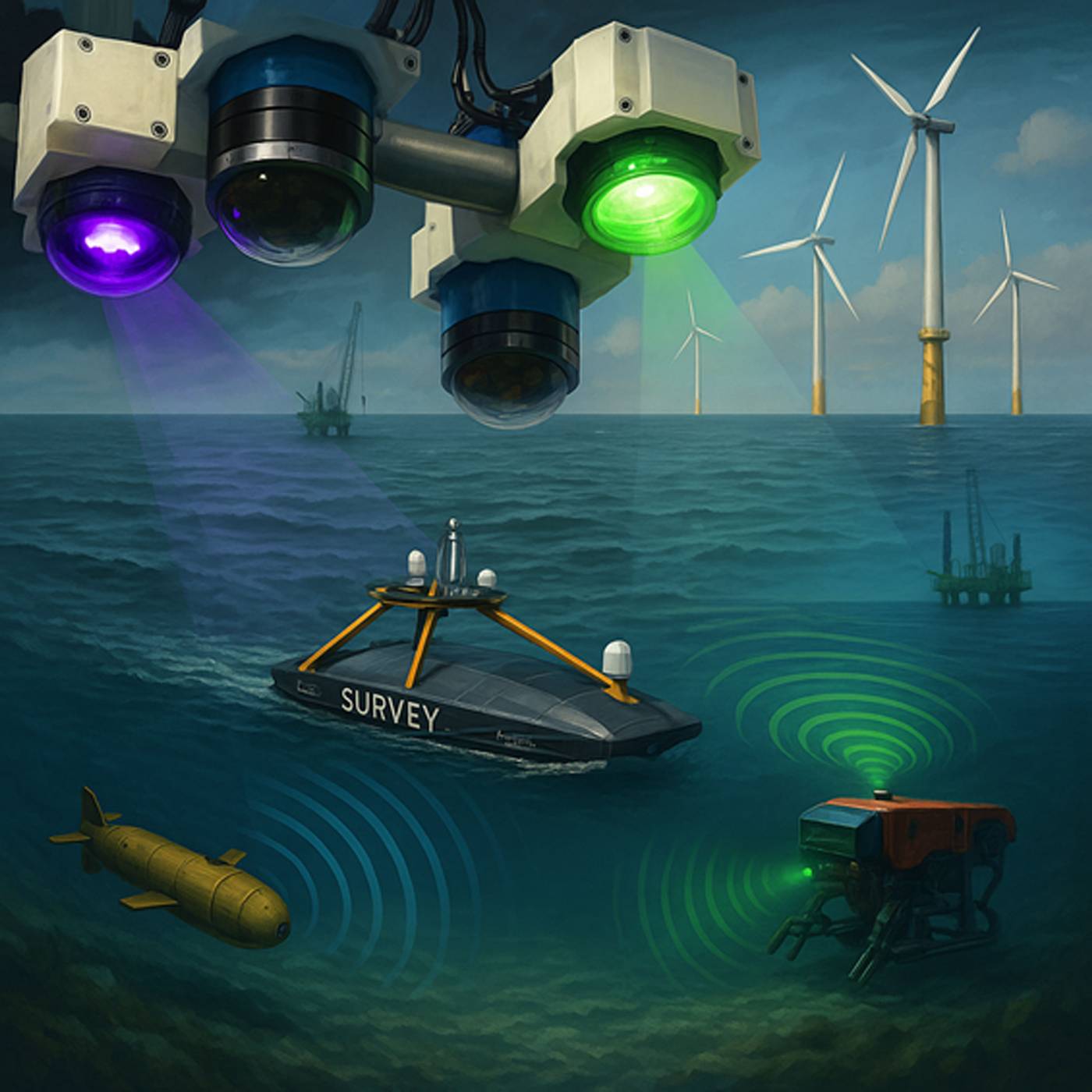
Across subsea cable corridors and tidal arrays, an Internet of Underwater Things emerges distributed sensor swarms coordinate via adaptive Medium Access Control (MAC) protocols to monitor vibration, scour, and biofouling over kilometers of infrastructure. Condition-based maintenance triggered by real-time analytics extends asset life and slashes unplanned outages by up to 20 percent, according to field reports, shoring up revenues and minimizing environmental impact.
Looking ahead, underwater 6G networks, quantum-secure links, and swarm-intelligent AUVs foreshadow a fully autonomous era: robotic fleets that self-deploy, hand off data peer-to-peer, and return to port laden with high-resolution logs. No crew aboard. Minimal emissions. Maximum uptime.
In this vision, each echo, each photon, each AI-driven decision honors centuries of hydrographic tradition, even as it charts a cleaner, smarter future beneath the waves. With companies like Interocean integrating cutting-edge survey, inspection, and marine operations with emerging communication networks, the renewable energy sector stands ready to accelerate, where every hour saved offshore and every pound conserved drives progress toward a cleaner, world-changing scale.
About the Author
Houssem Sadki
Houssem Sadki, Subsea & Survey Manager at Interocean, leverages 15+ years’ offshore experience in hydrography, data integrity, and geophysics to lead innovative subsea projects.
 Credit: Interocean

