In the Shipyard
New Deliveries, Contracts & Designs
Saronic’s Mirage Hits the Water

Saronic launched Mirage, a 52-ft. dual-use Autonomous Surface Vessel (ASV) that joins the 24-ft. Corsair and 180-ft. Marauder as the third flagship platform in Saronic’s growing fleet, and is the latest milestone in a production model delivering autonomous vessels at speed and scale. Mirage went from initial design to launch in under a year, and now begins on-water trials at the company’s privately funded test facility in Galveston, Texas, with the next hull already on the production line at the company’s Austin headquarters.
Mirage is built to extend the reach and capability of manned and unmanned teams across a range of maritime operations. With a top speed of 35+ knots, a range exceeding 2,500 nautical miles, and a payload capacity of 3,500 pounds, Mirage more than doubles the range and payload capacity of Saronic’s 24-ft. Corsair. Operating fully autonomously or under remote human supervision through Saronic’s Echelon command-and-control platform, Mirage supports maritime domain awareness, maritime security, and aerial and surface detection missions.
Mirage inherits the proven reliability, capabilities, and operational lessons refined across Saronic’s family of vessels. The 52-ft. ASV runs on the same core autonomy stack that Saronic has developed and validated through its other vessels. Passive perception and collaborative autonomy capabilities — including navigation, tracking, and detection — are enabled by redundant communications and intuitive control interfaces. Its open, modular architecture enables rapid integration of a wide range of Government-Off-The-Shelf (GOTS) and Commercial-Off-The-Shelf (COTS) hardware and software solutions, including mission payloads, sensor packages, and command-and-control systems, without reengineering the underlying platform. Mirage is operated through Echelon, Saronic’s unified platform for mission planning, simulation, and command-and-control.
MV Lilly Bordelon Delivered

Bordelon Marine has completed the conversion and redelivery of the MV Lilly Bordelon, a Stingray Series 260 Class DP-2 Ultra-Light Intervention Vessel (ULIV). Repurposed from an existing platform, the Lilly Bordelon has been transformed into a modern subsea intervention vessel designed to deliver cost-efficient, flexible solutions for offshore operations. The vessel features over 5,500 sq. ft. of clear deck space, a mezzanine deck supporting two work-class ROVs, with an integrated ROV control room. Equipped with a 60-ton active heave-compensated crane with over 3,000 meters of wire and a 17-meter USCG/ABS-certified helideck, the vessel is suited for a wide range of subsea inspection, maintenance, repair, and light construction activities.
Nichols Brothers to Build New San Francisco Bar Pilots Station Vessel

Nichols Brothers Boat Builders (NBBB) has been awarded a contract by the San Francisco Bar Pilots Benevolent and Protective Association to build the organization's next-generation station vessel.
Designed by Glosten, the vessel will measure approximately 110 feet in length and is being built to support the San Francisco Bar Pilots as they guide commercial vessels through the waters of San Francisco Bay and the Golden Gate.
The vessel will feature Tier 4 diesel propulsion designed to improve fuel efficiency, reduce emissions and meet California Air Resources Board (CARB) emissions requirements. It is also designed for continuous offshore service with modern accommodations, enhanced seakeeping characteristics and the endurance required to support round-the-clock pilot operations.
The San Francisco Bar Pilots operate 24 hours a day throughout the year, guiding nearly every deep-draft commercial vessel entering and leaving San Francisco Bay.
Pilots board container ships, tankers, vehicle carriers, cruise ships and other commercial vessels about 11 miles west of the Golden Gate Bridge before navigating them through more than 160 miles of waterways serving the ports of San Francisco, Oakland, Richmond, Stockton, Sacramento and surrounding terminals.
Glosten developed the vessel design, while Maritime Consulting Partners is providing owner's representation and project management services during the procurement and construction process.
NBBB will now complete the production engineering before beginning fabrication, assembly, outfitting, testing and final delivery of the vessel.
Construction will take place at NBBB’s shipyard in Freeland, Washington.
SDHI to Build Four Svitzer Tugs

Swan Defence and Heavy Industries Limited (SDHI), India’s largest shipbuilding and heavy engineering company, has secured a contract from Denmark-based towage operator Svitzer A/S to construct four advanced TRAnsverse 3200 tugs. Deliveries for the order are scheduled to commence in early 2028. The vessels will be constructed to Bureau Veritas class.
Co-developed by naval architects Robert Allan Ltd. and Svitzer, the patented TRAnsverse 3200 design is engineered for harbor towage and escort operations. Featuring a hydrodynamic hull design and omni-directional propulsion, the vessels are capable of safely guiding large ships through severe weather and restricted port channels.
Delivering an 80-ton bollard pull, the TRAnsverse design is up to 15% more fuel efficient than conventional tug designs, directly supporting global maritime decarbonization goals.
The Transverse 3200 tugs will be biofuel, IMO Tier III emissions standards, and FiFi1 firefighting class ready.
Copenhagen-headquartered Svitzer operates a fleet of over 500 vessels worldwide. This order is a part of Svitzer's long-term fleet renewal program, aimed at deploying high-efficiency vessels to optimize port and terminal operations globally.
The vessels will be built at SDHI’s yard in Pipavav, Gujarat, adjacent to the port where Svitzer also has a harbor towage operation.
SAAM Receives Two New Tugs
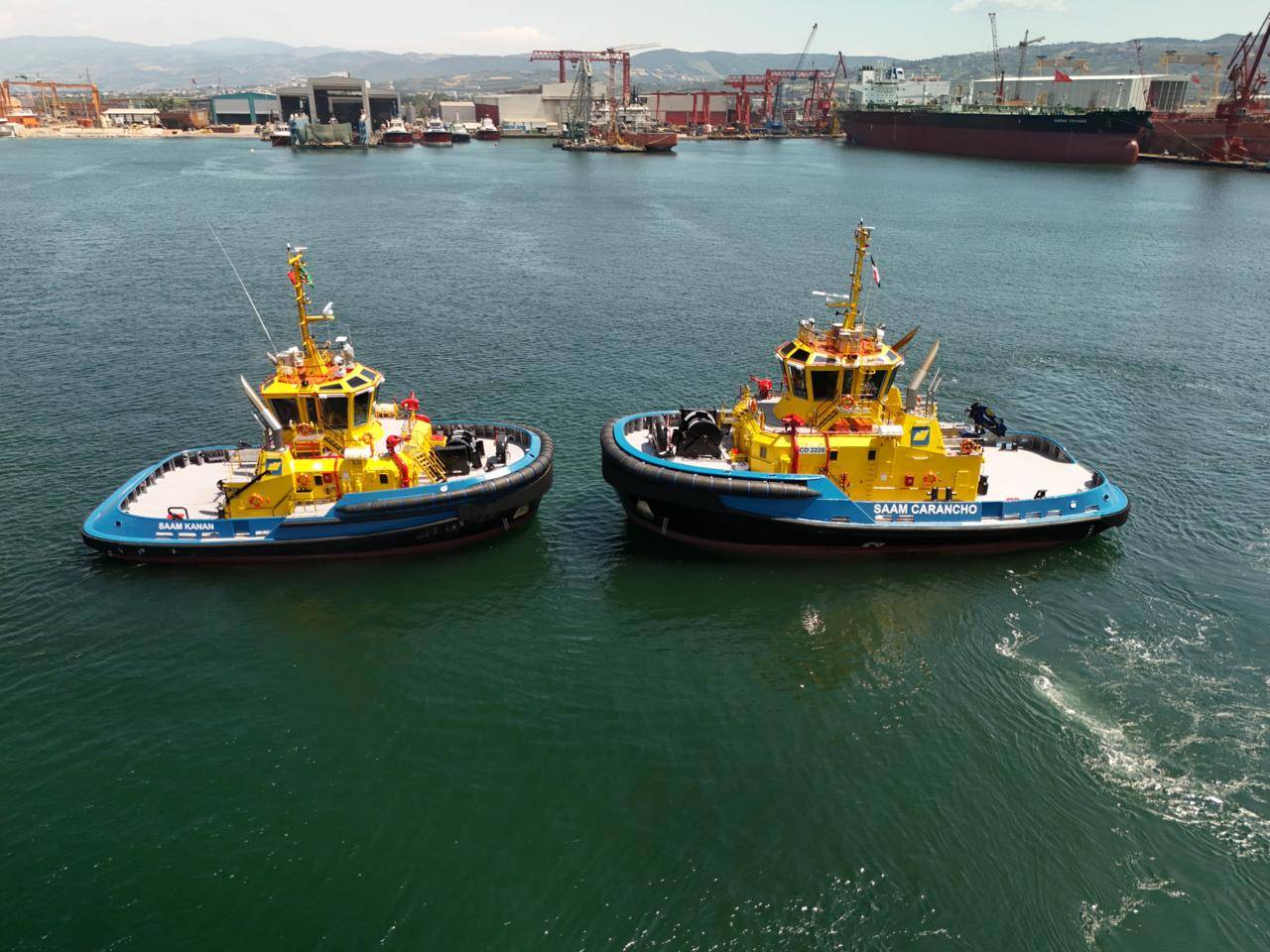
Sanmar Shipyards delivered two tugboats to SAAM Towage, a pair of IMO Tier Ill-compliant vessels were recently handed over to SAAM Towage representatives at Sanmar Shipyards' Altinova facilities in Türkiye following sea trials. Renamed SAAM CARANCHO and SAAM KANAN, the tugboats will be deployed in Chile and Mexico respectively.
With these latest deliveries, the number of Sanmar-built tugboats operating within the SAAM Towage fleet has increased to 15.
AAM CARANCHO is a Bigaçay Class escort tug based on the RAstar 2900SX design developed for Sanmar by Robert Allan Ltd. Capable of delivering 80 tons of bollard pull and achieving a free-running speed of 12 knots, the vessel has been specifically designed for escort operations in exposed waters. Powered by twin CAT 3516E main engines, each producing 2,350 kW, the tug is also equipped with FiFi 1 firefighting capability.
SAAM KANAN is a Bogaçay Class tug based on the RAmparts 2400SX-MKIl design by Robert Allan Ltd. Also powered by twin CAT 3516E main engines delivering 2,350 <W each, the highly maneuverable twin Z-drive vessel is designed to provide efficient and reliable ship-handling services in busy port environments. The tug is equipped with FiFi 1 firefighting capability and combines operational efficiency with advanced environmental performance.
Moose Boats Delivers for SFFD

Moose Boats delivered an M1-46 fire rescue catamaran vessel to the San Francisco Fire Department’s Airport Division. This will be the second M1 that the San Francisco International Airport will have available for emergency calls in the waters surrounding the runways. While many of the systems have been upgraded from their previous Moose Boat, the platform and controls have remained the same, enabling a seamless transition for pilots and crew to operate from.
According to San Francisco Fire, “The Airport Division is responsible for providing fire protection, fire prevention, code enforcement, emergency medical services, water rescue operations and hazardous materials abatement for the San Francisco International Airport.”
SFO is the 13th busiest airport in the United States accommodating over half a million passengers weekly. Moose Boats’ dependable 46-foot M1 will be the rescue boat used by the San Francisco Fire Department in case of emergency at the airport.
The vessel includes a 1,000 GPM pump, twin turbo diesel Cummins QSC 8.3 600 HP engines, storage for over 50 life rafts (each capable of carrying 10 persons), and a climate-controlled cabin featuring a dedicated patient care bench. The M1 Moose Boat will be stored at the Marine Emergency Response Facility near Seaplane Harbor allowing for a rapid emergency response time.
Parker Towing Repowers M/V Syble Fay

Parker Towing Company completed the repower of the M/V Syble Fay at Verret Shipyard, replacing the vessel's Cummins QSK38 main engines with two Mitsubishi S12R Tier 3 engines supplied by Laborde Products. Each engine is rated at 1,100 hp at 1,600 RPM, providing a total of 2,200 hp for the vessel's continued service on the inland waterways.
The M/V Syble Fay is a 78- x 34-ft. twin-screw towboat with a depth of 10 ft. The vessel has returned to service with Mitsubishi power as part of Parker Towing Company's ongoing investment in maintaining and modernizing its fleet.
“The Syble Fay has been a valuable part of our fleet, and this repower was an opportunity to position the vessel for continued service in the years ahead,” said Chas Haun, Executive Vice President at Parker Towing Company. “Projects like this require strong coordination from everyone involved, and we appreciate the support throughout the process.”
Verret Shipyard completed the repower installation, working alongside Parker Towing Company and Laborde Products throughout the project.
With the M/V Syble Fay back in operation, the project establishes a foundation for future Mitsubishi repowers within the Parker Towing fleet while extending the vessel's service life with Tier 3 mechanical power.

Hy-line Cruise's CAT Ferry Construction Commences

Construction on a new 48m catamaran passenger ferry designed by Incat Crowther for Hy-Line Cruises is now underway at Midship Marine in Louisiana. The vessel, when completed, will operate on Hy-Line Cruise’s critical tourism and commercial routes connecting Hyannis, Mass., with the islands of Martha's Vineyard and Nantucket.
Capable of transporting up to 493 passengers across three passenger decks, the vessel is capable of reaching speeds in excess of 30 knots and has been designed specifically for the unique local conditions experienced off the coast of Cape Cod.
The vessel is powered by four Cummins QSK60-M Tier 4 engines driving four Hamilton HTX65 waterjets. Composite shafting supplied by Driveline Service of Portland is incorporated into the drivetrain, reducing weight and maintenance requirements. The aluminum hull and superstructure construction supports the vessel’s performance targets, ensuring efficient and safe operations and features active ride control technology supplied by Naiad.

INCAT CROWTHER 48 – Main Particulars
| Length Overall | 157’ 5” / 48.0 m |
| Length Waterline | 149’ 11” / 45.7 m |
| Beam Overall | 34’ 5” / 10.5 m |
| Draft | 6’ 10” / 2.1 m |
| Depth | 14’ 1” / 4.3 m |
| Construction | Marine grade aluminum |
| Fuel Oil | 4000 gallons |
| Fresh Water | 660 gallons |
| Sullage | 660 gallons |
| Indoor seating capacity | 344 |
| Outdoor seating capacity | 200 |
| Total maximum passengers | 493 |
| Speed (Service) | 31.5 knots |
| Speed (Max) | 34 knots |
| Main engines | 4 x CUMMINS QSK60-M |
| Installed power | 4 x 2500 hp / 1864 kW @ 1800 rpm |
| Propulsion | 4 x Hamilton HTX65 Waterjets |
| Gearboxes | 4 x Twin Disc MGX 61500 SC HL/HR |
| Flag | United States of America |
| Regulatory Authority | USCG |
| Regulations | 46 CFR Subchapter K |