New Products
Lincoln Electric Debuts Aluminum MIG Welding System

Lincoln Electric introduced the AlumaFab aluminum MIG welding system, a purpose-built solution designed to simplify and optimize high-volume aluminum welding. Developed through a partnership with MK Products, the AlumaFab system combines wire feeding with proven power source and waveform technology, designed to provide smooth, consistent wire delivery and superior arc control.
The AlumaFab system is designed to make aluminum welding easy by providing a stable, forgiving arc and a consistent, user-friendly experience. This combination of benefits enables operators of any skill level to weld with confidence day after day.
The AlumaFab system is available in two packages—air-cooled and water-cooled—and is compatible with four MK Products® Python® MIG guns (15-foot and 25-foot, air- and water-cooled), sold separately.
The system includes:
-
AlumaFab Wire Feeder
-
AlumaFab 350 Power Source
-
Cool Arc 55 (Water-cooled package only)
Path Robotic’s Rove: Mobile Robotic Welding

Path Robotics launched Rove, a mobile robotic welding system that pairs the company's Obsidian physical AI model with a quadruped robot. The launch marks an expansion for Path Robotics – where Obsidian already delivers autonomous, adaptive welding inside fixed cells, Rove extends that capability to the field, bringing intelligent welding to the part rather than the part to the workpiece.
“Obsidian has proven that physical AI can solve some of the hardest welding challenges inside the cell,” said Andy Lonsberry, CEO and co-founder of Path Robotics. “Rove is a significant next step and one our customers have been seeking. Manufacturers can now deploy Obsidian wherever welding is needed – across large assemblies, production sites, and in environments where moving the part isn’t an option.”
Legged robots have long been considered too unstable for precision welding. Rove changes that narrative. Obsidian empowers Rove with the perception and adaptability needed to operate in high-variability environments, like shipbuilding.
Saronic Technologies, a leader in autonomous maritime vessels, is one of the first early adopters to evaluate the system, integrating Rove's intelligent mobile welding into its physical AI-powered shipbuilding operations in Franklin, Louisiana.
“Building the next generation of autonomous vessels means rethinking not just how ships operate, but also how they're made,” said John Morgan, Head of Manufacturing, Saronic. “Rove represents the kind of intelligent, adaptable tooling we need to bring shipyard operations into the modern era—we look forward to seeing what Rove can do and are excited to partner with Path Robotics as we scale production of the next generation of autonomous vessels.”
Rossi Expands its Planetary Range with EP Winch
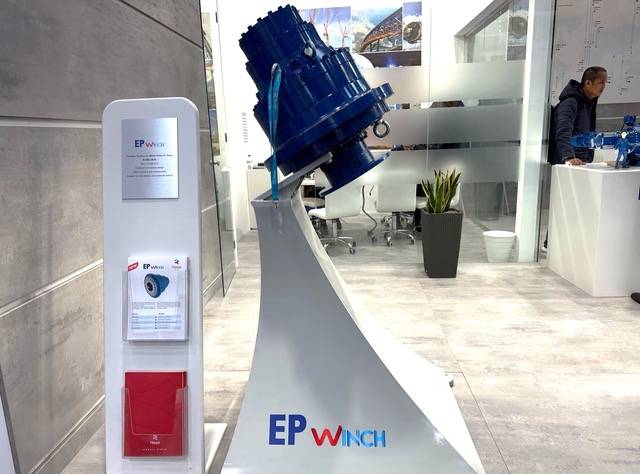
With EP Winch, Rossi strengthens its offering in the Marine, Construction and Mining sectors.
Rossi S.p.A., an international company headquartered in Modena and one of the world's leading groups in the production of gearboxes, gearmotors and electric motors, presents the EP Winch, the new planetary gearbox with rotating housing.
The new EP Winch expands the range dedicated to planetary gearboxes, a product that has characterized Rossi's experience and production capacity for decades. "With EP Winch," says Davide Ferrari, R&D Manager Planetary Gearboxes and deputy CTO, "we are expanding our range by entering strategic sectors with a very clear approach: not simply adding a product to the range, but making our Know-how available to customers and studying solutions capable of better integrating into their applications and responding to their needs.
The rotating housing that characterizes EP Winch allows the gearbox to be encased in the drum, so as to minimize overall dimensions. This is a particularly attractive solution, as well as featuring an elegant design, for the Marine, Construction and Mining sectors, where available space is often a decisive design constraint.
RAD Launches Autonomy Core

RAD launched the RAD Autonomy Core, a new product within the RAD Autonomy System designed to make vessels remotely controllable in a simple, reliable and flexible way. Built to integrate seamlessly with existing propulsion and onboard systems, the Autonomy Core provides a practical pathway to advanced marine autonomy, without compromising on safety or control.
The RAD Autonomy Core is an interface layer between vessel engines and onboard systems, enabling the RAD system to communicate over an IP network. This network can be connected to the internet via satellite, Wi-Fi, or cellular solutions, either through RAD supplied hardware or integration with existing customer infrastructure.
Operators can enable Degree 3 autonomy: fully remote vessel control without onboard crew. The DroneCAN interface supports compass and GPS integration, while the system’s modular design ensures flexibility across a wide range of vessel types and configurations.