In the Shipyard
New Deliveries, Contracts & Designs
C&C Marine & Repair Delivers a New Double-Hull Tank Barge
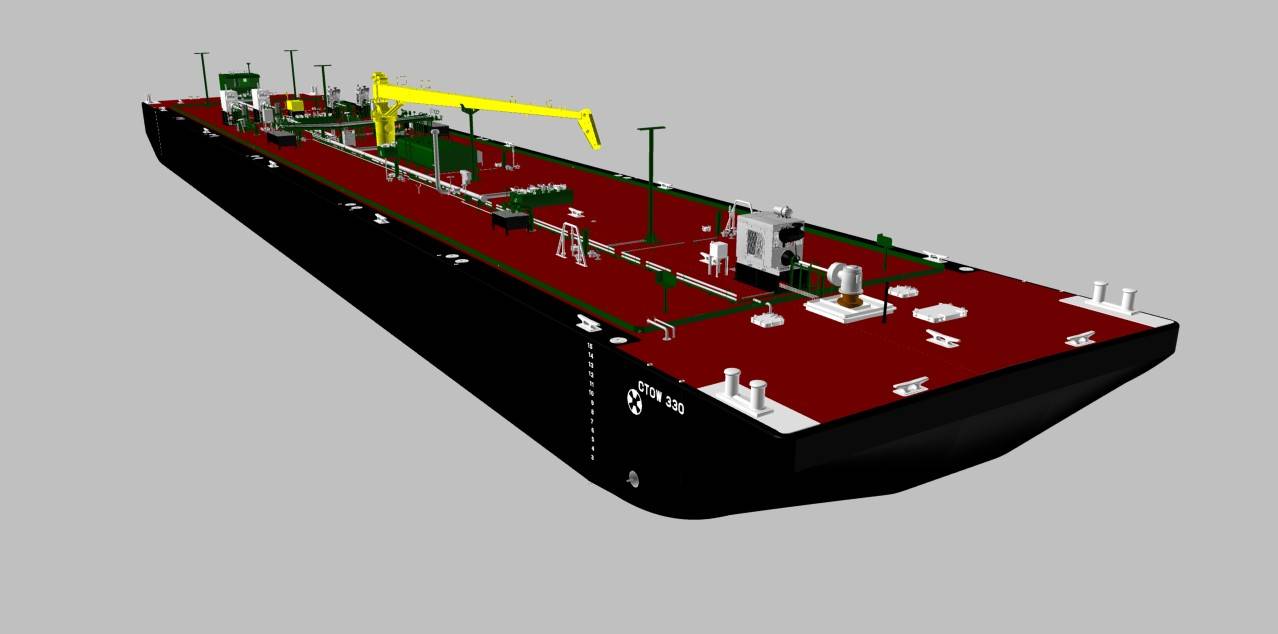
C&C Marine & Repair announced the delivery of CTOW 330, a newly constructed double-hull tank barge designed for bunker service and built to support modern fuel-handling requirements across Lakes, Bays, and Sounds service routes.
Measuring approximately 297.5 x 54 x 16 ft., CTOW 330 has a nominal cargo capacity of about 28,000 U.S. barrels and features a flush deck extending the full length and breadth of the vessel. The barge is designed for U.S. Coast Guard authorization for Subchapter “D” cargoes, Grade “A” and lower, inclusive of Biodiesel and Methanol, and incorporates a Type III double-skin hull with raked ends for operational durability and regulatory compliance.
CTOW 330 is configured with eight (8) cargo compartments arranged into two (2) cargo segregations, each served by a dedicated pipeline and pumping capability to support efficient and flexible fuel movements:
-
Bunker Fuel Segregation: Cargo tanks P/S 1, P 2, S 3, and P/S 4 piped together
-
Diesel Segregation: Cargo tanks S 2 and P 3 piped together
The forward deck is arranged with emergency suction risers that can be connected via spool piece to form a loop, enabling either pump set to move cargo from either segregation in an emergency. Colonial furnished four (4) diesel-driven cargo pumps rated at approximately 4,000 barrels per hour at 250 feet of head, with pumping performance based on a worst-case cargo condition of 8.8 API gravity and 700 cSt viscosity at 122°F. The load/discharge arrangement includes two transverse cargo headers located approximately 120 feet forward of the stern and configured for practical hose handling and manifold operations.
Vapor recovery, gauging, and safety-focused tank arrangements
The barge is equipped with a U.S. Coast Guard-approved Vapor Recovery System (VCS) including an 8-inch 304 stainless steel vent header, closed gauging provisions, and an Owner-furnished high-velocity pressure/vacuum valve (3.0 psig pressure / 0.5 psig vacuum). Vapor segregation is supported through strategically placed spectacle flanges and dedicated header arrangements.
Cargo tank monitoring includes open gauging, closed gauging, high-level alarms, and supporting fittings for inspection and measurement, with an Owner-furnished inspection team to measure volume and produce strapping tables.
Enhanced maneuverability and deck capability
To support positioning and handling, CTOW 330 includes a 600-horsepower bow thruster powered by a dedicated diesel engine and integrated tunnel arrangement in the bow rake.
The barge is also outfitted with an owner-furnished EBI pedestal-mounted hydraulic crane with an 85-foot boom and 5,000 lbs. capacity at 65-foot radius, supported by shipyard-furnished structural foundation and access provisions to facilitate inspection and maintenance.
Z-Drive Tug Completes Sea Trial

Silverback Marine has completed successful sea trials and commissioning of the OX series, twin Z-Drive equipped truckable tug earlier this month.
The concept was designed to fulfill the vision of a truly tow-capable, tractor tug style vessel to the non-subchapter M market. Traditional truckable tugs, driven by prop and rudder, are suited strictly for pushing, with limited maneuverability. The OX tug however, introduces a 25 x16 hull form with true tractor-tug lines, enabling the Schottel Z Drive propulsion package to deliver a whopping 14,300lbs of bollard pull astern.
Equipped with a Wintech, 480V 3 Phase towing winch, the tug also features two Wintech facing winches. The twin Cummins QSL9 diesel motors offer a strong yet fuel-efficient power package.
Another unique feature of the OX is the direct-glaze wheelhouse suite. Offering panoramic, 360 degree visibility, the large overhead spotter windows, coupled with a full-height forward window, offer the operator unmatched comfort. Additional seating in the wheelhouse for 2 crew members, and the large Norsap helm chair offer captain and crew luxurious passage.

“We are excited to offer towing companies a truly game-changing fleet option with the OX. Because of the nimble maneuverability, two of these smaller vessels can do the work of one costly, large vessel. With todays market challenges of licensed captain availability, Subchapter M costs, haulout and maintenance costs, the OX offers a truly cost effective, powerful solution to todays changing market”.
The OX tug also makes for an attractive Z-Drive trainer, which can be utilized not only for exposing new operators to the benefits of Azimuth style control, but also a dual purpose asset that can produce revenue when not used for training.
The first vessel will operate for the U.S. Army Corp of Engineers, working in ship assist and barge work. The vessel is available with a steel or aluminum hull option, and a wide range of interior customizations.
Watch sea trials for the Z-drive truckable tug:
AAM Starts RV Build

All American Marine (AAM) has begun construction on a next-gen 78 x 26.7-ft. aluminum catamaran research vessel for the University of Texas Marine Science Institute (UTMSI). The vessel is being built on Teknicraft Design’s multi-purpose research platform and is designed to support scientific research, survey, and teaching missions throughout the Gulf of Mexico, including offshore operations up to 150 nautical miles from shore.
Purpose-built for multi-mission flexibility, the twin-engine, propeller driven vessel will support a broad range of scientific operations including coastal and offshore ecology research, seismic surveys, gravity coring, water chemistry analysis, fisheries surveys, and undergraduate and graduate instruction. The platform integrates an adjustable hydrofoil system, modular deck equipment, and dedicated wet and dry laboratory spaces to accommodate evolving research requirements across diverse operating profiles.
Powered by twin 803hp CAT C18 Tier 3 diesel engines delivering cruising speeds of approximately 20 knots and fuel-efficient survey speeds as low as 3 knots. Fuel capacity is 1,600 gallons, allowing for long range missions, and the vessel will be inspected to USCG Subchapter T standards. The vessel is defined by Teknicraft’s hydrofoil-assisted aluminum catamaran hull, delivering stability at cruising and survey speeds, reduced resistance, and superior offshore efficiency. The adjustable hydrofoil system actively manages lift and drag, resulting in a smoother ride, lower fuel consumption, and consistent performance across a wide range of operating conditions. The resultant vessel is the most fuel-efficient hull in its class. The vessel is designed to carry up to 30 scientists, students, and crew on day trips, and up to 14 personnel on extended offshore missions.
Operations will include near-shore research based out of Port Aransas, Texas, as well as multi-day expeditions across the Gulf of Mexico. These missions will span near-coastal waters to deep-water environments, including the Texas shelf, the Mississippi, Trinity, and Sabine River Deltas, Salt Dome, and the Flower Garden Banks.
To support this work, the vessel is outfitted with a suite of scientific systems that allow researchers to collect water samples, study marine life, map the seafloor, and conduct geophysical surveys. Specialized equipment—including sampling systems, nets, seismic instruments, and coring tools—can be installed or removed as needed, allowing the vessel to be quickly reconfigured between research programs while maximizing time on the water.
Damen Debuts Waterbus 2907 Electric
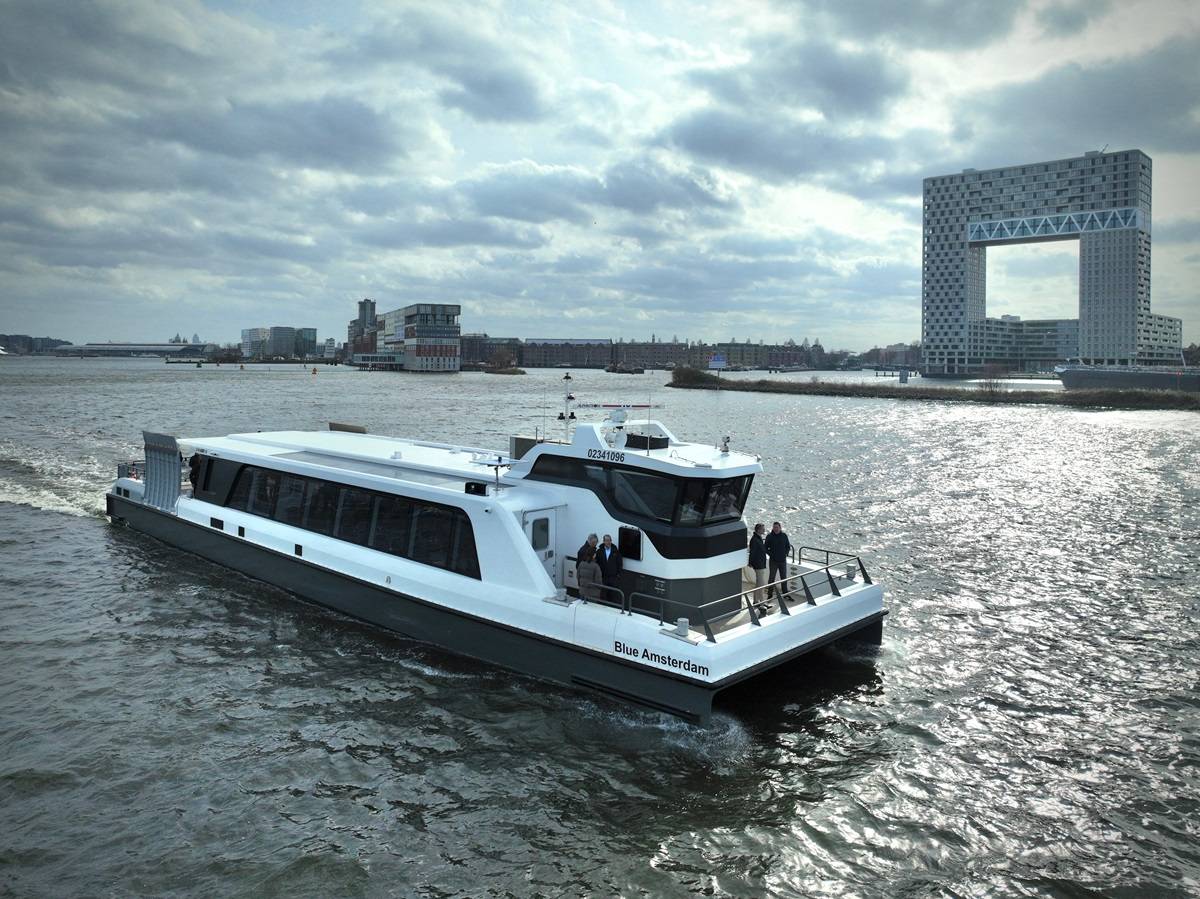
Damen Shipyards Group has completed construction of the first Waterbus 2907 Electric. The fully electric vessel is designed to provide sustainable public transport in urban areas, operating with extremely low levels of wash and zero emissions. The shipbuilder has introduced the vessel at a special event at Damen Shiprepair Amsterdam.
Damen is offering the vessel for immediate sale or lease as it aims to support wide access to sustainable solutions. For the development of the vessel, Damen has received a sustainable shipbuilding subsidy (Subsidie Duurzame Scheepsbouw (SDS)) from the Netherlands Enterprise Agency (Rijksdienst voor Ondernemend Nederland (RVO)). The subsidy aims to stimulate innovative, experimental technologies to promote sustainability in shipbuilding and conversion.
Damen initially built a series of hybrid Waterbuses 2907, prepared for conversion to full electric at a later date. This first fully electric version is an evolved design that draws on lessons learned in the construction of the first generation. This can be seen, for example, in the improved ergonomics in the vessel’s wheelhouse and 1000 VDC system architecture.
The Waterbus 2907 features an optimized hull that Damen developed together with MARIN (Maritime Research Institute Netherlands), and the vessel features slender hulls with a beam of just 1.1m.
Carbon fiber has been incorporated into the hull to reduce weight, compensating for the added weight of the batteries. The low weight of the hull ensures that the wake produced by the vessel is minimized.
The Waterbus 2907 Electric also features azimuth thrusters for enhance maneuverability. Damen, together with its co-makers, has developed a standard DC system and battery cabinets, a 1000-volt system designed for rapid recharging.
The vessel uses charging sockets proven in operation in the automotive sector. It is also prepared for the latest Megawatt Charging System (MCS), developed for the heavy-duty automotive sector. Damen has planned a full test later this year. With MCS, the Waterbus 2907 Electric will be able to charge even faster.