Maritime Power
Designing the Quiet Vessel
Designing the Quiet Vessel: Attention Noise and Vibration on Day One
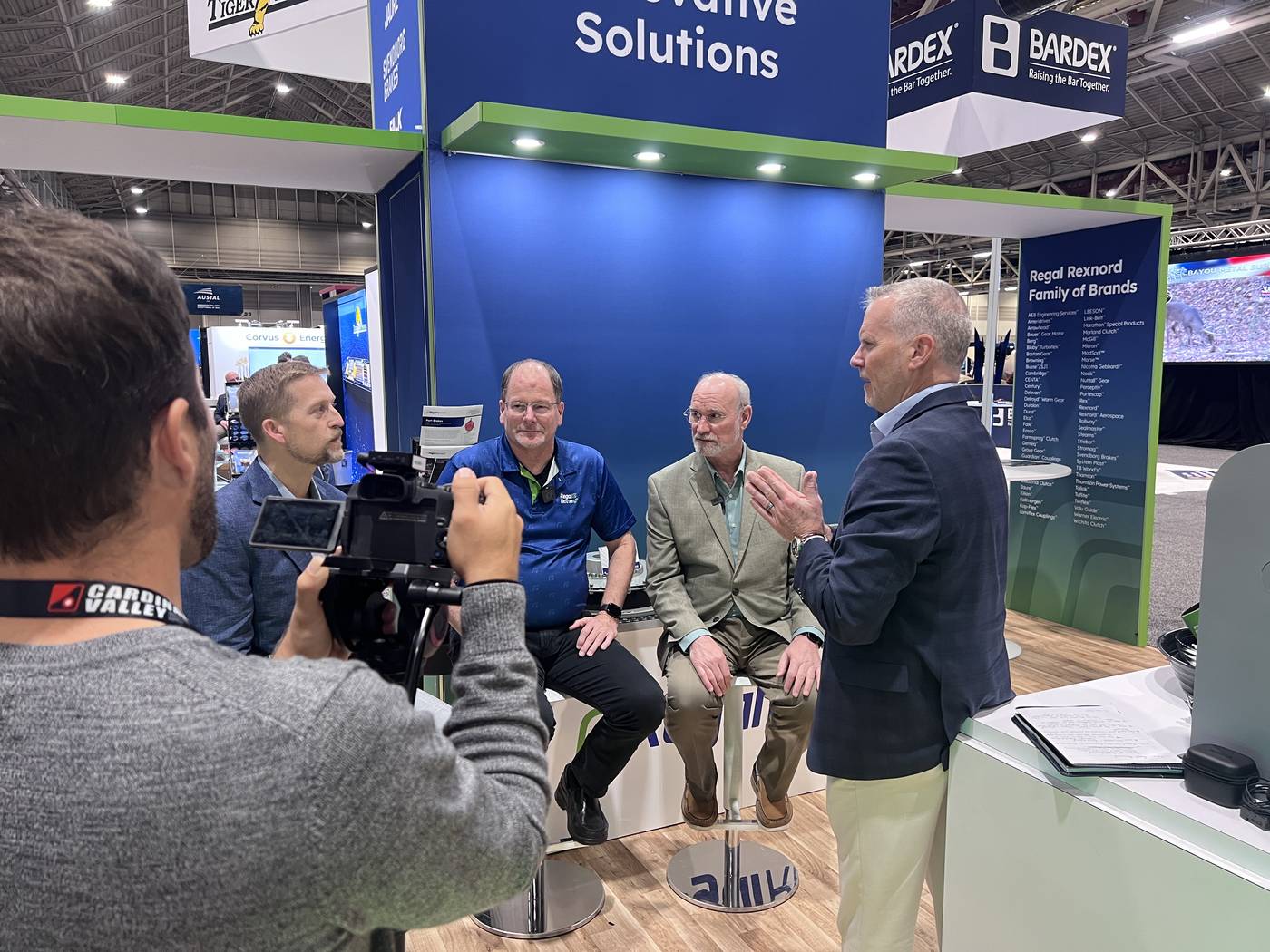
Owning and operating a quiet boat offers many benefits, from crew comfort and retention to efficient, safe operations. While the benefits are clear, it’s generally not the first line of design and concern for most vessel owners. Recently in New Orleans Maritime Reporter TV had the opportunity to tap the minds and experience of experts – Jesse Spence, President, Noise Control Engineering; Bob Lennon, Industry Manager and Expert, Regal Rexnord; and Matthew Coombs, VP, North American Operations, Christie & Grey Inc. – for their insights on the optimal time in the vessel design and build process to address noise control; and some of the best tools available to get the job done.
By Greg Trauthwein
Noise is a funny thing in the marine world: it’s invisible, it sneaks up on you, and it’s usually not the headline item on a newbuild spec sheet, until you’re standing in the pilothouse, trying to talk over the machinery, thinking, “oh my gosh, I can’t stand this thing.”
That’s the moment Jesse Spence, President, Noise Control Engineering, has been called in to fix the problem. Spence joined Bob Lennon, Industry Manager and Expert, Regal Rexnord and Matthew Coombs, VP, North American Operations, Christie & Grey Inc. for a wide-ranging conversation on what it really takes to deliver a commercial vessel that meets an owner’s noise and vibration expectations without turning the post-delivery period into a costly blame game.
The theme from all three was consistent: quiet isn’t a “finish detail.” Quiet is a design requirement that is best addressed from the very beginning. Like speed, bollard pull, cargo capacity, or endurance, you only get it if you spec it, model it, and build to it from the outset.
… Until it hurts
When asked how often noise and vibration are discussed early in the process, Spence didn’t hesitate: not enough. “Noise is one of those things that you don't really think about until you're there,” he said, “and you're like, ‘Oh my gosh, I can't stand this thing.’”
Owners tend to start with the big rocks — payload, speed, mission, compliance — and assume the shipyard will “take care of the noise.” In reality, you can force a vessel toward quieter performance late in the build, but the options narrow, the costs rise, and the results are harder to guarantee.
The why is obvious to anyone who’s spent time aboard: crew comfort, safety, fatigue, and more than ever, crew retention. Lennon put it in plain terms, drawing a line between the tug and workboat market and the realities of labor today: if the boat next door is quieter, that’s where people want to work. Hearing loss isn’t theoretical. It’s cumulative. And it’s part of an owner’s operational risk profile, whether it’s captured in a spreadsheet or not.
Combs added another angle: vibration isolation isn’t just about people. It protects machinery, reduces wear, and extends service life. That ties directly into cost per operating hour, reliability, and maintenance planning. “You build the boat and then, oh, we have a problem,” he said. “The cost of remediation is far and excessive if we had done it right in the first place.”
The First Step: Write it Down
In marine engineering, you get what you specify. That’s the starting point Spence kept coming back to.
“How do we make this happen?” he asked rhetorically. “You have to have a spec. You have to have a noise requirement in your vessel specification.”
That line deserves to be on a sticky note in every owner’s newbuild folder. Because without a stated requirement — cabins, pilothouse, machinery spaces, deck areas — there’s no target to design toward, no basis for trade studies, and no clear way for a shipyard to price the work.
Spence made a comparison that every owner will recognize: if you don’t tell the naval architect you need 20 knots, you won’t get 20 knots. Noise is no different. It needs thresholds, measurement methods, acceptance criteria, and clarity on what spaces matter most.
From there, the work becomes part of the “design spiral” — integrated with structure, arrangement, machinery selection, foundations, and outfitting. The goal is not to make the vessel silent; it’s to manage pathways: airborne noise, structure-borne vibration, and the points where energy transfers from machinery into the ship.
Make the shipyard’s job easier — and the bid cleaner
One of the most practical moments in our conversation came when Combs described the pain point shipyards face when noise requirements are vague. “I get requirements that it’s got to meet 65 dB,” he said. “Oh, okay. That means a lot to me. What are we putting in the boat, where, how? How do I bid that?”
That’s not a knock on shipyards, it’s reality. If the spec only provides a number without a defined design approach, yards are forced into guesswork: what level of isolation, what bulkhead treatments, what mount types, what foundations, what ducting arrangements, what exhaust details, what acceptance testing?
Spence’s answer is to translate the acoustic intent into a practical equipment and treatment list that can be priced. In other words: don’t just demand a quiet boat — define what it takes to build one. “These are the things that we know you’re going to need so you can bid to this,” he explained, “ultimately have a quieter vessel that is going to cost you less because you’re not guessing.”
It’s a subtle point, but a powerful one: better definition early can reduce cost because it reduces uncertainty. It also reduces the odds that the vessel is delivered “technically complete” but operationally disappointing.



The Component Decisions [That Quietly Make or Break You]
Noise and vibration mitigation isn’t only insulation and soft paneling. It’s also decisions in the drivetrain and mechanical train that owners may never see, but will feel every day.
Lennon, whose world is couplings and driveline components, framed it with a mechanical truth: vibration energy looks for the weakest link. “That reaction force is going to go into that mechanical equipment and find the weakest length,” he said. “It’s going to go after that first bearing in a gearbox or a clutch pack.”
That’s the crossover between comfort and reliability. Choices that reduce vibration transfer can also reduce misalignment loads and stress on equipment—meaning longer life and fewer failures.
On the coupling front, Lennon pointed to natural rubber as a proven “mousetrap” for damping and absorption — simple in concept, meaningful in execution. His point wasn’t that couplings solve everything, but that smart component selection is one of the easiest, lowest-cost levers to pull early — before equipment is purchased and installed.
The larger takeaway: noise and vibration isn’t a single-system problem. It’s a system-of-systems problem, and every interface matters — engine to foundation, foundation to structure, structure to accommodation.
Proof That it Can be Done
It’s easy to talk about “quiet vessels” in the abstract. Combs brought it down to a real-world example that anyone can ride: the M/V Island Home ferry serving Martha’s Vineyard.
“That boat is so quiet,” he said. “That’s truly what can be achieved.”
The most telling detail? “The loudest piece of equipment on that boat is a galley fan.”
That’s not luck. It’s the result of conscious decisions: effective isolation, attention to bulkhead pathways, and cutting off transmission routes. It’s also the result of an owner deciding upfront to invest in quiet—then carrying that intention through design and build.
Spence added a line that captured the experience: riders have joked they didn’t realize the vessel had even left the dock. That’s the standard many owners don’t realize is possible, until they experience it.
Cost: Single Digits Now, Double Digits Later
If you want a number, the panel was willing to give a directional one, with appropriate caveats.
Spence pegged upfront engineering and materials as “single digit” percentages of total vessel cost, “exceedingly low” in many cases. Lennon called the delta “minuscule” when viewed against major machinery costs. A better coupling choice or a quality set of mounts is a rounding error compared to a 3,000-hp engine, but the downstream effects can be enormous.
What everyone agreed on: remediation is “deadly.” Late-stage fixes push you into double-digit cost impacts quickly — especially if bulkheads need to be reworked, treatments added after outfitting, or equipment repositioned. And then there are the intangibles that aren’t truly intangible at all: fatigue, turnover, communication failures, and reduced operational performance.
Reduce Risk [& Finger Pointing]
When a boat is delivered that’s louder than expected, the finger pointing begins, and nobody wants to own the problem.
Spence’s answer was straightforward: integrate acoustic design from the earliest stages and keep it integrated through delivery. It doesn’t have to be exotic, but it does have to be continuous — requirements, modeling, component selection, construction details, and validation.
Lennon’s answer was similarly practical: make better component choices early, with a clear understanding of how drivetrain decisions influence noise transfer and misalignment loads.
Combs tied it together with a reminder that good acoustics are not achieved by addressing only the “big three” culprits—propulsion engines, generators, and exhaust. Those matter, but quiet boats are won in the secondary and tertiary details: bulkhead treatments, mass damping, isolation of smaller equipment, and eliminating transmission paths before the boat is fully built out.
“You can’t put acoustic mass stuff in after you’ve put everything in,” he said. “You’ve got to strip the boat out and do it.”
The Next Frontier: Underwater Radiated Noise
Underwater radiated noise (URN) is another aspect of vessel noise, albeit less understood with less direct impact on vessel operations and crews.. Spence, who has engaged directly at IMO forums on the topic, said momentum is growing internationally around reducing underwater noise, whether through incentives or future regulation.
For most commercial operators, it’s still a niche requirement, common for research vessels, NOAA-type missions, oceanographic survey, or specialized operations. But the pattern is familiar: few think about it until they have to. And the same rule applies: if you want URN performance, it must be decided early and written into the vessel specification so designers and suppliers can deliver it.
The Quiet-Vessel Checklist
If there’s a practical takeaway for owners, designers, builders, and suppliers, it’s this:
-
Owners: Put clear noise/vibration requirements in the spec — targets by space, measurement method, acceptance criteria. Decide early that it matters.
-
Designers/naval architects: Treat acoustics as part of the design spiral — run trade studies, manage pathways, and coordinate structure, arrangement, and machinery integration.
-
Shipyards/builders: Ask for defined equipment/treatment lists so you can bid cleanly. Build to a validated plan, not assumptions.
-
Equipment makers/suppliers: Offer options that reduce transmission and manage misalignment loads, and make the tradeoffs clear early — before procurement locks in.
Because once the vessel is outfitted, “quiet” becomes far more expensive — and far less predictable.
Or as the trio essentially summed up: you can pay a little now and get the vessel you want, or you can pay a lot later and hope you can retrofit your way into it. In a market where crew, uptime, and lifecycle cost determine competitiveness, the quiet ship isn’t a luxury. It’s good engineering.
Watch the full interview on “Keeping a Lid on Vessel Noise Levels” on Maritime Reporter TV: